
AI news ·
PolyU Advances Maritime Safety with AI-Driven Vessel Monitoring and Typhoon Response Tools
PolyU uses AI and big data to boost maritime safety in typhoon-prone Hong Kong, improving vessel monitoring and emergency response. Their tech predicts typhoon shelter demand with 98.6% accuracy.
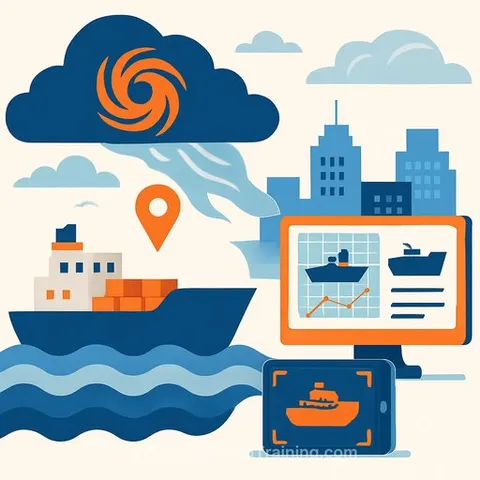
PolyU Applies AI and Big Data to Improve Maritime Safety and Management
The Hong Kong Polytechnic University (PolyU) is advancing maritime and shipping management through AI and big data. Its Maritime Data and Sustainable Development Centre (PMDC) has developed new tools to improve vessel monitoring and emergency response, especially critical for typhoon-prone Hong Kong.
Enhancing Typhoon Shelter Management
One key innovation is a system that estimates supply and demand for typhoon shelter berths. Led by Prof Yang Dong, the team collaborated with the Hong Kong Marine Department to create monitoring technology using unmanned aerial vehicles (UAVs) paired with deep learning algorithms. This system identifies and classifies local vessels with 98.6% accuracy, enabling better predictions of berth requirements through 2035.
This approach helps streamline government monitoring and emergency management while reducing operational costs. The Marine Department now uses these findings for planning local typhoon shelters, and the technology shows promise for applications such as port state control inspections and managing port congestion.
Future Developments and Broader Applications
Plans include expanding data collection techniques that leverage video and image processing, integrating deep learning further to improve vessel regulation. This blend of maritime expertise and advanced technology significantly boosts the speed, quality, and accuracy of data collection.
Improving Maritime Data and Analytics
Traditional maritime data collection can be inefficient and error-prone. To address this, the research team partnered with Tsinghua University to develop algorithms that process Automatic Identification System (AIS) data effectively. This collaboration produced a global shipping and trade network database alongside an online platform that delivers real-time indicators such as port congestion and connectivity indices.
These tools provide actionable insights for management decisions and operational planning within the maritime industry.
Addressing Fishing Vessel Management and Navigation Safety
- Fishing vessel behavior recognition: Using a semi-supervised machine learning framework, the team developed a model that detects abnormal fishing activities with 90% accuracy, enhancing regulation of fishing vessels in Hong Kong waters.
- Risk assessment for cruise ships: They integrated various maritime data sources to evaluate risks posed by large cruise ships moving through Hong Kong’s central channel.
- Vessel trajectory prediction: Recent work applies graph neural networks to predict vessel movements in busy waterways, contributing to safer navigation.
These developments contribute to safer and more efficient maritime operations, supporting both local authorities and the shipping industry.
For management professionals interested in AI applications that improve operational oversight and safety, exploring relevant AI courses can provide practical knowledge to implement similar technologies within your own sectors. Visit Complete AI Training's latest AI courses for options tailored to various skill levels and industries.