
AI news ·
POSTECH researchers develop wearable neck sensor that converts silent speech into a person's own voice
POSTECH researchers built a wearable neck sensor that reads silent muscle movements and converts them into the user's own voice using AI. The device works in noisy environments and targets people who lost speech due to surgery or vocal cord disease.
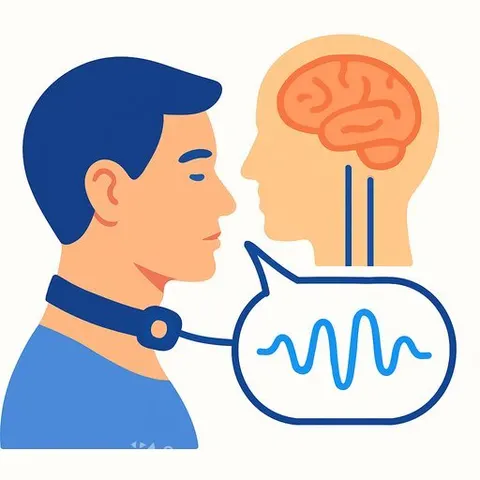
Researchers Develop Wearable Sensor to Restore Speech From Silent Neck Movements
A research team at POSTECH has developed technology that reconstructs spoken words from the subtle muscle movements in a person's neck-even when no sound is produced. The system combines a wearable optical sensor with AI to convert these silent movements into intelligible speech.
The sensor detects microscopic skin deformations that occur whenever someone speaks. These movements form what researchers call an "invisible movement map" that contains information about intended speech, independent of whether the vocal cords produce sound.
How the Technology Works
The team built a Multiaxial Strain Mapping Sensor consisting of a miniature camera paired with reference markers embedded in soft silicone. The device adheres to the neck and captures minute skin movements during speech.
An algorithm automatically corrects positioning errors when the device is reattached, allowing it to function reliably in everyday environments. The wearing position and tightness adjust to individual users.
AI analyzes the strain patterns to estimate what the user intends to say. Voice synthesis technology trained on the individual's vocal characteristics then converts these patterns into their actual voice.
Advantages Over Existing Methods
Previous voice restoration approaches relied on electromyography (EMG) or electroencephalography (EEG) signals. Both required complex equipment and proved uncomfortable for daily use.
The new sensor operates effectively in noisy environments-researchers confirmed high accuracy even in factory settings where background noise would typically interfere with voice capture.
Potential Applications
The technology targets several use cases:
- Restoring communication for patients who lost their voices due to vocal cord disease or laryngeal surgery
- Enabling communication in industrial settings where microphones or radios are impractical
- Supporting silent communication in libraries or conference rooms
Professor Sung-Min Park, who led the research, said the work "will accelerate the day when patients with speech disorders can reclaim their voices."
The findings appear in Cyborg and Bionic Systems, a Science Partner Journal focused on biomedical engineering. The work received support from South Korea's Ministry of Education and Ministry of Science and ICT.