
AI news ·
President Trump’s Executive Order Accelerates AI Education and Workforce Development Through Public-Private Partnerships
President Trump’s new executive order boosts AI education from K-12 to workforce training, fostering public-private partnerships to prepare America for AI-driven industries.
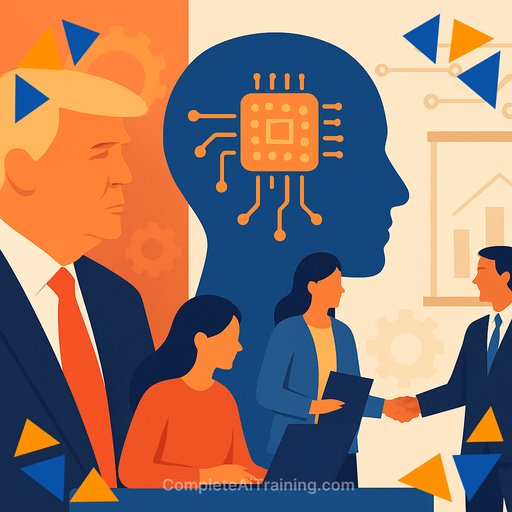
On April 23, 2025, President Donald Trump signed an executive order (EO) aimed at boosting artificial intelligence (AI) education and workforce development across the United States. This initiative targets K-12 schools, higher education, and workplace environments, leveraging public-private partnerships with industry leaders and academic institutions to expand AI learning and integration.
Key Highlights of the Executive Order
- The EO focuses on enhancing AI education and workforce skills nationwide.
- It establishes a cross-agency task force to oversee implementation and encourages partnerships between government, industry, and academia.
- The secretary of labor is tasked with promoting registered apprenticeships specifically for the AI sector.
Expanding AI Education in Schools
The order, titled “Advancing Artificial Intelligence Education For American Youth,” sets a clear strategy to introduce AI concepts early in education. The goal is to build a workforce that is prepared for AI-driven industries.
A major step is the creation of the Artificial Intelligence Education Task Force, including leaders from federal agencies such as the Departments of Labor and Education, along with advisors specializing in AI and crypto technologies. This task force will launch the Presidential Artificial Intelligence Challenge, a nationwide competition spanning multiple age groups to inspire and engage students.
Another priority is equipping teachers with the necessary resources and training to confidently teach AI literacy in K-12 classrooms. To support this, the EO calls for public-private partnerships with AI companies, academic institutions, and nonprofits. These collaborations will provide materials, funding, and expertise to strengthen AI learning programs.
Building the AI Workforce Through Registered Apprenticeships
The executive order directs the secretary of labor to increase participation in AI-related registered apprenticeships. This involves working with industry groups and employers to develop standardized apprenticeship programs recognized across the country.
States and federal grantees are encouraged to use Workforce Innovation and Opportunity Act (WIOA) funds to support AI skills training and work-based learning opportunities. The EO also calls for expanding AI coursework and certifications for high school students, with the Department of Education and National Science Foundation collaborating on these efforts.
Context and Implications
This EO extends President Trump’s earlier efforts to strengthen America’s position in AI technology, following a previous order aimed at removing barriers to AI leadership. While the Trump administration focuses on rapid AI adoption and workforce readiness, it contrasts with the Biden administration’s approach, which balanced AI development with caution around its risks.
During the Biden years, regulatory agencies issued guidance on AI risks and encouraged self-regulation within the private sector. The Biden administration also introduced the Blueprint for an AI Bill of Rights, providing recommendations to protect individual rights in AI applications.
Without a similar federal emphasis on AI safeguards in this new order, states are stepping in to fill the gap. Several states, including California, Colorado, Illinois, and New York City, have enacted or are considering laws regulating AI use in employment and other areas to prevent discrimination and ensure human oversight.
Opportunities for Educators
For educators, this executive order brings new opportunities to integrate AI into curricula and expand students’ access to AI learning tools. The emphasis on teacher training and public-private partnerships means schools may soon have greater access to AI resources and funding.
Educators interested in preparing students for the evolving job market can explore AI courses and certifications to complement these initiatives. Resources such as Complete AI Training’s latest AI courses offer practical programs aligned with industry needs.
By engaging with these developments, education professionals can help build an AI-ready workforce equipped with the skills demanded by modern employers.