
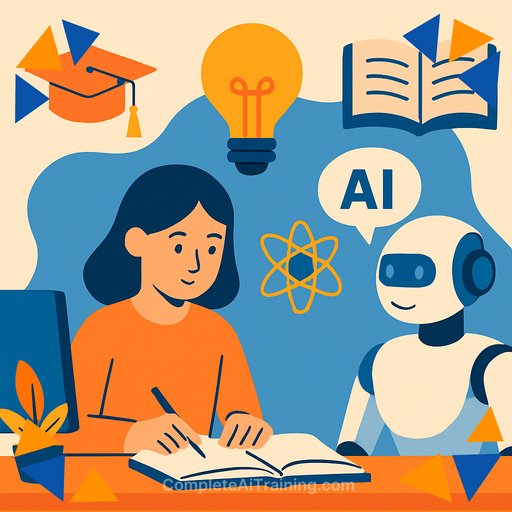
Conversations with AI: Education
The traditional classroom setup has remained largely unchanged for over a century: a teacher at the front, rows of students listening, and a curriculum focused more on what’s testable than what’s meaningful. But AI, one of the most powerful tools humanity has developed recently, is poised to disrupt this model. It’s not just about smarter software or faster grading. AI forces us to reconsider: What is the real purpose of education in a world where machines can teach?
Instead of speculating about distant futures or focusing on product launches, we started a direct conversation with an AI. We asked it to observe the classroom, the teacher, and the learner. What follows is a clear summary of that exchange, offered not as a technical report, but as a prompt for reflection.
The System Cracks
Education is under strain worldwide. Teachers are overwhelmed, students often disengaged, and curricula struggle to keep pace with a changing society. AI enters this scene not as a simple add-on but as a potential accelerator. We asked, “What roles might AI play in education?” The AI’s response covered a broad range:
- Personalised learning pathways
- Intelligent tutoring systems
- Administrative efficiency
- Language translation and accessibility tools
- Behavioural and emotional recognition
- Scalable, always-available content delivery
These are the core functions of an educational system. But what about deeper questions of meaning and ethics?
Flawed by Design?
Bias was a recurring concern. We asked the AI, “If you’re trained on internet data filled with human biases, won’t your outputs be flawed too?” The AI acknowledged this. Bias, inaccuracies, and blind spots get passed down from teacher to student—and AI learns from the same imperfect sources. It can replicate our worst habits at scale.
However, we didn’t want to excuse human educators either. So we asked, “Isn’t bias also a human problem?” The AI agreed: educators are shaped by their training, culture, and experiences, which come with limitations. Both AI and humans can reproduce bias, but only humans can reflect on and care about it. This led to a bigger question: if both systems are imperfect, why use AI at all?
Why Use AI in Education?
The AI highlighted its advantages as mostly systemic, not revolutionary. Personalised learning stood out. Software excels at speed and scale, after all. We asked, “How much data is needed to personalise learning effectively?” The AI said it varies, but to be effective at scale, it might require gigabytes or even terabytes of student data—tracking performance, preferences, feedback, and progress over years.
This raises a critical question about privacy: what are we trading in return for such precision?
A Personalised or Fragmented Future?
If every student gets a customised lesson plan, what happens to the shared experience of learning? Education has always been more than just information. It’s about dialogue, debate, empathy, and the clash of different perspectives—not just mirroring algorithms. AI can personalise content, but it can’t replicate the unpredictable magic of a classroom. We risk confusing customisation with connection.
“I use ChatGPT to provide more context […] to plan, structure and compose my essays.” – James, 17, Ottawa, Canada.
The Teacher Reimagined
What role remains for the teacher? According to the AI, teachers could be freed from repetitive tasks and administrative overload. This would allow them to focus more on guiding, mentoring, and fostering critical thinking. But this requires a mindset shift—from delivering knowledge to curating wisdom.
Teachers would move from part-time administrators and part-time educators to full-time collaborators in the classroom. AI won’t replace teachers but could highlight which teaching tasks truly matter.
“The main way I use ChatGPT is to either help with ideas for when I am planning an essay, or to reinforce understanding when revising.” – Emily, 16, Eastbourne College, UK.
What We Teach Next
So, what should students learn next? In a world with AI, critical thinking, ethical reasoning, and emotional intelligence become even more important. Ironically, as machines get smarter, we’ll need to focus more on what makes us human. The ultimate lesson might not be what AI can teach us, but what it can’t—or perhaps, shouldn’t try to.
Conclusion
The future of education won’t be shaped by AI alone. It’s an opportunity to modernise classrooms and rethink learning. Instead of fearing machines, we need to ask: “What does learning mean when all knowledge is accessible instantly?” The answer to that question should guide how we teach next.
For educators interested in practical AI applications in teaching, exploring AI courses for education professionals can offer valuable insights and skills.