
AI news ·
Researchers propose a collaborative research agenda to steer AI beyond automation
Stanford researchers argue the push to fully automate human labor with AI is misguided, and they outline a collaboration-first agenda instead. Their paper identifies four technical problems to solve-including white-box agents and low-latency interaction-to make human-AI teamwork practical.
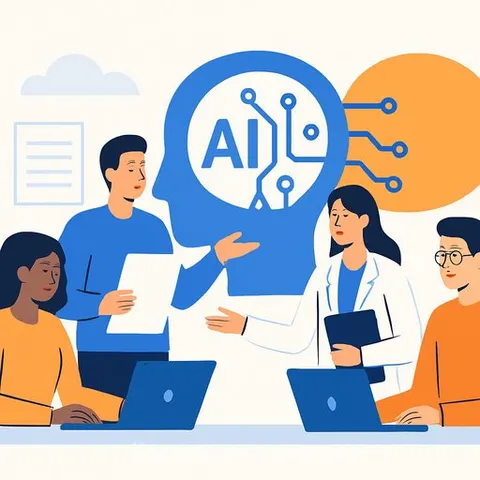
The dominant approach to building AI treats the technology almost entirely as a tool for automating human labor. Arvind Narayanan and Gabriel Unger, an economist at Stanford's Digital Economy Lab, argue this narrow focus is technically and economically misguided. In a new essay, they lay out a concrete research agenda for steering AI toward human collaboration instead of pure replacement.
"The bias toward the automation agenda is partly because of economic incentives, but partly because of some deeper intellectual and cultural aspects of computer science as a field," they write. The paper, published October 14, 2026, arrives as billions in capital expenditure chase unclear returns on fully autonomous agents.
A technical roadmap for collaborative AI
Narayanan and Unger identify four specific research problems that a collaboration-first AI program must solve. These challenges are largely ignored by labs focused on building agents that work independently.
First, they call for "white-box agents" that reveal their intermediate processes - sources, assumptions, methods, and uncertainties - rather than operating as black boxes. The authors note that software coding benefited enormously from publicly available code repositories that capture every step of development. Most other professions lack this infrastructure. "The shift we advocate is the equivalent of introducing code repositories and coding agents into this world - and doing so in every domain that currently lacks them."
Second, agents must achieve latency low enough for real-time interaction. Current tools force a tradeoff: fast but shallow chatbots, or thorough agents that break conversational flow. Low latency matters because it enables workers to stay in a state of flow. "Many programmers report that the shift from manual programming to supervising coding agents has resulted in a loss of flow, cognitive overload and burnout," the authors write. Redesigned agents could restore and even deepen flow states.
Third, human-AI interaction must move beyond turn-based delegation. True collaboration requires shared workspaces, simultaneous editing, interruption handling, and other patterns where the human actively steers the agent as it works. "Meeting this challenge would require designing architectures of interaction that allow continuous control without melting down under the interruption."
Fourth, the field needs new methods to evaluate and optimize for team performance, not solo task completion. Static benchmarks won't work when a human is part of the loop. Simulated users offer promise, but even small deviations between simulated and real behavior could reward the wrong things in training.
The economics and culture behind the automation bias
The preference for automation has obvious financial roots. Labor is the largest cost for most firms. Replacing workers shows up immediately on profit-and-loss statements, while augmentation investments pay off over years and are harder to estimate. Tax policy in the U.S. often favors capital over labor.
Less visible are the cultural forces inside computer science. Autonomous systems are presented to students as an aesthetic ideal. An end-to-end system is a triumph; requiring human supervision is treated as a defect. Peter Thiel called this "the ideology of computer science" in his book Zero to One: "Software engineers tend to work on projects that replace human efforts because that's what they're trained to do."
The "automate and compensate" bargain - mass unemployment softened by Universal Basic Income - also ignores political reality. Since the 1980s, income inequality has risen sharply without a corresponding expansion of welfare programs. "Most Americans want real lives with real work, not welfare checks," the authors note.
Market signals point toward change
A small but growing number of companies are betting on collaboration. Thinking Machines, the lab founded by OpenAI's former CTO Mira Murati, has published an architecture for agents that pair an ultra-low-latency user-facing model with a more capable background model. All three frontier labs - OpenAI, Anthropic, and Google - are pushing for lower latency. The authors predict a flywheel effect as more workers experience collaborative AI and demand more of it.
Domain-specific firms like Harvey AI in law or OpenEvidence in medicine may be best positioned to build true collaboration agents. These heavily regulated industries require human decision-makers at many points, making them natural targets for human-AI teams rather than full automation.
The paper also sketches alternative configurations beyond direct collaboration: collective intelligence tools that help teams coordinate, ambient agents that observe context and offer help without being explicitly invoked, and AI designed for upskilling workers over the long term. For executives building AI strategy, these frameworks offer a way to think beyond the binary of automate-or-ignore. Courses on AI Strategy for CEOs and AI for Managers Courses can help leaders evaluate which approach fits their organization.
Why this matters for executives and strategy leaders
The automation agenda is struggling on its own terms. The authors describe a trilemma: agents that are completely autonomous, reliable in high-stakes settings, and truly general-purpose cannot all be achieved at once. Relaxing the demand for full autonomy may open a more economically sustainable path - one that delivers ROI without requiring perfect reliability or massive task-specific configuration. For leaders evaluating AI investments, the collaboration framework offers a way to capture value from AI now while avoiding the trap of waiting for AGI that may never arrive on the timeline or budget promised.