
AI news ·
Researchers publish roadmap for applying flow matching to accelerate biomedical AI
University of Missouri researchers published a September 9 review in Nature Machine Intelligence mapping how flow matching-an AI method that models biological change over time-can be applied to drug discovery and precision medicine.
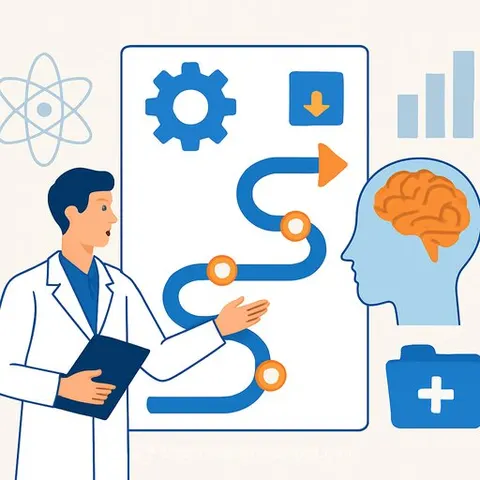
A University of Missouri research team has published one of the most detailed reviews to date on flow matching, an AI approach that models how biological systems change over time. The paper, published September 9 in Nature Machine Intelligence, offers researchers a practical roadmap for applying the technique to drug discovery, precision medicine, and other biomedical work.
Traditional computational tools often analyze biological data as isolated snapshots. Flow matching takes a different approach: it trains AI models to learn the trajectory from one biological state to another, whether that's a protein folding into shape or a cell responding to treatment.
Modeling change at multiple scales
"Flow matching helps computers learn how biology changes from one state to another," said Jianlin "Jack" Cheng, a Curators' Distinguished Professor and Paul K. and Diane Shumaker Professor in Bioinformatics. "This gives scientists a powerful new way to study everything from protein folding to cell development and cancer progression."
The method works across biological scales. At the molecular level, researchers can predict how proteins fold, a step that informs drug development. At the cellular level, flow matching can simulate how cells respond to different conditions. At larger scales, it connects activity inside individual cells to changes across whole tissues.
Cheng, who is also a NextGen Precision Health investigator, said the approach lets computers spot patterns that humans cannot. "Computers can see connections across enormous amounts of data that humans simply can't," he said. "That helps researchers move faster and ask better questions."
Toward a virtual cell
The review also outlines a longer-term goal: an AI-powered virtual cell, a digital model that would let scientists test hypotheses on a computer before running laboratory experiments. Cheng said this could reduce reliance on animal and human studies over time and speed progress toward personalized medicine.
For researchers applying these methods in their own work, the paper provides a structured overview of current techniques and applications. Those building skills in this area may find an AI Learning Path for Research Scientists useful for grounding flow matching within broader generative modeling practice.
Cheng framed flow matching as part of a larger shift in computational biology. "Flow matching is becoming a unifying framework for generative AI in biology," he said. "It has the potential to fundamentally change how we model, study and understand living systems."
Why this matters for science and research professionals
Flow matching addresses a core limitation in bioinformatics: static analysis of dynamic systems. Researchers working on protein structure prediction, single-cell analysis, or disease modeling can consult the review for guidance on where the method applies and where it doesn't. The full paper, "Flow matching for generative modelling in bioinformatics and computational biology," is available through Nature Machine Intelligence with DOI 10.1038/s42256-026-01220-0. Those tracking broader developments in this space can follow AI for Science & Research coverage.