
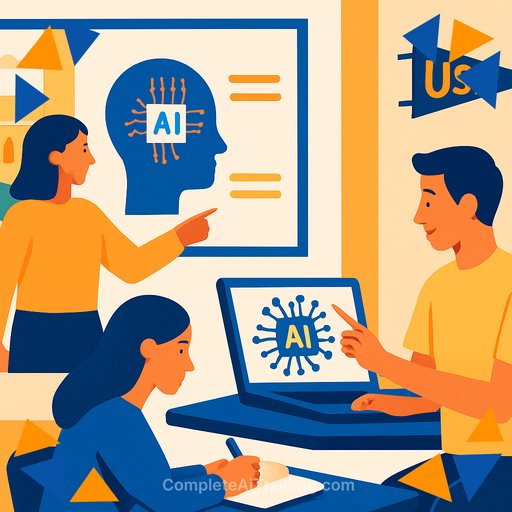
AI in Education: Enhancing Learning Experiences
Artificial Intelligence (AI) is changing how students learn by providing new ways to practice skills like negotiation. From business deals to diplomatic conversations, AI offers a safe space for students to build confidence and gain experience without fear of judgment.
At the University of South Florida (USF), educators are actively integrating AI into their teaching methods to boost hands-on learning. Throughout the 2024–2025 academic year, faculty, staff, and administrators have engaged in workshops and discussions aimed at finding practical ways to improve student engagement using AI tools.
Using AI as a Teaching Tool
AI is viewed as a tool that supports strong teaching practices rather than replacing them. Catherine Wilkins, associate dean of the Judy Genshaft Honors College, emphasizes that technology should enhance, not overshadow, good pedagogy. Faculty Learning Communities at USF explore challenges and solutions around AI in education by researching and sharing ideas.
One workshop featured philosopher Graham Clay from the University of North Carolina at Chapel Hill. He demonstrated how AI can create immersive learning experiences, such as simulating business negotiations or customer interactions, which help students practice real-world skills in a controlled environment.
- AI platforms like ChatGPT, Claude, or Gemini can simulate business scenarios for negotiation practice.
- Students can engage with AI anytime, reducing anxiety and encouraging participation.
- AI-driven simulations assist in building confidence and communication skills.
Balancing AI Use with Fundamental Learning
While AI can complete tasks and generate content, educators stress the importance of students learning the core concepts and gaining real experience. Clay warns against over-reliance on AI for quick answers, encouraging learners to develop judgment and wisdom alongside technology.
Caylen Holmes, an instructional designer at USF, highlights the focus on using AI safely and creatively to improve learning outcomes. This balanced approach ensures students benefit from AI without losing essential skills.
USF’s Commitment to AI in Education
USF’s establishment of the Bellini College of Artificial Intelligence, Cybersecurity, and Computing reflects a commitment to integrating AI responsibly in education. This new college combines AI, cybersecurity, and computing disciplines, preparing students and educators for a future where AI plays a central role.
Holmes notes, “AI isn’t going anywhere. We need to understand how to use it effectively in digital learning.” This mindset supports ongoing professional development for educators and the creation of AI-informed curricula.
For educators looking to expand their skills with AI tools, resources such as Complete AI Training offer courses on AI applications in education and beyond.