
AI news ·
Routine jobs in retail, healthcare and education face highest risk from generative AI, Goldman Sachs report finds
Goldman Sachs warns routine education tasks face high AI automation risk, affecting 6% of total employment. Complex teaching roles will use AI for support, not replacement.
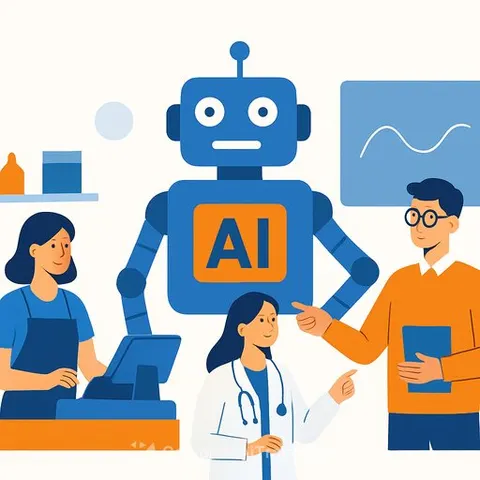
A new Goldman Sachs report finds that routine, repetitive tasks in education face a higher risk of automation from generative AI, while more complex instructional work will likely be supported rather than replaced. Education accounts for roughly 6% of total non-agricultural employment, placing thousands of grading, administrative, and assessment roles in the path of disruption.
The report categorises work by complexity level. Lower levels represent routine activities susceptible to automation, while higher levels involve sophisticated tasks where AI serves as a supporting tool. "Skilled-service sectors appear better placed for AI complementarity, while routine service sectors face higher substitution risk," the report said.
Where AI fits in the classroom
In education, generative AI is expected to enhance tutoring through personalised learning tools covering difficulty levels 3 and 4. These adaptive systems can adjust content to individual student needs without replacing the teacher. Conversely, repetitive tasks like grading standardised assessments or multiple-choice tests fall into level 1 and are more likely to be automated. Many of these grading functions already use basic automation, and gen-AI accelerates that trend.
Teachers and administrators can explore how AI handles these shifts through an AI Learning Path for Teachers, which covers practical applications for the classroom. The same technology that automates scoring can also free up time for lesson planning and one-on-one instruction. AI for Education resources show that the goal is not to remove educators but to offload repetitive work.
The broader employment picture
Education is not alone. The Goldman Sachs analysis shows that routine jobs in retail, healthcare, and financial services also face high substitution risk. In retail, cashier positions are already being replaced by self-checkout systems, while sales staff get AI help with inventory management. Healthcare sees administrative scheduling tasks (level 2) targeted for automation, while doctors get diagnostic support at level 6. Financial services analysts may lose basic modelling work to AI but keep higher-level decision roles.
Across all sectors, the report makes clear that the danger is concentrated on level 1 tasks. These are the same, repeatable actions that require minimal judgment. For education, that means grading answer sheets, recording attendance, and processing standard forms. The 6% employment share underscores how many people this could affect.
Why this matters for educators
Teachers and school staff should identify which parts of their daily work fall into the routine, automatable category and which require human judgment. The report suggests that AI will not replace instructors but will change what they do. Investing time now in learning to use AI grading tools and personalised learning platforms can shift a teacher's role toward higher-value activities-mentoring, curriculum design, and direct student interaction-that resist automation. The risk is not that AI will take over the classroom, but that professionals who ignore these tools may find their workload dominated by tasks that no longer need a human.