
AI news ·
Salesforce Agentforce delivers 72% self service deflection and measurable enterprise savings at Smarsh
Smarsh reported a 72% self-service deflection rate using Salesforce's Agentforce AI agents, while support staff saved 7.5 hours per complex case.
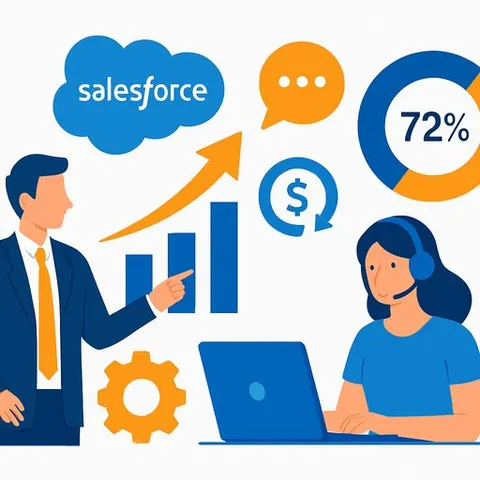
Salesforce's Agentforce AI platform is delivering measurable results in enterprise customer support, with compliance technology firm Smarsh reporting a 72% self-service deflection rate from its AI agents. The figures provide early evidence that agent-based automation can move beyond pilot programs into production workflows that reduce support volume and save staff time.
What Smarsh's deployment shows
Smarsh runs two Salesforce-powered AI agents - Archie and Emmy - across its support operations. Archie handles self-service requests, deflecting nearly three out of four inquiries without human intervention. Emmy assists with complex cases, saving support staff an average of 7.5 hours per case. User adoption sits at 65%, a figure that suggests the tools are embedded in daily work rather than sitting idle.
The company has filed for a US patent on its Archie AI agent. The move signals that enterprises building on Agentforce see enough proprietary value in their configurations to pursue intellectual property protection, a development worth watching as agentic AI deployments mature.
The ROI signal for AI monetisation
These metrics matter because they test a central question hanging over enterprise AI: whether the technology generates recurring value that justifies higher contract spend. The deflection rate, time savings, and adoption numbers from Smarsh tie directly to arguments that AI agents can raise switching costs and support margin growth - not just generate press coverage.
Salesforce has a market capitalisation of roughly US$212.4 billion. Its Agentforce platform sits inside the company's broader customer relationship management toolkit, which spans the United States, Europe, and Asia Pacific. For investors and industry observers, the signal to watch is whether the company reports growing AI-related annual recurring revenue as more customers expand from single-agent pilots to multi-agent deployments across external support and internal operations.
Why this matters for customer support teams
For support professionals, the Smarsh data offers a benchmark. A 72% deflection rate is not a vendor promise - it is a reported outcome from a live enterprise deployment. That number gives teams a concrete reference point when evaluating whether AI agents can handle enough volume to change staffing models, shift agents toward higher-complexity work, or reduce response times. The 65% adoption figure also reinforces a practical truth: even effective AI tools require deliberate change management to reach the people who will use them. For those looking to build skills in this area, the AI Learning Path for User Support Specialists covers the workflows and governance models that turn agent deployments into sustained operational gains.