
AI news ·
San Diego Researchers Launch AI Tutor Study to Boost Student Success in Higher Education
UC San Diego researchers received $1.5M to expand an AI tutor that integrates with course materials, supporting students without giving direct answers. The tool will be tested in eight courses starting fall 2025.
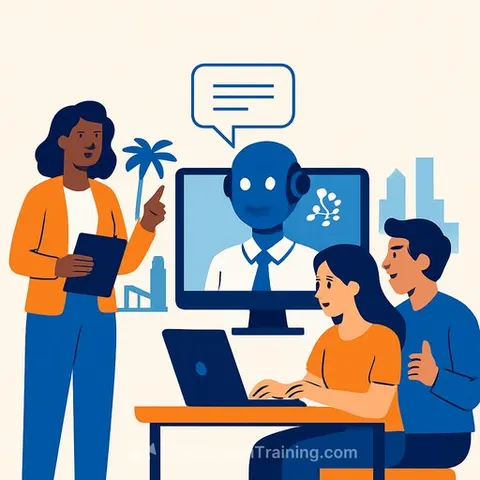
San Diego Researchers Advance Study of a New AI Tutor System
A team at UC San Diego has developed an AI tutor system currently in pilot testing. With a $1.5 million grant from the State of California, researchers will expand deployment and evaluation of this tool across universities and community colleges in San Diego County.
AI chatbots like ChatGPT have changed how students approach assignments and studying. However, these general-purpose tools lack access to specific course content and instructors’ educational goals. They often provide direct answers rather than guiding students through problem-solving.
This new AI tutor aims to address these shortcomings by integrating closely with course materials and teaching methods. The grant will support three main objectives:
- Deploying the AI tutor in eight foundational courses across higher education institutions in San Diego County.
- Assessing the tutor’s effectiveness in supporting student learning.
- Developing AI literacy courses and workshops for faculty members.
Thousands of students and dozens of faculty will gain access to the AI tutor alongside traditional help from teaching assistants and tutors. The research team comprises AI engineers, cognitive psychologists, biologists, and educators, collaborating across UC San Diego, San Diego State University, Palomar College, Cal State San Marcos, and San Diego City College.
Building on Instructor-Centered AI
The AI tutor is built on large language models from OpenAI and Anthropic. Unlike off-the-shelf AI tools, it incorporates safeguards to prevent simply doing students’ work. It aligns with each instructor’s teaching materials and philosophy, providing support without giving away answers.
The tutor understands the content covered in each session, has access to course videos and podcasts, and tracks assignment deadlines. This contextual awareness helps it guide students effectively.
“Our goal is to help students and provide a better educational experience,” said Mohan Paturi, the project’s lead principal investigator and professor at the UC San Diego Jacobs School of Engineering.
Evaluating AI Tutor Impact
Following a successful pilot in UC San Diego courses on nanoengineering and programming, the researchers will now assess the AI tutor’s impact on learning outcomes and student experiences.
Currently, there is limited high-quality data on whether generative AI tools improve student learning. Gena Sbeglia, a principal investigator from San Diego State University, is leading the evaluation efforts to identify the tutor’s effectiveness, target populations, and optimal conditions.
Researchers are collecting baseline data on student performance in the target courses ahead of the AI tutor’s wider rollout in fall 2025. This data will provide benchmarks for measuring improvements.
Supporting Students and Faculty
The AI tutor offers 24/7 support aligned with instructors’ teaching styles. However, researchers recognize it may not be suitable for every class. The goal is to complement, not replace, instructors and teaching assistants by enhancing the virtual learning environment outside of class hours.
The tutor can help identify students who need extra assistance, allowing faculty to focus their efforts where most needed. “I spend a lot of time with students in the bottom 15% of the class,” noted Sbeglia. The AI tutor aims to surface these students more efficiently.
Deployment and AI Literacy Initiatives
Next academic year, the AI tutor will be implemented in eight foundational courses across computer science and biology. Examples include a Python programming class at UC San Diego and an introductory biology course at San Diego State University.
In parallel, the team is developing AI literacy courses for both students and faculty. These courses will cover AI fundamentals and its role in education. A master template will be created for customization at each institution, with initial offerings planned for spring 2026.
At Palomar College, faculty will receive AI literacy training to better integrate AI tools into teaching. Luis Guerrero, a mathematics professor and professional development coordinator at Palomar, emphasizes the need to understand how to teach effectively with AI.
In addition to the state grant, UC San Diego’s Department of Computer Science and Engineering is contributing $500,000 to support the project.
Key Learning Objectives for the AI Tutor
- Enhance learning and retention for all students, including those with less prior knowledge.
- Boost student self-sufficiency and foster a sense of belonging within subject areas.
- Ensure intuitive and productive student interactions with the AI tutor.
- Maintain high levels of active engagement with course content.
- Detect and correct common misconceptions in student reasoning.
- Perform effectively across different course formats.
- Provide instructors with actionable assessments of student progress.
This project exemplifies practical, scalable AI applications in real educational settings. It reflects a growing emphasis on integrating AI thoughtfully to support both students and educators.