
AI news ·
Schools teach AI literacy by showing students chatbots' flaws
Charleston schools are training teachers and students in AI literacy after banning the tools proved futile, with a 50,000-student district building its own policy. Utah has trained over 7,000 teachers-nearly a third of its instructors-as 37 states publish official AI guidance.
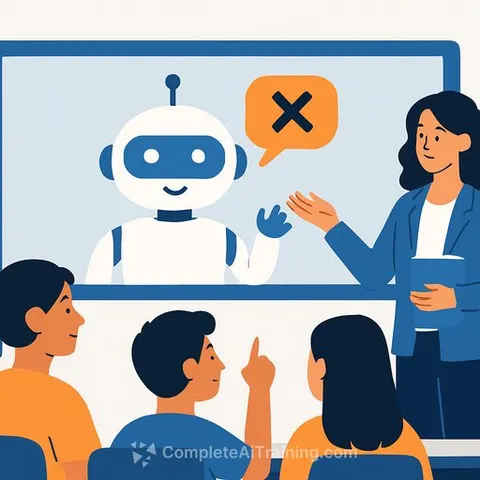
Artificial intelligence chatbots have become a recurring headache for teachers, but when educators in Charleston, South Carolina, gathered this summer to prepare for the new school year, they focused on bringing AI into the classroom rather than banning it. The district is part of a growing movement in U.S. public schools to teach AI literacy - helping students understand both the capabilities and the serious flaws of generative AI tools.
The shift comes after an initial wave of panic led many schools to block the technology outright. Now, districts are finding that students were using AI anyway, often without guidance. A demonstration at the Charleston training showed why blind trust in chatbots is risky: an instructor asked an AI tool to "create a map of the world," and the result was riddled with errors, misspelled country names, and gibberish labels. The room erupted in disbelief.
"If you ever want kids not to over trust these tools, try the map demo," said Amanda Bickerstaff, founder and CEO of AI For Education, an organization that helps schools draft AI policies and train teachers and students.
A new approach to an old problem
There is no single definition of AI literacy, and approaches vary widely across the country. Tech companies like OpenAI, Google, and Anthropic offer their own training sessions, but many educators say AI literacy must go beyond learning how to write good prompts.
"Good AI literacy includes knowing when not to use it," said Rebecca Winthrop, director of the Center for Universal Education at the Brookings Institution.
Thirty-seven states have published official AI guidance for schools. South Carolina has not, so the Charleston County School District built its own approach. The 50,000-student district worked with AI For Education to develop policy, gathering input from teachers, students, and parents. Student focus groups revealed that AI use was widespread but unguided - teenagers were teaching themselves how to use the tools and wanted clear rules.
That pattern mirrors national surveys showing most teenagers and teachers use AI for schoolwork but receive no formal training on how it works. Schools are determined to avoid the mistakes made with social media, where young users were left to navigate platforms without understanding addictive algorithms or the psychological downsides that followed.
The district's training program, now rolling out for teachers and middle and high school students, covers how AI tools work and how to use them effectively. The student course walks through familiar scenarios, such as asking a chatbot for help with a research paper, to show that generative AI can deliver fabricated studies with unshakable confidence. It advises students to verify any factual information they receive from AI, especially for classwork. A section on data privacy warns against sharing personal information, since conversations can be stored, used for training, and potentially leaked.
Ray Knauer, a high school teacher who attended the summer training, plans to use examples of AI bias and hallucinations in his AP Research class to spark discussion.
"We're all trying to figure this out right now: What's the right balance so we don't scare students away from AI but don't encourage them to run to it," Knauer said. "We have to teach students: You can't just get an answer and move on. You have to use analytical skills and dig deeper."
Statewide models take shape
Utah took an early lead with a top-down approach. In 2024, the state board of education named Matt Winters its AI education specialist, making Utah the first state with a full-time position overseeing AI in schools. Since then, Winters has led training for more than 7,000 teachers - nearly a third of Utah's public school instructors - and is helping districts shape policies they must have in place by July 2027.
"There is a clear method from the top in Utah," said Chris Agnew, director of the Generative AI for Education Hub at Stanford University. "When you're tackling big change, it's easier to have coherence if everyone is singing from the same hymn book."
Maine, West Virginia, and Georgia have since created similar positions. Other states are moving piecemeal, with each district charting its own course. That patchwork approach raises equity concerns: extensive AI literacy training requires significant investment, and under-resourced districts may struggle to keep pace.
Utah's training starts with the fundamentals - how AI works, what bias and hallucination mean, and why data privacy matters - before moving to specific tools. The Canyons School District, which oversees AI for its schools, took a mobile approach to reach educators across the state, delivering over 150 training sessions funded by a $500,000 grant from a local healthcare provider.
"We said, 'We will come to you.' Whether you are in a rural area or urban, it didn't matter," said Emma Moss, who leads AI efforts at Canyons.
Winters also negotiated data privacy agreements and discounted pricing for AI tools, giving rural and under-resourced districts access they otherwise wouldn't have. He cautioned against blanket bans, arguing that AI literacy is about preparing kids for the future, not shielding them from it.
"Everyone needs to understand what this technology is and how it works," Winters said. "AI literacy is much larger than saying: 'Don't use AI.' It's about how we can prepare kids for the future."
Changing adult mindsets is part of the work. Kristina Yamada, the Utah Board of Education's digital technology specialist, said teachers need to rethink their assumptions about cheating. Students have always found ways to cheat, she said; the job now is convincing them they can't rely on AI for every answer.
For younger children, Yamada suggests starting with simple conversations: "People can lie. A program can lie. A robot can lie." For older students, the message is more practical: "Sure, you can use ChatGPT to write computer code. But when the program stops working, you need to be able to fix it."
Why this matters for educators
For teachers and school administrators, the takeaway is that AI literacy is not a single lesson or a one-time workshop. It is an ongoing part of curriculum design, requiring districts to decide what students should know about how AI works, when it fails, and when it should not be used at all. Educators who want structured support can find training resources through organizations like AI for Education or explore dedicated programs such as AI for Teachers. The districts making the most progress are treating AI literacy as a core competency - not an add-on - and building it into teacher training, student coursework, and district policy alike.