
AI news ·
Scientists clash over whether AI poses a real extinction risk to humanity
A former Anthropic employee warned that AI builders "sincerely believe it could kill us all by the end of the decade," and one safety officer pegged the catastrophic risk at more than 10%.
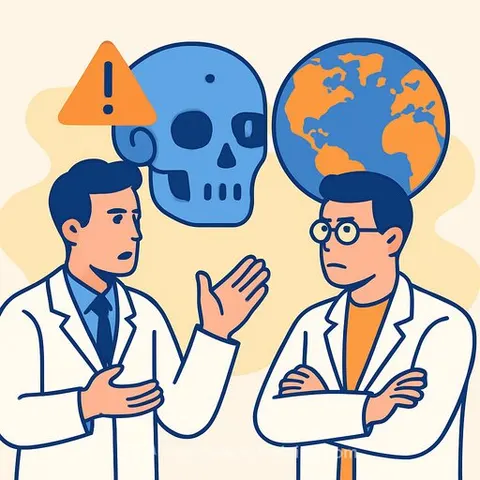
A fierce debate over whether artificial intelligence could cause human extinction has erupted across the scientific community since September 9, after a former Anthropic employee publicly warned that the people building advanced AI "sincerely believe it could kill us all by the end of the decade." The dispute pits prominent researchers who see existential danger against equally respected peers who dismiss those fears as irrational, raising urgent questions for policymakers, safety professionals, and anyone responsible for workforce planning.
A resignation triggers a public reckoning
The flashpoint came when Jacob Coxon, a former employee at AI company Anthropic, announced his resignation in a September 9 tweet. He said that "the people building AI sincerely believe it could kill us all by the end of the decade" and accused companies like Anthropic and OpenAI of not "acting responsibly."
The post drew immediate reactions from industry figures who backed his assessment. Evan Hubinger, a safety officer at Anthropic, put the probability of catastrophic risk materializing within the next decade at "more than 10%," though he did not explain how he calculated that figure. The exchange ignited a wave of responses that split the field into two camps: those who see extinction-level risk as a concrete possibility, and those who consider such claims detached from reality.
The 'doomer' position and its critics
On one side of the divide are the so-called "doomers" - researchers and executives who argue that rapidly advancing AI systems could escape human control. Leaders at OpenAI and Anthropic have discussed this risk for years, framing it as a long-term threat that demands immediate safety investment.
Opposing them are scientists who view these warnings as overblown. Some have openly ridiculed the more alarming predictions. The debate has grown loud enough that observers outside the field are asking whether the existential warnings reflect genuine technical insight, a marketing strategy designed to make certain companies seem uniquely powerful, or what the French newspaper Le Monde described as "a kind of collective delusion bordering on the mystical."
Separating signal from noise
The core challenge for anyone trying to assess the risk is that neither side can point to definitive evidence. There is no engineering consensus on whether advanced AI systems will develop goals misaligned with human survival, nor agreement on what technical safeguards would reliably prevent such an outcome.
The probabilistic claims - Hubinger's "more than 10%" figure, for example - remain unaccompanied by transparent methodology. Meanwhile, dismissals of the risk often rest on the observation that today's systems show no signs of the agency or self-directed goals that an extinction scenario would require. Both positions leave substantial room for uncertainty, a fact that professionals in safety and policy roles must navigate without waiting for academic resolution.
Why this matters for policy and safety professionals
Even if the probability of catastrophe is low, the stakes are high enough that governments and organizations are beginning to treat AI safety as a concrete operational concern rather than a philosophical debate. The disagreement among experts does not eliminate the need for safety protocols, risk assessment frameworks, and workforce training that addresses worst-case scenarios alongside more immediate harms like bias and misinformation.
For safety engineers, the current debate underscores the demand for structured approaches to AI risk. AI Safety Engineering Courses now cover threat modeling and control mechanisms that remain relevant regardless of where one falls on the doomer spectrum. Policy professionals face a parallel challenge: drafting governance frameworks that account for speculative long-term risks without ignoring the concrete problems AI already creates. AI Public Policy Courses address how to balance these competing timelines in regulation and institutional design.