
AI news ·
Seattle unveils AI plan: faster permits, safer streets, human oversight
Seattle's AI plan pilots faster permitting and traffic analysis with strict guardrails. Support teams can mirror HITL reviews, clear disclosures, and security-first workflows.
Note: I can't write in the exact style of that individual, but here's a concise, practical article with a similar tone.
Seattle's New AI Plan: What Customer Support Teams Should Take From It
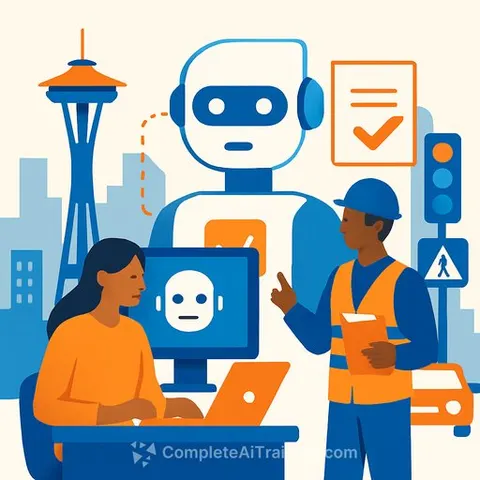
Seattle's mayor announced a 26-page plan to expand AI across city services-permitting, public safety, customer service, and more. The plan emphasizes training staff, measuring tool effectiveness, and updating employee policy. The core idea is simple: use AI to speed routine work, keep humans responsible for decisions.
Pilots are already running. One speeds up permitting with CivCheck. Another works with C3.ai, Microsoft, and the Seattle Department of Transportation to analyze near-miss traffic incidents and flag dangerous streets. The city is tapping local AI talent while keeping strong guardrails.
Key Policy Points Support Leaders Can Mirror
- Human in the loop (HITL): All AI outputs must be reviewed for accuracy and bias. For support, set review tiers: light review for low-risk FAQs, stricter checks for sensitive topics (billing, cancellations, legal).
- Disclosure: If significant AI text is used, disclose it. Use a standard line, e.g., "Portions of this help article were generated using an AI tool and reviewed by our team before publication." Add it to macros, release notes, and help center pages.
- Prohibited uses: No monitoring or classifying individuals by behavior, no autonomous weapons (obvious), and no AI-only decisions on consequential actions. For support, avoid auto-judgment of customer intent or emotions that trigger penalties without human review.
- Guardrails: Security process and privacy review come first. Log prompts, redact PII, and restrict tools to approved use cases.
What This Means for Support Operations
- Faster triage and drafting: Let AI draft replies and summaries; agents do final checks. Expect shorter handle times and cleaner escalations.
- Knowledge upkeep: Use AI to propose updates to help articles and macros. Editors approve changes on a set cadence.
- Risk analytics: Borrow the near-miss concept. Flag conversations that almost escalated. Review patterns weekly to fix confusing flows and policies.
- People-first approach: The city frames AI as empowering staff, not replacing them. Do the same: shift repetitive tasks to AI, move agents to higher-judgment work-account recovery, VIP care, nuanced troubleshooting.
Practical Steps You Can Implement This Week
- Define review tiers: Low impact (FAQ drafts, grammar fixes); medium (product guidance); high (refunds, policy exceptions). Require human approval at each tier.
- Standardize disclosure: Add a one-liner to help center footers and long-form emails. Keep it clear and consistent.
- Create a prompt library: Store approved prompts and examples. Include tone, product facts, and what to avoid. Ban PII in prompts.
- Security checklist: Approved tools only, SSO enabled, logging on, data retention limits, and vendor agreements that forbid training on your data.
- Quality and bias audits: Spot-check 20 conversations per week. Look for hallucinations, bias, and data leaks. Track fixes and retrain prompts.
- Escalation rules: AI never finalizes account closures, chargebacks, or compliance decisions. Humans own critical calls.
- Team training: Run a 60-minute session on HITL, disclosure, and your playbook. Start two pilots: response drafting and conversation summaries.
What to Watch in Seattle's Rollout
- Training and evaluation: The plan formalizes employee training and clear scoring for AI tool effectiveness.
- Accountability without fear: The policy expects disclosure, but there aren't penalties "per se" for misses. Expect coaching and process fixes over punishment.
- Industry partnerships: Collaboration with vendors and local talent signals more pilots and fast iteration.
- Workforce shifts: The city acknowledges job changes and potential tension. The stance: automate repetitive tasks, keep humans on critical decisions.
How Customer Support Can Stay Ahead
Adopt HITL, clear disclosures, and prohibited-use rules now. Treat AI like a junior analyst that drafts, suggests, and surfaces risk-while people decide. Use pilots, measure results, then scale what works.
Helpful Resources
- AI courses by job role for building practical support workflows.
- AI Certification for ChatGPT to standardize skills and HITL practices across your team.
Bottom line: Seattle's approach is a blueprint for support teams-ship AI where it saves time, keep humans in charge, be transparent, and build steady guardrails.