
AI news ·
Seventy years after Dartmouth, AI emerges as a partner in scientific discovery
Seventy years after AI launched as a discipline at Dartmouth, a new editorial argues its greatest potential is augmenting-not replacing-human scientific judgment.
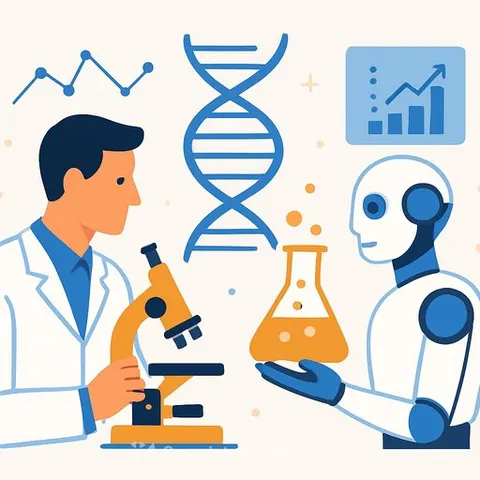
Seventy years after a small group of scientists gathered at Dartmouth College and launched artificial intelligence as an academic discipline, a new editorial maps the technology's evolution from ambitious concept to an active partner in scientific discovery. Published in Artificial Intelligence & Environment, the review argues that AI's greatest potential lies not in replacing human judgment, but in augmenting it.
"The challenge ahead is not to slow this progress, but to guide it wisely," the authors write, stressing that AI should serve the common good rather than displace human decision-making.
From symbolic reasoning to protein folding
The editorial traces AI's arc from early symbolic reasoning and IBM's Deep Blue chess victory through deep learning, large language models, and systems like AlphaFold. DeepMind's AlphaFold2 demonstrated a clear acceleration in structural biology, predicting protein structures that once demanded years of experimental work. That shift from tool to time-compressing research engine previewed what was coming next.
Emerging AI co-scientist systems now go further. These platforms generate hypotheses, evaluate ideas, propose experiments, analyze results, and refine research directions. The authors describe a near future where AI functions as a digital scientific collaborator, not simply a passive instrument. For researchers navigating this shift, structured guidance exists through resources like the AI Learning Path for Research Scientists, which maps the skills needed to work alongside these evolving systems.
Environmental monitoring gets faster
The review highlights the United Nations Environment Programme's Methane Alert and Response System as a working example of AI-assisted environmental protection. The system combines satellite observations with AI to detect methane emissions and trigger mitigation efforts. According to the editorial, AI-assisted workflows have substantially increased the volume of environmental data that experts can process, while helping translate those observations into concrete climate action.
Why this matters for science and research professionals
The editorial's central argument carries a practical edge for working researchers. AI systems are moving beyond automation into hypothesis generation and experimental design - tasks once considered exclusively human. The authors frame the next decade as a question of integration, not replacement. Staying current with AI for Science & Research means understanding where these co-scientist systems fit into existing workflows, and where human creativity and ethical judgment remain non-negotiable. The technology won't pause, and the researchers who learn to direct it will shape what comes next.