
AI news ·
Siemens and Salesforce connect Teamcenter and Agentforce to embed engineering data in sales and service workflows
Siemens and Salesforce connected Teamcenter to Agentforce, cutting engineering answers from days to seconds. The deal targets aftermarket revenue that grows six times faster than new equipment sales.
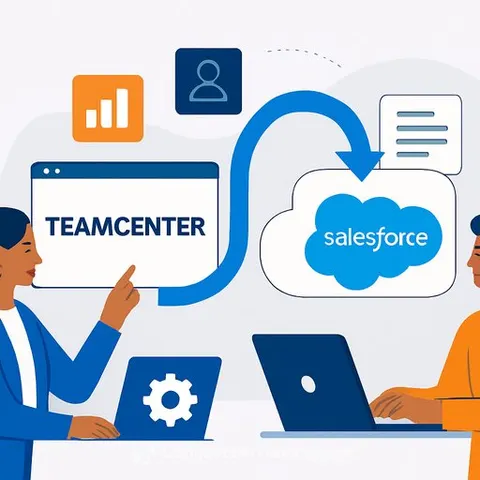
Siemens and Salesforce are weaving engineering data directly into sales and service workflows, a move designed to help manufacturers turn every customer interaction into a faster, more precise transaction. The companies announced the integration of Siemens' Teamcenter Service Lifecycle Management software with Salesforce's Agentforce platform at Dreamforce 2026, creating what they call an agentic enterprise at industrial scale. For sales teams, the partnership means no more waiting days for engineering to confirm whether a quoted upgrade is technically valid or manufacturable.
Closing the gap between the back office and the field
The core of the deal connects Siemens' digital twin technology - a virtual representation of a physical product - to Salesforce's CRM. When a service technician looks up a machine by serial number, the system can identify the correct spare parts before the first site visit. A sales representative can quote upgrades with certainty that the configuration will work. Customers can find and order parts without calling a hotline or waiting for an engineer. The integration turns questions that once took days into answers delivered in seconds.
"For decades, the expert knowledge of the engineer has been separate from the person servicing the machine in the field. We are closing an important gap," said Roland Busch, President and CEO of Siemens AG. "By embedding our digital twin into the commercial workflow, we are putting a virtual engineer in the hands of service technicians and salespersons."
The financial logic is straightforward. Aftermarket parts and service revenue grows roughly six times faster and carries about four times the margin of new equipment sales, according to industry analysis cited by the companies. Faster, more reliable quoting opens the door to deeper customer relationships and performance-based service contracts, moving manufacturers beyond one-time equipment transactions.
Turning thousands of cold leads into qualified pipeline
Siemens is also using Agentforce to solve a volume problem inside its own sales organization. The company received more than 2,500 unqualified inbound leads each month with no systematic way to separate the promising ones from the noise. Now, two AI agents work in sequence inside Sales Cloud. An engagement agent contacts every inbound lead with a personalized email. When a prospect clicks through, a qualification agent picks up the conversation, confirms or adds information, and captures details like budget and timeline. The strongest opportunities are handed off to the appropriate seller.
Siemens now engages 100% of inbound leads across 132 countries. Marc Benioff, Chair and CEO of Salesforce, described the broader ambition: "Siemens and Salesforce are showing what it means to become an agentic enterprise at industrial scale. We're bringing the best of our technology, expertise, and industry knowledge together to reinvent how work gets done and how customers are served."
Rethinking partner onboarding
The partnership also previews a streamlined path for new distributors. A prospective partner who fills out an intake form on Siemens' website will be met immediately by an AI SDR agent - named Piper - that builds a personalized pitch and books a meeting with a partner account manager. Once the partner signs, a Slackbot orchestrates certification, financial, and risk checks. Agentforce Operations, powered by Regrello, completes the final onboarding steps in SAP without manual data entry. Siemens expects the end-to-end process to compress from weeks to days.
For sales professionals navigating increasingly complex product lines, the ability to access engineering-grade answers inside the CRM reshapes the daily workflow. Instead of chasing internal experts for basic technical confirmation, reps can spend time on higher-value conversations. For those looking to build skills in this area, the AI Learning Path for Sales Representatives covers how agents and automation are changing qualification and pipeline management. Broader trends in the space are tracked under AI for Sales.
Why this matters for sales professionals
When engineering truth sits inside the CRM, the sales cycle shortens and the quote becomes a commitment the factory can actually honor. The Siemens-Salesforce integration removes a persistent friction point: the lag between a customer's question and a technically accurate answer. For individual reps, that translates to higher close rates on upgrades and service contracts. For sales leaders, it means a pipeline where every lead gets a response and only qualified opportunities reach the team. The technology does not replace the seller. It removes the busywork that keeps sellers from selling.