
AI news ·
Smart Vineyard Management Market to Hit $3.39B by 2030 on AI, IoT and Sustainable Wine Demand
Smart Vineyard Management market to $3.39B by 2030 from $1.82B in 2024. Precision ag, IoT, drones, and AI lift yields, cut waste; barriers include capex, connectivity, OPEX, skills.
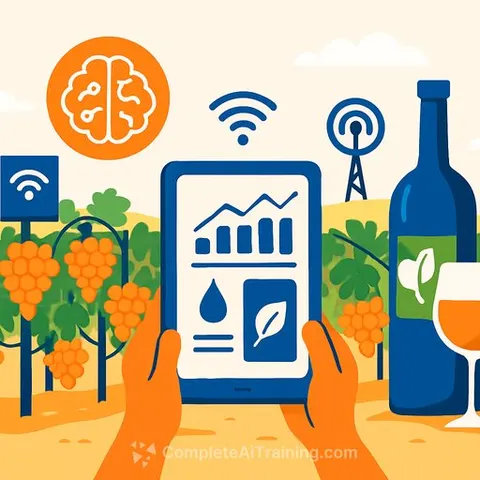
Smart Vineyard Management Market: A Manager's Brief for 2024-2030
The Smart Vineyard Management Market is valued at USD 1.82 billion in 2024 and is projected to reach USD 3.39 billion by 2030, at a CAGR of 10.86%. Growth is being driven by precision agriculture: IoT sensors, GPS-guided equipment, drones, and AI analytics that raise yield quality while cutting waste.
For management, the upside is clear-better forecasting, fewer inputs, tighter cost control, and credible sustainability proof points. The gap is execution: capital, infrastructure, and skills.
Why Demand Is Growing
- Premium and sustainable wine wins: 78% of global wine consumers say they would pay more for sustainably produced bottles.
- Values-led buying among younger segments: ~70% of Millennials and Gen Z report sustainability strongly influences purchases.
- Operational gains from precision ag: Real-time monitoring, early disease detection, optimized irrigation, and targeted inputs improve grape quality and margins.
- Better resource efficiency: Data-driven irrigation and nutrient plans cut water, fertilizer, and labor costs while improving predictability.
What's Holding Adoption Back
- High upfront costs: Sensors, drones, autonomous machinery, and precision irrigation require significant capital-especially tough for small and mid-sized growers.
- Infrastructure load: Connectivity, cloud storage, and power systems add to total cost and complexity.
- Ongoing OPEX: Maintenance, software updates, sensor calibration, and replacements continue after deployment.
- Skills and training: Teams need data literacy to interpret insights and adjust practices; hiring specialists increases cost.
- Financing gaps: Limited subsidies or affordable credit in several regions slows adoption or forces piecemeal rollouts.
How AI and ML Create Value in Vineyards
- Early issue detection: Computer vision spots leaf discoloration and pest pressure before they are obvious to the eye, reducing crop loss and chemical use.
- Prescriptive decision support: Recommendations for irrigation, nutrient timing, and harvest windows based on sensor, drone, weather, and satellite data.
- Yield and quality forecasting: Better planning for harvest labor, logistics, and winery operations.
- Resource optimization: Precise water and input application supports sustainability goals and certification requirements.
Manager's Playbook: From Pilot to Scale
- Define outcomes: Set targets by block-yield variance reduction, Brix consistency, water use per ton, input cost per hectare.
- Start with high-ROI use cases: Irrigation management and disease scouting deliver fast wins with clear metrics.
- Phase adoption: Pilot on representative blocks, validate savings and quality impact, then scale across similar terroirs.
- Budget for lifecycle cost: Include connectivity, cloud, maintenance, and training. Treat this as a multi-year program, not a one-time purchase.
- Address the skills gap: Upskill supervisors and vineyard techs to read dashboards and act on alerts; appoint a data lead.
- Explore financing: Look at leasing, vendor financing, and grants where available. Align repayment with seasonal cash flows.
- Standardize data: Consolidate telemetry into a single source of truth; set data governance for sensors, drones, and weather stations.
Market Segmentation
By Product
- Hardware: Robots & drones, sensors, others
- Software: On-cloud software, on-premises software
- Services: Professional, managed
By Technology
- Guidance
- Sensing
- Variable Rate Technology
- Others
By Application
- Yield monitoring
- Crop scouting
- Harvesting
- Irrigation management
- Others
Regional Outlook
- Europe: France, United Kingdom, Italy, Germany, Spain
- North America: United States, Canada, Mexico
- Asia-Pacific: China, India, Japan, South Korea, Australia
- South America: Brazil, Argentina, Colombia
- Middle East & Africa: South Africa, Saudi Arabia, UAE, Turkey, Egypt
Vendors to Watch
- PrecisionHawk, Inc.
- SureHarvest Services, LLC
- TracMap Limited
- YANMAR HOLDINGS CO., LTD.
- Trimble Inc.
- AGRIVI Ltd.
- AHA Viticulture
- VineView
- TeeJet Technologies
- Elmibit d.o.o.
Key Report Attributes
- No. of Pages: 188
- Forecast Period: 2024-2030
- Estimated Market Value in 2024: USD 1.82 Billion
- Forecasted Market Value by 2030: USD 3.39 Billion
- Compound Annual Growth Rate: 10.8%
- Regions Covered: Global
KPIs to Track
- Water use per hectare and per ton
- Input cost per hectare (fertilizer, crop protection)
- Yield variance by block
- Disease detection lead time vs. manual scouting
- Labor hours per hectare and per ton harvested
- Percentage of blocks with sensor coverage and closed-loop irrigation
Where to Learn More
See the full market details here: Smart Vineyard Management Market Report.
If you are building internal capability for AI-enabled operations, explore role-based upskilling: AI courses by job.