
AI news ·
SoftBank and Tohoku University partner to develop domestic disaster prevention AI platform
Tohoku University and SoftBank open a domestic disaster AI lab on August 1 to keep data local. The system uses digital twins, simulating a major quake in fiscal 2026.
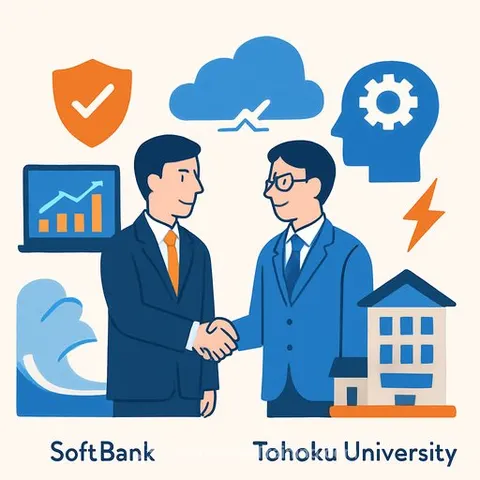
Tohoku University and SoftBank will open the "AI for Disaster Science Co-Creation Laboratory" on August 1, building a domestically developed disaster prevention platform that merges disaster-specialized AI with digital twin technology. The project's insistence on sovereign AI - keeping residents' location data and infrastructure vulnerabilities off overseas platforms - will directly shape how developers design and deploy critical AI systems in Japan.
The new lab sits within Tohoku University's International Research Institute of Disaster Science (IRIDeS). The two organizations are linking a large language model trained on records from the Great East Japan Earthquake and other past disasters with a disaster digital twin that recreates real-world conditions in virtual space. The combined AI for Disaster Science Platform will predict compound risks from earthquakes, tsunamis, floods, and volcanic activity.
What the platform will do beyond prediction
The system aims to go further by explaining vulnerabilities in social infrastructure and local communities in natural language. It will automatically generate hypotheses for countermeasures and adaptation strategies, then verify their effectiveness in simulations. The long-term vision is a single platform that issues consistent guidelines from the immediate aftermath of a disaster through long-term reconstruction.
SoftBank Managing Executive Officer Hirotora Tamba said, "Using AI, whose strength lies in learning, analyzing, and applying knowledge, we can provide consistent guidelines from disaster onset through to recovery." IRIDeS Director Shunichi Koshimura added that "Collaborating with SoftBank, which is at the forefront of sovereign AI development, is highly meaningful," pointing to the lab's industry-academic structure.
Sovereign AI and data-sensitive development
The platform handles extremely sensitive information, including emergency location data and infrastructure weak points. For that reason, the partners are building the entire system on domestic infrastructure, avoiding reliance on overseas platforms. Tamba, who also leads the domestic AI developer Noetra, is expected to guide the technical direction around sovereign AI, where data stays within national borders under local operational control.
That constraint matters for IT teams tasked with architecting disaster systems. The platform must operate even with restricted cloud access, enforce strict data residency, and still deliver real-time predictions. The lab's design emphasizes continuous learning: as more disaster data streams in, prediction accuracy and proposal quality are supposed to improve autonomously.
Proof of concept and expansion plans
A proof-of-concept experiment simulating a Nankai Trough earthquake will start in Hyuga City, Miyazaki Prefecture, during fiscal 2026. The lab plans to collaborate closely with local governments and administrative agencies during the drill. Over time, both partners intend to build an ecosystem that offers the platform to Japan's national government, research institutions, and private companies, evolving the lab into a nationwide joint research hub.
Why this matters for IT and development
For development leads and infrastructure architects, the project signals rising demand for AI systems that reconcile high-accuracy modeling with hard data-sovereignty requirements. The platform's use of digital twins and disaster-specialized LLMs aligns with growing government interest in secure, nationally controlled AI infrastructure, a trend that also underpins AI for Government initiatives. Meanwhile, the technical choices - on-premise training, data isolation, continuous model improvement - are directly applicable to AI for IT & Development roles charged with deploying critical AI in heavily regulated environments. The lab's approach offers a concrete reference for teams navigating similar sovereignty constraints in other sectors.