
AI news ·
Sound editor president urges legislation to deny copyright to AI prompt outputs
MPSE president David Barber is pushing federal legislation to block copyright for AI-generated outputs and require clear labels on all prompt-driven assets, warning they siphon revenue from artists. Tens of thousands of AI tracks hit Spotify daily, diverting payouts from human musicians.
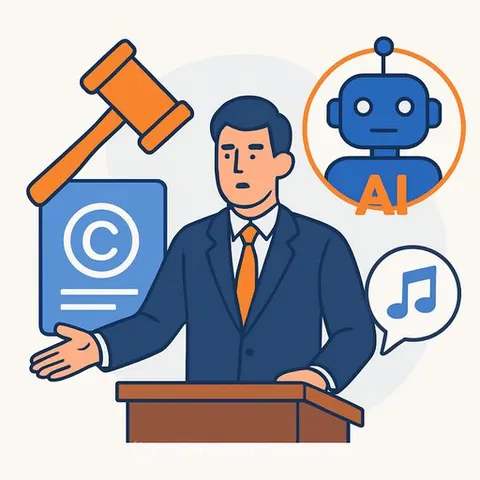
Generative AI tools can now produce songs, scripts, images, and film assets from a simple text prompt. The Motion Picture Sound Editors president argues that without federal legislation, these outputs will siphon revenue from working artists and dismantle the legal foundations of copyright.
The core problem, according to David Barber, CAS, MPSE, is that prompt-driven outputs are statistical calculations, not acts of authorship. "Having art reduced to a 'prompt' is an indignity to all creatives of the past, present, and future," Barber said.
Two legislative provisions
Barber proposes a framework built on two rules. First, legislation should prohibit prompt-driven outputs from being copyrighted, including whole works that contain such outputs as any component. Second, all prompt-driven outputs, assets, and derivatives must carry clear labels - visible for images and video, audible for music and sound design, and trackable in metadata.
These measures would prevent individuals or companies from prompting a song or film into existence and profiting from it. They would also block creative departments from being replaced by generated assets, and make deepfakes identifiable.
Under U.S. law, a copyrightable work requires "an original work of authorship" with a "spark" and "modicum" of creativity. Barber contends that generative AI models are inherently derivative, built on massive datasets that amalgamate existing works through algorithmic prediction. The output is math, not expression.
The copyright loophole problem
Current Copyright Office rules already state that generative AI outputs are not eligible for protection. But exceptions for "significant human editing" and "creative selection and arrangement" leave the door open. Barber describes this as a frayed thread that will be picked at until the hole becomes unmanageable.
One company has already tested the boundary. Invoke AI secured a copyright for "A Single Piece of American Cheese" by CEO Kent Keirsey, a work generated from a prompt and modified enough to satisfy the office's exception. The company's stated goal "wasn't to create a masterpiece," but to find the floor for copyright protection of AI-assisted work. They found it.
For creatives following developments in generative art, the ruling signals how quickly ambiguous language gets exploited. Legislation, Barber argues, is the only way to close these gaps.
Revenue displacement and training data
Tens of thousands of AI-generated tracks are uploaded to Spotify daily. Because artist payouts come from a shared pool of subscription and ad revenue, every streamed AI song diverts money from human musicians. Some of these tracks have charted.
The legal battles over training data add another layer. Companies fed whole books, films, songs, and artworks into their models without permission. Under the Fair Use Doctrine, the amount of a copyrighted work used is a key factor. Ingesting complete works severely weakens the fair use argument, Barber said, calling the outputs "fruit of the poisoned tree."
The theft extends beyond rights holders. Every song ingested into a model contains the uncredited work of producers, engineers, mixers, and musicians. Every film assimilated carries the artistry of cinematographers, editors, Foley artists, and costume designers. Decades-old work-for-hire contracts never anticipated that an artist's output would be used to train machines that replicate their skill.
For those working in AI for creatives, the stakes are direct: your past work may already be inside these models, and your future income may compete with their outputs.
Why this matters for creatives
If prompt-driven outputs remain uncopyrightable and unlabeled, anyone can generate a film score or background vocal and use it commercially without paying a musician. If the loopholes stay open, corporations can secure copyright on slightly edited AI assets and lock out human creators. The legislation Barber proposes would make generated content unprofitable to claim as original work, preserving the economic value of human authorship. Watch for whether any member of Congress takes up the proposal - and whether trade groups representing editors, mixers, and musicians throw their weight behind it.