
AI news ·
Stanford Health Care and UT Southwestern use ambient AI to improve OR operations
Two academic medical centers are using ambient AI to automate operating room documentation and provide real-time case visibility, according to a Sept. 29 session with leaders from Stanford Health Care and UT Southwestern.
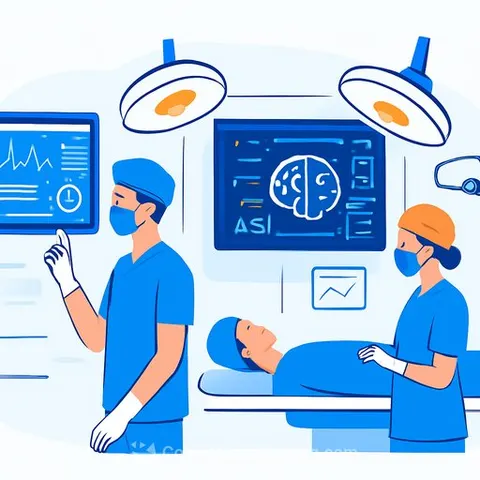
Two academic medical centers are using ambient AI to automate operating room documentation and give perioperative teams real-time visibility into case progress, addressing a persistent bottleneck in hospital operations. On Sept. 29 at 11:00 AM CDT, Jeffrey Cadeddu, MD, executive medical director for perioperative services at UT Southwestern Medical Center, and Sam Wald, MD, MBA, FASA, chief medical officer for perioperative and interventional care at Stanford Health Care, will discuss how their organizations are applying the technology.
Perioperative teams face pressure to improve throughput and reduce documentation burden while relying on fragmented information about what is happening across the OR. The session will cover how ambient AI and real-time procedural intelligence can automate documentation, improve coordination, and optimize schedules.
Automating intraoperative documentation
Ambient AI can capture procedural timestamps and write them directly into the EHR, reducing manual work for clinical teams. That removes a documentation layer that typically pulls clinicians away from patient care during surgery.
The approach extends beyond recording what happened. It gives perioperative teams a shared understanding of where each case stands at any moment, improving coordination across front desks, preoperative areas, operating rooms, and PACU.
Optimizing schedules with AI
AI-powered schedule optimization can prospectively recommend case sequencing and room assignments. The goal is to improve throughput and reduce idle time, overtime, and operational variation across the surgical day.
That marks a shift from using AI to analyze OR performance after the fact. The systems discussed in this session are designed to improve the workflows and decisions that shape operations in real time.
Both presenters run perioperative services at major academic medical centers. Wald oversees perioperative and interventional services, pharmaceutical services, laboratory services, and imaging services at Stanford Health Care. Cadeddu is a professor of urology and radiology at UT Southwestern in addition to his perioperative leadership role.
For professionals working in hospital operations, the session offers a concrete look at how two large health systems are deploying AI in the OR today. The practical applications - automated documentation, shared case visibility, and schedule optimization - map directly to the throughput and staffing pressures that perioperative leaders manage daily. Those interested in broader applications of AI in clinical settings can explore related AI for Healthcare training, and the operational efficiency focus connects to AI for Operations courses.
Why this matters for healthcare professionals
For perioperative leaders, the takeaway is that ambient AI has moved from pilot stage to production use at two of the country's most prominent academic medical centers. The documented benefits - reduced documentation burden, fewer manual handoffs, and data-driven case scheduling - address the operational pain points that directly affect OR utilization and staff workload. If these systems hold up at Stanford and UT Southwestern, they offer a template for other health systems facing the same pressures.