
AI news ·
Study finds AI layoffs backfire as productivity gains fail to materialize
Over 90% of executives say AI had no impact on employment or productivity in the past three years, per new NBER research. Yet firms keep cutting staff while investing in AI, a strategy that backfires as poor employee sentiment offsets any efficiency gains.
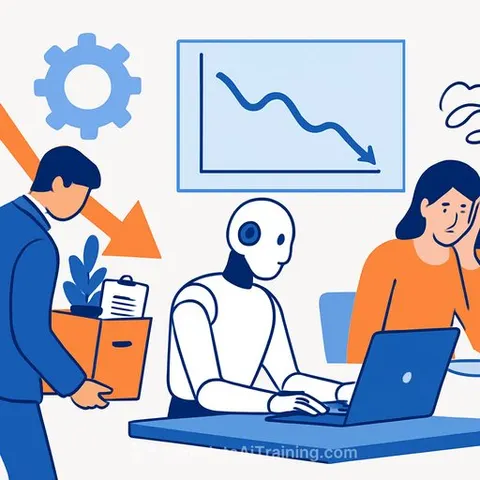
Nearly every executive knows AI has failed to deliver on its promises - and they admit it. New research from the National Bureau of Economic Research found that more than 90 percent of executives surveyed said AI had no impact on their firm's employment over the past three years, and 89 percent reported no impact on labor productivity at all.
That hasn't stopped companies from layoffs. University of Pittsburgh business professor Mark Ma, who was not involved in the research, wrote in The Conversation that executives continue to cut staff while doubling down on AI investments - a pattern that may be actively undermining the productivity gains they're chasing.
The self-defeating logic of AI layoffs
"AI-driven layoffs and the resulting job insecurity are actively destroying the very conditions needed for AI to make workers more efficient," Ma wrote. "In fact, these job cuts damage employee sentiment toward AI - which is one of the strongest predictors of firm productivity when AI is used."
The stock market isn't rewarding the strategy either. When Ma and his colleagues examined market reactions to layoff announcements tied to AI, "the average return was close to zero." Investors appear unmoved by the narrative that cutting workers while adopting AI will boost value.
Employee morale tells a similar story. At Meta, sweeping and poorly executed layoffs have made it harder for the company to keep workers enthusiastic. Ma's analysis of Glassdoor reviews found a "strong association between employee sentiment toward AI and firm productivity based on the employer's financial information," suggesting that "anti-AI sentiment among workers actually lowers productivity and offsets the potential efficiency gains caused by AI."
In short, managers who use AI to justify job cuts are making a "strategic miscalculation that cuts against the benefits of AI," Ma said. For executives navigating these decisions, the evidence points to a clear conclusion: workforce sentiment, not technology spending, determines whether AI investments pay off. That's a core lesson for anyone in an AI for Executives & Strategy role.
Even AI leaders admit the hype got ahead of reality
The industry is beginning to acknowledge the gap between promise and performance. OpenAI CEO Sam Altman said over the weekend that "we have not had the iPhone moment of like completely changing how someone interfaces with technology."
For executives, the practical takeaway is straightforward: stop treating AI as a substitute for human judgment and start treating it as a tool that works only when employees trust it. That means communicating clearly about how AI will change roles, investing in training, and resisting the urge to use automation as cover for cost-cutting. Executives who ignore employee sentiment while pushing AI adoption are likely to get the worst of both worlds - lower morale and no productivity gain.
Why this matters for executives and strategy
The research challenges a core assumption behind billions in corporate spending: that AI adoption plus workforce reduction equals higher profits. The data says otherwise. Productivity gains from AI depend on workers who are willing to use it, and layoffs destroy that willingness.
Leaders should treat AI adoption as a change-management problem, not a technology procurement decision. That means measuring employee sentiment alongside technical metrics, communicating honestly about job impacts, and building skills across the organization rather than replacing people. For executives looking to build that capability, structured training can help - an AI Learning Path for CEOs is one place to start. The companies that get this right will be the ones that treat AI as a complement to their workforce, not a replacement for it.