
AI news ·
Study projects US, Brazil and China to lead global food exports in 2035
A new study projects the U.S. will keep its top spot in global agri-food exports with 9.74% market share by 2035, while Brazil (5.34%) and China (4.59%) gain ground. Logistics infrastructure, not farmland, emerged as the strongest predictor of export dominance.
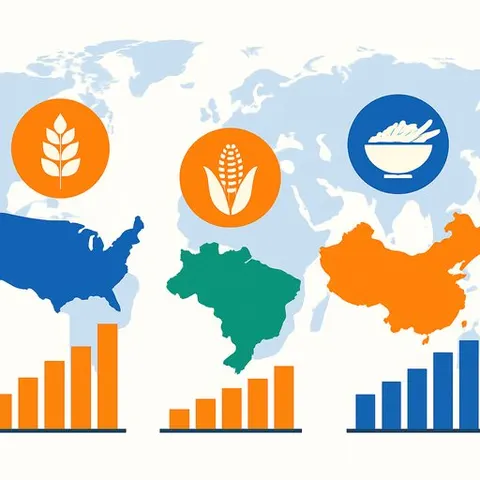
The United States will remain the world's largest agricultural exporter in 2035, but Brazil, China and Canada are projected to gain ground while some traditional European powers lose share, according to a new peer-reviewed study published in npj Science of Food.
Researchers led by Deniz Berfin Karakoc, an assistant professor of industrial engineering at Arizona State University's School of Computing and Augmented Intelligence, used machine learning to analyze roughly three decades of trade data from 25 countries that account for more than 75% of global agri-food exports. The analysis identified which economic, social and infrastructure factors most strongly predict export dominance, then projected how countries' market shares could shift by 2035 if current trends hold.
What the projections show
The U.S. is projected to hold 9.74% of the market in 2035, keeping its top position. Brazil's share is projected to reach 5.34%, China's 4.59% and Australia's 3%. Canada is projected to reach 4.03%, Poland 2.96% and India 2.41%.
Traditional European exporters are projected to command smaller shares than they have historically as competitors gain ground. The result is a food trade system whose leading exporters are more widely distributed around the globe.
These rankings matter beyond national pride. Millions of people rely on food produced outside their borders, making the global trade system a critical link between where food is grown and where it is needed. Knowing which countries are likely to gain or lose influence could help policymakers anticipate vulnerabilities, strengthen trade relationships and build more resilient supply chains.
Logistics beat farmland
The researchers used AI to sort through data spanning GDP, population, disasters, transportation investment and other factors to identify which characteristics most closely track export power. The strongest predictor was logistics - the ports, roads, customs operations and other infrastructure that moves food from producers to global markets. Population, government reliability and the value of agricultural production also ranked among the strongest factors.
"When we think about agricultural power, we tend to think first about how much food a country can produce," Karakoc said. "What we found is that production is only one part of the system. The ability to move those products efficiently, maintain reliable institutions and connect producers to global markets can be just as important."
Geopolitical risk and the number of days a country experienced disasters did little to explain which countries commanded the largest export shares. That doesn't mean wars or natural disasters don't disrupt food supplies - rather, the findings suggest a country's long-term position in global food trade is more closely tied to the systems that support production and move goods to market.
For professionals working in AI for Science & Research, the study demonstrates how machine learning can surface patterns across interconnected systems that single-country or single-commodity analyses miss. The same approach could apply to supply chain forecasting, climate risk assessment or other domains where many variables interact.
How the forecast was built
The team, including Amirhosein Ghozatfar of the University of Strathclyde and Tina Sardashti of Lancaster University, used historical patterns from 1988 to 2022 to train a machine-learning model that projects how factors associated with export power could change through 2035. A second model applied those projections to estimate countries' future market shares.
Karakoc cautions that the results are not a prediction of certain outcomes. The forecasts assume that relationships observed over the past three decades broadly continue - meaning an unexpected war, climate shock, policy change or transformation of the food system could alter the trajectory.
"We're not saying this is exactly what the world will look like in 2035," Karakoc said. "These projections show us where countries are headed if the patterns we've observed over the last three decades continue. That gives policymakers an opportunity to think about where vulnerabilities are developing and what they can do about them now."
The research also illustrates how AI can help people make sense of systems with many moving parts. "Food security is one of those challenges that touches nearly every part of society, including infrastructure, economics, technology and public policy," said Ross Maciejewski, director of the School of Computing and Augmented Intelligence. "AI gives us new ways to understand how all of those pieces interact."
Why this matters for science and research professionals
For researchers and analysts who work with large datasets, the study offers a practical template: use machine learning to identify which variables actually drive outcomes in a complex system, then build forecasts from those patterns. The finding that logistics infrastructure outweighs production capacity in determining export dominance is a reminder that domain expertise and data science must work together - the AI found the pattern, but interpreting what it means for policy required understanding how food systems operate. For those building similar models in their own fields, the study's transparency about its assumptions and limitations is a useful standard for presenting probabilistic forecasts to decision-makers.