
AI news ·
Synergy and Order in Human–AI Collaborative Classrooms: Insights from the Hybrid Intelligence Synergy Degree Model
Human–AI collaboration in classrooms blends teacher expertise with AI’s data insights to support learning. The Synergy Degree Model reveals moderate coordination, highlighting areas needing better balance.
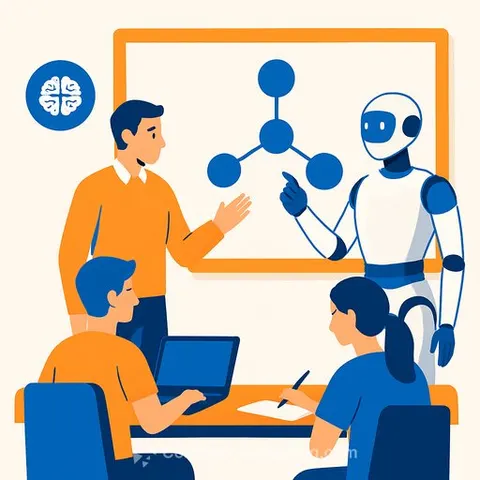
Examining Human–AI Collaboration in Hybrid Intelligence Learning Environments: Insights from the Synergy Degree Model
The integration of artificial intelligence (AI) into education is transforming traditional classrooms into hybrid intelligence learning environments. Here, human teachers and AI-powered educational robots collaborate to enhance student learning and outcomes. Understanding how these human–AI partnerships work and how to optimize their synergy is critical for effective classroom integration.
Understanding Human–AI Collaboration
AI in education is evolving from a simple assistant role to an active participant in classroom interactions. Unlike traditional models, which often struggle to meet personalized learning needs and optimize resources, human–AI collaborative teaching offers a way to address these challenges efficiently. This collaboration combines human judgment with AI’s data processing and real-time feedback capabilities, supporting personalized learning, cognitive engagement, and classroom management.
Examples include AI recommending tailored educational resources, assisting teachers with grading and attendance predictions, and even interacting directly with students through robots or chatbots. This collaboration reduces teacher workload while maintaining or improving instructional quality.
The Challenge: Measuring Collaboration Effectiveness
Despite advances in AI technology for education, much of the research focuses on technical capabilities rather than the quality of human–AI collaboration in classrooms. Effective collaboration requires more than technology; it demands alignment between teachers, AI systems, students, and the learning environment.
To address this, the Synergy Degree Model (SDM) was developed. It evaluates the order and synergy among three key subsystems in a human–AI classroom:
- Collaboration Subject Subsystem: The human and AI participants involved.
- Collaboration Process Subsystem: The interactions and activities that take place.
- Collaboration Environment Subsystem: The physical and digital classroom setting.
Research Questions Explored
- What is the level of order among the collaboration subject, process, and environment subsystems in hybrid intelligence learning environments?
- What is the overall synergy degree of human–AI collaboration in classroom teaching?
Case Study Overview
A case study was conducted in a junior high school English class in Beijing involving 40 students, one teacher, and an educational robot. The 40-minute lesson on "Will people have robots?" included 12 teaching activities designed collaboratively by the teacher and researchers.
The classroom operated as a hybrid intelligence learning environment, integrating AI through the educational robot in a structured six-stage teaching process. Researchers collected and coded data from classroom activities, scoring interactions on a scale from 0 to 3 to analyze collaboration quality.
Key Findings
The order degree scores for the three subsystems were:
- Collaboration Subject: 0.91
- Collaboration Process: 0.90
- Collaboration Environment: 0.73
These results indicate a generally moderate and orderly development with some imbalance, especially in the environment subsystem.
The overall synergy degree fluctuated between low and moderate levels, with a maximum value of 0.46. This suggests that while the human–AI collaboration is functioning reasonably well, there are moments when one subsystem may lag or behave inconsistently compared to the others.
What This Means for Educators and HR Professionals
Effective human–AI collaboration requires continuous monitoring and adjustment to maintain balance among participants, processes, and environments. This study shows that AI integration in classrooms is promising but still evolving, with room for improvement in aligning all elements harmoniously.
For education leaders and HR professionals, investing in training programs that build skills in managing human–AI interactions is essential. This includes understanding AI capabilities, designing collaborative teaching activities, and creating supportive learning environments.
To explore practical AI training programs tailored for educators and HR professionals, visit Complete AI Training’s courses by job.
Final Thoughts
Hybrid intelligence learning environments represent a new frontier in education. Balancing the contributions of human teachers, AI systems, and the learning environment determines the success of this collaboration. Using models like SDM can help institutions measure and improve the synergy between humans and AI, ultimately enhancing teaching effectiveness and student engagement.
As AI continues to enter classrooms, practical evaluation frameworks and structured collaboration methods will be key to making the most of these emerging partnerships.