
AI news ·
Teacher says assess thinking, not just final products, in AI era
Teachers should assume all students have used AI on assignments and shift assessments to evaluate thinking process over final product, says Geelong Grammar teacher Trudy Purcell.
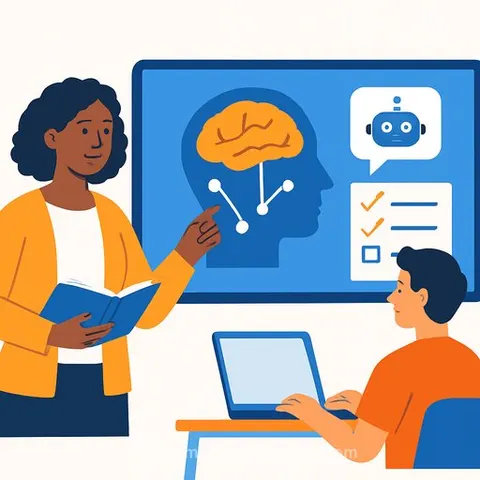
Teachers should assume students have used AI on their assignments and shift assessment toward evaluating the thinking process rather than just the final product, says Trudy Purcell, a secondary school teacher at Geelong Grammar School in Victoria.
Purcell will present those ideas this week at the Artificial Intelligence in Education Conference 2026 in Geelong. Her session, "Preparing Students for a World Where Knowledge Is No Longer Scarce," addresses how schools can update assessments when students can generate credible-looking work in seconds.
"We have to assume now that AI has been used," Purcell said. "It's our role to get in there and figure out to what extent AI informed the process."
She teaches commerce and economics and has experimented with AI chatbots in her classrooms for the past year, projecting them on screens and prompting students to debate the quality of AI-generated answers against their own prior knowledge.
The fluency illusion
Educational neuroscientists and researchers have warned that students who hand routine tasks to AI never build the foundational knowledge they need for harder work later. Purcell describes the result as a "fluency illusion": a student reads AI output, feels confident, and mistakes that feeling for real learning.
"If we go back to the science of learning, it's not the case," she said. Her response has been to change how she collects evidence in her own classroom.
In one Year 10 commerce class, students now submit the transcript of their AI conversations as part of their assessments. She talks with each student about the history of prompts and asks them to justify why they asked what they did and how the AI changed their thinking.
The goal is not to catch rulebreakers, she said. "It's not a punitive or a deficit-based approach. It's about embracing what we've got, moving forward, understanding that now is our time to switch assessment from purely output to process."
For educators looking for practical strategies on this approach, courses in AI for Teachers offer structured frameworks for integrating AI into assessments without losing sight of student development.
Role modeling in the classroom
Purcell creates custom chatbots for each subject, loaded with the syllabus and teaching materials. In her Unit 3-4 Accounting classes, she asks students to print what they already know about a topic before approaching AI for help, then refine that prompt together with the class.
"My gauge on it is that it's enhanced learning," she said. "Now I've got students who are having deeper conversations. Their questions are allowing them to critically evaluate their prior knowledge, as opposed to using AI to generate knowledge for the first time."
Students in her school work on laptops throughout the day, and Purcell believes a ban would backfire. "Unless there's a directive to say 'don't use AI,' which is not what we've received, I feel like a better way to approach the scenario is to guide them and role model it." The alternative, she said, is that students "go rogue, and then we have to wind it back."
The broader AI for Education community is watching how schools like Geelong Grammar handle this tension between overt and covert AI use.
Why this matters for teachers
Purcell argued that the teacher's job is shifting: less about checking whether an assignment is original and more about watching how students think. She wants teachers to treat AI-related assessment not as a compliance issue but as a design exercise.
"Every one of those educators will have an opportunity to influence the way in which their students engage with AI," she said. "If that way is deliberate and meaningful and substantiated, we're in a really good place ensuring our students have the skills to safeguard their critical thinking."