
AI news ·
Techman Robot launches Physical AI Development Package with NVIDIA and QCT
Techman Robot launched a Physical AI Development Package with NVIDIA and QCT to unify AI training and robot execution. It cuts deployment cycles and reuses vision models.
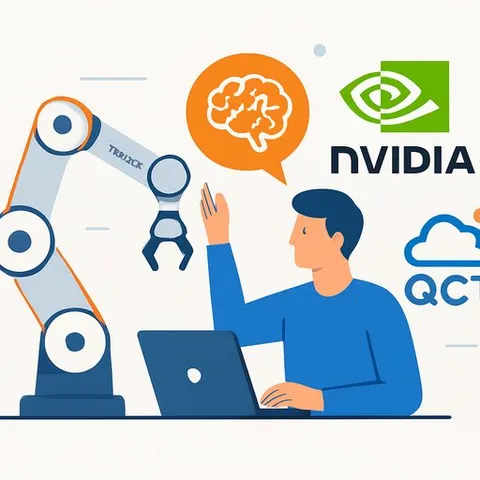
Techman Robot launched its Physical AI Development Package, an end-to-end workflow built with NVIDIA and QCT that connects AI model training to physical robotic platforms. The package aims to cut deployment cycles and customization costs for manufacturers by unifying data capture, computing infrastructure, and robot execution in a single framework. It serves as the intelligence backbone for both the company's TM Xplore I humanoid robot and its AI-enabled collaborative robots (cobots).
The announcement positions Techman Robot as an integration layer in Taiwan's AI hardware supply chain. The company frames the release as part of a Dual AI Engines strategy, where one shared AI architecture powers multiple robotic form factors. Instead of building separate intelligence stacks for each machine type, enterprises can reuse vision and VLA multimodal models across existing cobot lines and emerging humanoid applications, reducing duplicate R&D spend.
Stage 1: Demonstration and high-precision data capture
Human expertise is digitized through VR devices and the MOXI wearable motion capture suit, developed with j-mex. The system uses NVIDIA Isaac Teleop technology for high-fidelity teleoperation and real-time motion retargeting. By capturing detailed human movements in unstructured environments, engineers create training datasets far richer than traditional teaching pendants can produce.
Stage 2: AI infrastructure and multimodal skill learning
Training and simulation run on QCT's Dev. Kit for physical AI and QuantaGrid servers, equipped with NVIDIA's Isaac GR00T open platform and NVIDIA HGX H200 systems. The stack combines NVIDIA Cosmos 3 world models for synthetic data generation with the Isaac GR00T 1.7 reasoning VLA model. Robots learn to interpret natural language instructions, perceive unstructured environments, and make task-level decisions rather than follow fixed commands.
Stage 3: Deployment in high-value industrial scenarios
Trained models are validated inside NVIDIA Isaac Lab Arena before moving to hardware like the TM Xplore I. An integrated NVIDIA Isaac ROS layer connects sensors, actuation, and AI functions. Techman Robot showed a live server manufacturing process on a fully operational line, performing tasks in dynamic production environments typical of electronics assembly and smart logistics. The demonstration moves beyond simple material transport to highlight precision handling and real-time adaptation.
"Taiwan has one of the world's most complete AI hardware ecosystems. Techman Robot's mission is to turn that powerful digital computing capability into real productivity on the factory floor," said Scott Huang, chief operating officer of Techman Robot. "With the Physical AI Development Package, we are lowering the barrier for enterprises to adopt AI robotics while shortening the path from digital twin development to real-world production."
Why this matters for IT and Development professionals
The package illustrates a shift toward standardized AI workflows for robotics, which directly affects how IT teams evaluate AI Agents & Automation in manufacturing. The three-stage pipeline-teleoperated data capture, simulated model training, and direct deployment on NVIDIA-accelerated hardware-creates a template that narrows the gap between prototype and production. For development leads, the cross-platform model reuse reduces the risk of siloed integrations and lowers the total cost of ownership when scaling AI for IT & Development inside industrial facilities.