
AI news ·
Threading the Needle Between Trump's AI Executive Order and State Rules: What Employers Should Do Now
Trump's AI order sets up a federal challenge to state rules, with preemption and lawsuits looming. Employers should stick to strict state rules now and tighten AI governance.
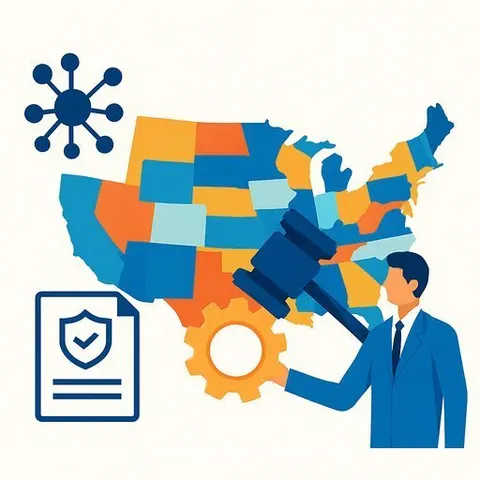
Preempting the Patchwork: Employer Playbook for Trump's AI Executive Order vs. State Laws
President Trump's December 11, 2025 Executive Order on AI adds a federal push onto an already messy map of state AI rules. If you advise employers, the signal is clear: expect federal preemption efforts, more litigation, and a moving target for compliance.
Below is a fast, practical breakdown of what the order drives, what it leaves alone, where the legal fights will land, and what in-house and outside counsel should do now.
What the Executive Order does
- State law evaluations: Commerce will review state AI laws and refer "onerous" or inconsistent ones to DOJ for action.
- DOJ AI Litigation Task Force: The attorney general must stand up a task force within 30 days to challenge state AI laws as unconstitutional, preempted, or otherwise unlawful.
- Funding conditions: Within 90 days, Commerce must issue a Policy Notice conditioning certain federal funds on adherence to the federal AI framework. The order flags the Broadband Equity, Access, and Deployment (BEAD) Program and directs agencies to assess other discretionary grants.
- Legislative push: The administration will send Congress a proposal for a federal AI framework that would preempt inconsistent state statutes, with carve-outs for areas like child safety, data center infrastructure, state government use of AI, and others to be named.
What it does not do
- Invalidate state AI laws today: Existing state AI laws stay in place unless and until courts or Congress say otherwise.
- Target employers directly: The order is aimed at state laws and the officials who enforce them, not individual companies.
- Shield employment-focused state AI rules: Workplace AI is likely to be a central battleground if preemption advances.
- Immunize employers: Federal duties under Title VII, the ADA, and the ADEA still apply. If a hiring model screens out people with disabilities or creates disparate impact by race, sex, or age, federal liability remains. See EEOC guidance on algorithmic bias in selection tools for context: EEOC AI guidance.
Expect legal pushback
States are poised to sue. Look for federalism and 10th Amendment arguments, claims that funding conditions are coercive under the Spending Clause, and challenges to agency authority to carry out the order. States with active AI regimes-Colorado, New York, California-are likely first movers.
Congress is another pressure point. Members in both parties have questioned using an executive order to set a national AI policy, especially after similar preemption ideas stalled in recent bills.
What employers should do now
- 1) Stay compliant with state law: Map AI-related obligations in every jurisdiction where you hire or monitor employees. If you operate across multiple states, consider a single policy aligned to the strictest rule. Keep HR, TA, and IT synced on disclosure, notice, bias audit, and recordkeeping requirements. For tracking activity, legislative resources like NCSL's overview can help: NCSL AI legislation tracker.
- 2) Update internal policies: Refresh policies for AI-driven hiring, promotion, and employee monitoring. Bake in flexibility so you can adjust fast if courts pause a state rule or a federal standard lands. Push updates into handbooks and agreements, and train teams on practical do's and don'ts and bias mitigation.
- 3) Tighten AI governance and documentation: For each system, document purpose, data sources, security controls, human-in-the-loop checkpoints, and fallback procedures. Test outcomes for fairness using real-world scenarios. Where appropriate, run evaluations with counsel to preserve privilege. Create a simple channel for users to report issues and keep a paper trail of fixes.
- 4) Rework vendor agreements: Require disclosures about model purpose, data lineage, and any bias audits (methods and results). Add clauses for quick configuration changes, audit rights, termination for legal noncompliance, and indemnity aligned to AI risks. Confirm the tool can be tuned to meet the strictest state rule you face.
- 5) Track federal milestones: Calendar the DOJ Task Force timeline (30 days) and the Commerce funding Policy Notice (90 days). Watch for agency guidance and grant conditions, particularly around broadband and infrastructure that support AI. For BEAD context, see NTIA's program page: BEAD Program.
- 6) Involve counsel early: Have employment and privacy counsel review policies, assessments, notices, and vendor terms before rollout. Set a quarterly review cadence so issues are caught before they escalate.
Key risks to watch
- Disparate impact in hiring or promotion tied to protected categories under Title VII, age screening under the ADEA, or exclusionary effects on candidates with disabilities under the ADA.
- Employee monitoring tools that trigger consent, notice, or retention obligations under state law.
- Data use conflicts with state privacy statutes that intersect with AI features (e.g., profiling, automated decision-making).
- Operational whiplash from injunctions or agency funding conditions-plan for fast policy toggles and version control.
Action now beats reaction later
The fight between federal and state AI rules will play out in courts and in Congress, but your obligations don't pause. Standardize to the strictest rules you face, keep your documentation tight, test models, and pressure-test vendor contracts. That puts you in a defensible position whether preemption advances or stalls.
If your HR, legal, and IT teams need structured upskilling on practical AI use in the workplace, explore targeted learning paths such as the AI Learning Path for Regulatory Affairs Specialists or the AI Learning Path for CIOs.