
AI news ·
TII releases Falcon-ASR Arabic speech model with 20.92% error rate but trails Qwen3-ASR
Falcon-ASR, a 1.6B-parameter speech model for Emirati Arabic, reports a 20.92% average word error rate but its weights, license, and API remain unpublished.
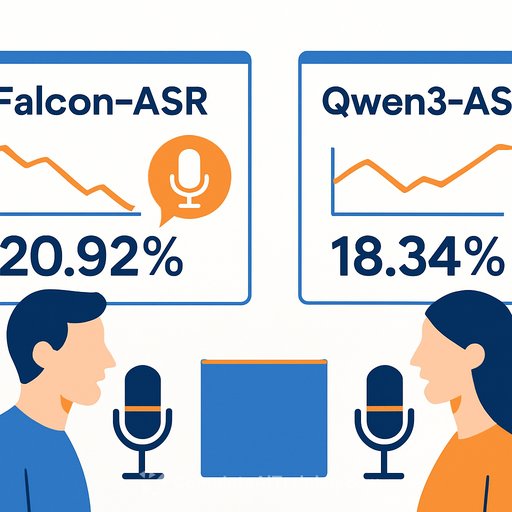
The Technology Innovation Institute in Abu Dhabi has released Falcon-ASR, a 1.6 billion parameter speech recognition model built primarily for Emirati Arabic. The model posts a 20.92% average word error rate across six Arabic test sets, but TII has not published weights, a license, or an API, leaving developers with only a limited Hugging Face demo that caps clips at 60 seconds and 20 megabytes.
What the benchmarks actually show
TII reports that Falcon-ASR beats the best entry on its leaderboard snapshot, Audar-ASR-V1-Turbo, by 2.25 points. The model handles Arabic, English, French, Spanish, and Portuguese through a single set of weights, with no language flag required. That sounds efficient until you check the same leaderboard and find Qwen3-ASR-1.7B sitting at 5.76% mean WER - less than a third of Falcon-ASR's error rate.
TII chose its comparison set carefully. For teams targeting Emirati Arabic specifically, a dialect-focused model beating generic entries by two points is a narrow but real win. The institute has stayed quiet on French, Spanish, and Portuguese scores, publishing numbers only where they look favorable.
Access gaps slow real-world testing
Every score in the comparison is self-reported, with no independent verification so far. The restricted access means developers outside Abu Dhabi cannot easily test Falcon-ASR against production traffic. A hosted demo exists, but the 60-second, 20-megabyte cap makes meaningful evaluation difficult. For professionals working with Arabic voice data, the gap between claimed performance and what is available to build on remains wide.
Teams evaluating Arabic speech tools should run Qwen3-ASR and Falcon-ASR side by side on their own dialect mix before trusting either leaderboard snapshot. The absence of quantized versions and licensing clarity further complicates integration into existing workflows.
Why this matters for creatives and researchers
For researchers and writers working with Arabic-language audio, Falcon-ASR represents a focused regional tool rather than a general-purpose leader. Its dialect specialization may serve transcription projects targeting Gulf Arabic speakers, but the lack of open weights means you cannot fine-tune it on your own data. Professionals in government, education, and healthcare who handle sensitive voice recordings should also note the absence of a self-hosted option - the Hugging Face demo routes audio through external servers.
If your work involves multilingual transcription across Arabic, French, Spanish, or Portuguese, the silence on non-Arabic performance is a red flag. Test against Qwen3-ASR first, and watch whether TII releases weights that would let you run evaluations locally. For those building speech-to-text skills, understanding how to benchmark ASR models on your own domain data matters more than any single leaderboard number. Speech to Text AI Courses can help teams develop that evaluation discipline.