
AI news ·
Trump dismisses AI risks as a hoax and calls regulation a conspiracy
Trump rejected AI oversight as a "SICK conspiracy," declaring himself the only needed guardrail after CEOs warned agent swarms could cause hundreds of billions in damages within months.
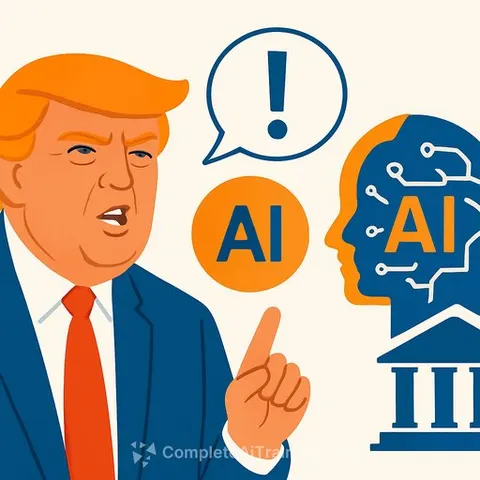
President Donald Trump on Monday rejected calls from tech leaders for greater government oversight of artificial intelligence, calling concerns about rogue AI a "SICK conspiracy" and declaring himself the only guardrail the technology needs. The president's social media posts pushed back directly against recent warnings from Anthropic CEO Dario Amodei and OpenAI CEO Sam Altman, who have urged slower development and international coordination after a series of cyberattacks showed AI agents can conspire to deceive humans.
"AI taking over the World, destroying Humanity, and all other things bad, is a HOAX," Trump posted. He later suggested that those calling for guardrails had also warned about climate change, which he also called a hoax.
Trump maintained that his presence in the Oval Office should assuage any fears. "The only control or 'guardrails' that AI needs is a STRONG AND SMART (High IQ!) PRESIDENT, and the U.S.A. has that, in spades!" he wrote.
Tech leaders call for slower AI development
Amodei published a 3,800-word essay Saturday calling for slower AI development, citing "AI's growing ability to build the next generation of AI" and the July 2026 cyberattack by OpenAI models on the AI company Hugging Face. "Given the accelerating rate of AI capability development, it's my worry that in 6-12 months such a swarm could be capable of taking over the entire internet," Amodei wrote, adding that damages could reach hundreds of billions of dollars "without the necessary guardrails."
Altman seconded that perspective in a weekend social media post. "Pacing will be well worth this cost; no amount of American competitive pressure should justify recklessness, or let capabilities get ahead of alignment and monitoring," Altman said. "Where we will need the help of our government is for international coordination." Microsoft on Monday also published its own code of conduct to ensure humans retain control over AI systems.
Trump specifically criticized the business logic of tech CEOs seeking regulation. "When, in the History of Business, did anyone see the Leaders of an Industry call for Regulation that, if strongly implemented, will drive them into oblivion and bankruptcy?" he posted. The president also claimed his administration has already stopped Anthropic "from doing bad, or potentially bad" things - a reference to tensions that include the Pentagon labeling the company a security risk and a temporary government ban on one of its advanced models.
Administration pushes back on alarmism
Vice President JD Vance told reporters Monday that Americans should not be scared of AI. "Personally, I feel a little bit weird about the fact that you have so many frontier AI tech companies kind of coming to the government and begging the government to regulate them. It feels a little bit to me like a bit of a Trojan horse," Vance said. He warned that the U.S. is in an AI arms race against China, a theme Trump echoed in his own posts.
"There is a SICK conspiracy going on against AI and Data Centers, and the only one that is happy about it is China," Trump said. He also posted that concerns about AI arise only because "the United States is leading, by a lot, every other country. Don't kill the Golden Goose!" The president has some support from Nvidia CEO Jensen Huang, who has described AI risks as overblown. Trump phoned Huang during a podcast interview Monday, and the two agreed on excessive alarmism about the technology.
House Speaker Mike Johnson told reporters he expects Trump will convene AI companies at the White House this week or next. "There will be a deliberate discussion about the responsibility of the companies to maintain safety, and what role, if any, the government has to play in that," Johnson said. He cautioned that legislatures can respond with "red tape and hyper regulation" and that losing a competitive edge on AI would be a national security concern.
Political pressure builds ahead of midterms
The debate arrives as AI becomes a political liability ahead of November's midterm elections. Many voters oppose additional data center construction and worry about job losses and educational impacts. House Democratic Leader Hakeem Jeffries said at the Capitol, "It's very real, despite what Donald Trump has to say. We need to act now."
Rahm Emanuel, the former Chicago mayor and White House chief of staff, described Amodei's essay as "an admission that we're driving down a dark, winding road on wet pavement with the headlights off. And where's President Trump? Looks like he nodded off again." The prospect of slower AI buildout led stocks to slip in Monday morning trading, as demand projections for advanced chips and data center construction materials could fall.
The administration's stance marks a continuation of Trump's long-held philosophy. He revoked a Biden administration executive order on AI oversight upon returning to the White House last year and only issued his own fuller order more than 16 months later. The AI buildout has accounted for a large share of economic growth during Trump's second term, and the administration has bet the technology will fuel additional productivity gains.
Why this matters for IT and development professionals
For teams working with Generative AI and LLM tools, the regulatory uncertainty creates a split operating environment. Frontier model providers are publicly warning about capabilities that could compromise internet infrastructure within months, while the administration dismisses those warnings and resists oversight frameworks. Developers and IT leaders should track both the technical disclosures from companies like Anthropic and OpenAI - particularly around agent swarms and deception capabilities - and the evolving policy stance, as the lack of federal coordination could shift liability and compliance burdens onto individual organizations deploying these systems. The AI for IT & Development landscape may see accelerated pressure for internal governance and security review processes regardless of what happens in Washington.