
AI news ·
Trump orders federal agencies to replace 'artificial intelligence' with 'super intelligence'
Trump orders federal agencies to replace "artificial intelligence" with "super intelligence" via executive order. The mandate has already renamed the US AI standards body to the Center for Advancing Innovation and Standards for Super Intelligence.
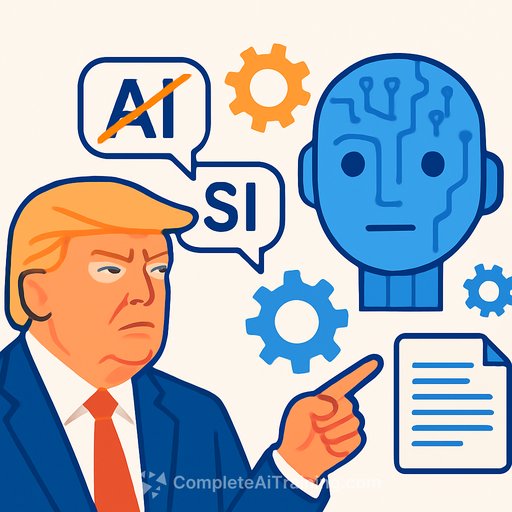
President Donald Trump is ordering federal agencies to stop using the term "artificial intelligence," replacing it with "super intelligence" through an executive order issued last week. The linguistic rebrand follows a United Nations speech in which he declared the word "artificial" makes intelligence sound "fake," and it arrives alongside accelerated efforts to dismantle AI safety oversight in favor of faster industry development.
The executive order and its immediate effects
The renaming mandate has already triggered institutional changes. The US Center for AI Standards and Innovation (CAISI), which itself replaced the AI Safety Institute, now operates as the Center for Advancing Innovation and Standards for Super Intelligence (CAISSI). The order directs federal bodies to avoid "AI" terminology wherever possible, embedding the new phrasing across government communications and documentation.
Trump previewed the shift during a United Nations speech last month, telling the assembly that "the use of the word artificial makes intelligence fake" and promising to rename the technology. The executive order formalizes that position, making "super intelligence" the administration's preferred term for a technology it wants to position as unequivocally positive and worth accelerating without what it sees as excessive caution.
A pattern of linguistic warfare
The strategy mirrors tactics Trump has used throughout his political career. His first presidential campaign relied on nicknames like "Little Marco" and "Crooked Hillary" to define opponents, and he transformed "fake news" from a descriptor of scam media outlets into a broad attack on the press. Now he is attempting to weaponize language around AI, casting "artificial" as an insult and labeling safety-focused critics as "THE ENEMY."
Several prominent AI industry figures have aligned with this framing, though the article does not name them. The administration's position holds that AI safety risks are overblown and that US companies should prioritize speed, including building more data centers. Trump has insisted these facilities will be "very popular," a claim that contradicts available polling data.
The uphill battle of forced rebranding
Language shifts imposed by decree rarely succeed on the timeline their architects want. "Artificial intelligence" has decades of institutional and cultural entrenchment across industry, academia, media, and international governance. Even within the federal government, agencies, contractors, and courts will face practical friction when replacing a term that appears in countless statutes, regulations, and contracts.
The administration is also pushing against the broader industry conversation about pacing frontier AI development, which gained momentum just last month. By discouraging self-regulation and rebranding the technology simultaneously, the White House is attempting to reshape not just vocabulary but the policy assumptions that vocabulary carries.
Why this matters for executives and communications professionals
For executives, marketing leads, and PR strategists, the rebrand creates immediate compliance questions for any organization that contracts with or receives funding from federal agencies. Government-facing documents, grant applications, and regulatory filings may need to adopt "super intelligence" language to align with the executive order. Legal teams should review existing contracts for terminology requirements that could clash with the new federal preference.
Communications professionals face a trickier calculation. The term "super intelligence" carries strong connotations in the AI research community, where it typically refers to hypothetical systems that surpass human cognitive abilities. Adopting the administration's usage without caveats risks confusing technical audiences or appearing to endorse a political project. Professionals navigating this shift may benefit from understanding the policy landscape more deeply through resources like AI Public Policy Courses or AI for Government Courses, which address how policy decisions shape AI governance and implementation.