
AI news ·
Trust and relationships remain core to London market despite AI advances, Liiba study finds
AI will radically reshape digital trading in the London insurance market, but human judgment and relationships built over 340 years will remain its core pillars.
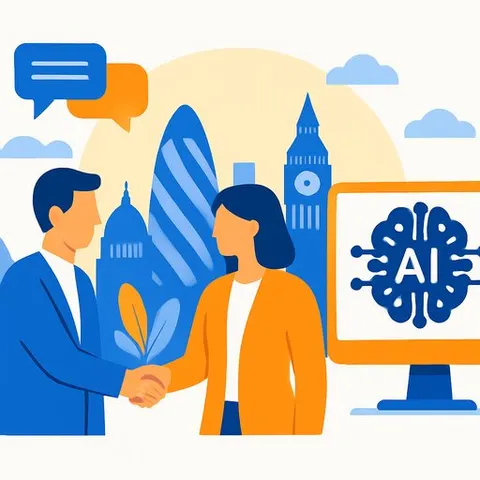
The London insurance market will see AI "radically reshape" digital trading, but the trust, personal relationships and human judgement that built the sector over 340 years will remain its core pillars. That is the headline finding from new research by the London and International Insurance Brokers' Association (Liiba), released 21 September 2026 in a study titled The Trust Imperative - How digital trading can revolutionise client outcomes but why humans must stay in control.
The study found most market participants are sceptical their firms would let AI make decisions autonomously where reputation and client outcomes are at stake. The "ability to take informed decisions without perfect information" was identified as a defining feature of the London market - one that depends as much on long-term relationships and human judgement as on AI-powered calculations.
How broker roles will shift
Christopher Croft, chief executive at Liiba, said the focus of brokers will move beyond business development and client relationship management. They will get "ever better at risk analysis, understanding their clients' risk and developing the right mitigation approach."
As digital trading reduces costs that currently stop people buying insurance, Croft sees a new avenue for growth. "The huge opportunity - as one of our board members said - is for brokers to become 'hunter gatherers' and to try and penetrate parts of the world where London traditionally hasn't been particularly successful such as Latin America, Asia and Africa," he said.
The research also pointed to changes in skillsets as the market shifts from static annual renewal cycles toward dynamic, real-time risk assessment. Brokers will need to work more closely with large-volume datasets to create niche financial instruments. Frontline traders, the study suggests, will provide a layer of human expertise over AI outputs to catch incomplete or incorrect information.
Growth potential and administrative change
Croft framed the evolution in commercial terms. "There will be more of a focus on getting new business in and, if that's successful, then the overall size of the pie will hopefully grow and the number of people employed will grow because we'll become a bigger market," he said.
He acknowledged that some roles will disappear. "Will there be administrative roles that fall away as part of that? You assume that's kind of inevitable in any technological advance."
For professionals looking to build the data and analytical skills these shifts demand, structured learning paths in AI for Insurance Courses and AI for Executives Courses offer targeted training on applying AI within risk assessment and strategic decision-making.
Why this matters for insurance professionals
The research confirms brokers are not being replaced - but their daily work is changing. The brokers who thrive will be those who can pair deep client relationships with the ability to interpret AI-generated risk analysis, spot gaps in machine outputs, and use those insights to open business in markets London has historically struggled to reach. Administrative roles will contract. Advisory and analytical roles, Liiba's findings suggest, will expand.