
AI news ·
UNESCO-CENIA Partnership Brings Ethical AI Into Classrooms Across Latin America
UNESCO and CENIA join to advance ethical AI in Latin American schools with training, guidance, and shared standards. Latam-GPT will aid ministries through a new observatory.
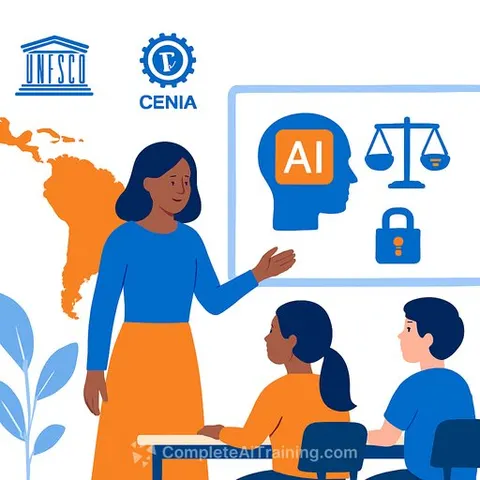
UNESCO-CENIA partnership advances ethical AI in education across Latin America
Dated: March 6, 2026
UNESCO's Regional Office in Santiago and Chile's National Centre for Artificial Intelligence (CENIA) have signed a cooperation agreement to accelerate responsible AI in education across Chile and Latin America. The focus is simple: build capacity, raise digital competencies, and ensure AI systems meet ethical standards from design to classroom use.
The partnership creates a shared framework to coordinate AI literacy initiatives and people-centered development. It brings together educators, technical teams, and policymakers to co-create adaptable training resources and strengthen national and regional ecosystems for responsible innovation.
Why this matters for educators and education leaders
- Teacher and student AI literacy will expand through practical training, workshops, and adaptable materials.
- Clear guidance for safe, effective classroom use grounded in ethics, inclusion, and human rights.
- Support for Ministries of Education on strategy, procurement, and implementation that protects learners.
- Stronger dialogue among schools, universities, EdTech, and government to align on standards and impact.
Early milestone: Latam-GPT in the Regional Observatory
The partnership will integrate Latam-GPT, the region's first open large language model built for Latin America and the Caribbean. This tool will support Ministries of Education and power UNESCO's new Regional Observatory on AI in Education.
Practically, that means governments and institutions can explore real use cases-curriculum support, teacher development, admin workflows-while testing safeguards and measuring outcomes. The priority is responsible adoption with clear oversight and transparent documentation.
What you can do now
- Map current AI use in your institution (tools, data flows, decision points) and identify quick wins and high-risk areas.
- Create or update an AI policy covering data privacy, academic integrity, disclosure to students, and teacher-in-the-loop review.
- Launch a short AI literacy module for staff and students: benefits, limits, bias, citation, and safe prompts.
- Set a procurement checklist: alignment with curriculum, age-appropriateness, bias testing, accessibility, and exportable audit logs.
- Nominate pilot teams (teachers + IT + curriculum leads) to trial Observatory resources and share evidence.
- Build skills with practical training like the AI Learning Path for Teachers.
Governance and safeguards you can expect
This agreement reinforces UNESCO's commitment to ethical, inclusive, rights-based AI-supported by policy guidance and international standards such as the Recommendation on the Ethics of AI. CENIA adds deep research, technology transfer, and large-scale training to put these principles into practice.
- Lifecycle oversight: from data collection and model training to deployment, monitoring, and feedback loops.
- Transparency: clear documentation, age-appropriate explanations, and educator controls.
- Equity checks: bias audits, multilingual support, and local context relevance for Latin America and the Caribbean.
- Wellbeing and safety: guardrails for academic integrity, privacy protections, and responsible assessment use.
Who's involved
UNESCO's Regional Office in Santiago leads regional coordination with governments and institutions. CENIA brings technical expertise and capacity building-learn more about their work at CENIA.
Bottom line
This partnership gives schools and ministries a clear path to use AI responsibly-grounded in ethics, evidence, and practical training. If you lead in education, start small, document everything, and build capacity now so your teams can implement AI with confidence and care.