
AI news ·
United States ranks 24th in generative AI adoption despite leading global investment, Stanford report finds
Despite a $285.9 billion investment, the U.S. ranks 24th globally in generative AI adoption at 28.3%. This gap forces IT teams to rethink real-world deployment strategies.
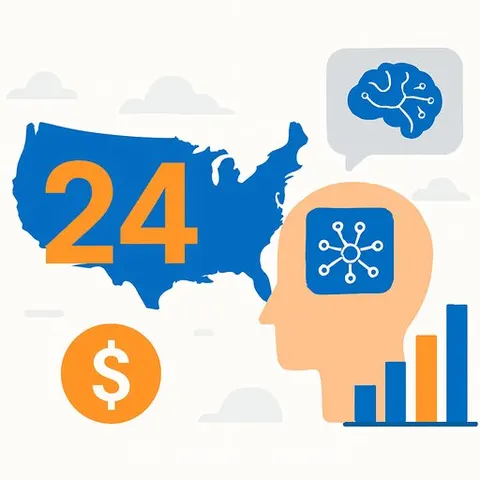
The United States invested $285.9 billion in AI in 2025-23 times more than China-yet ranks 24th globally in generative AI adoption at just 28.3%, according to Stanford University's 2026 AI Index. The United Arab Emirates and Singapore lead adoption at 54% and 61%, respectively, while the U.S. trails most comparable economies despite dominating model development and private funding. For IT and development teams, the gap between where models are built and where they are actually used reshapes deployment planning, product-market fit, and the metrics that matter for real-world impact.
The 2026 AI Index: a 400-page snapshot of global AI
The annual report from Stanford's Institute for Human-Centered AI (HAI) tracks technical performance, investment, labor markets, environment, public attitudes, and adoption across dozens of countries. It found that generative AI reached 53% population adoption worldwide within three years-faster than the personal computer or the internet-but the pace varies sharply with GDP per capita and regulatory environment. The U.S. leads all countries in AI private investment, yet its adoption lags behind nations with more permissive regulatory stances and higher digital-infrastructure density.
Etzioni's chasm: builders vs. adopters
Oren Etzioni, writing in GeekWire, described the split as a chasm between builders and adopters with concrete implications for who shapes the next generation of AI products. He said high model performance and growing investment do not automatically translate into broad consumer or enterprise uptake. Design, trust, regulation, and local workflows determine whether models reach end users, and the gap is not incidental-it reflects a structural pattern where countries with concentrated knowledge-work sectors and permissive regulatory stances outpace R&D leaders in real-world usage.
What the divergence means for AI deployment and evaluation
For ML engineers and product managers, the Index's finding means evaluation priorities should include local usage signals and deployment friction, not just benchmark scores. Adoption rates shape data collection opportunities, user feedback loops, and the representativeness of real-world evaluation datasets. Monitoring policy and public-attitude metrics matters when planning rollouts across markets, especially in regions with lower baseline adoption. The report also documents that AI talent inflows to the U.S. dropped 89% since 2017 and 80% in the last year, adding a supply-side dimension to the development-adoption gap.
For IT and development teams, these adoption metrics are operational signals for deployment choices, telemetry needs, and localization priority-a topic covered in resources on AI Deployment Strategies for IT and Development Teams. Similarly, product managers must shift their focus from raw model performance to real-world usage patterns, as discussed in AI Product-Market Fit and Evaluation for Product Managers.
Why this matters for IT and development teams
Adoption metrics are not just academic data points-they are leading indicators of where models will encounter real users, generate training data, and face regulatory friction. Teams that track national adoption rates, enterprise SaaS integration patterns, and API call growth by region can make smarter decisions about localization, compliance, and infrastructure investment. The Stanford report makes clear that building the best model is not enough; the organizations that win are those that close the gap between development and deployment.