
AI news ·
Universities redesign teaching as AI reshapes what students learn
A Brown University economics midterm taken at home jumped from typical 65-80% averages to 96%; back in the classroom, the final averaged 48.6% and 18 students dropped the class.
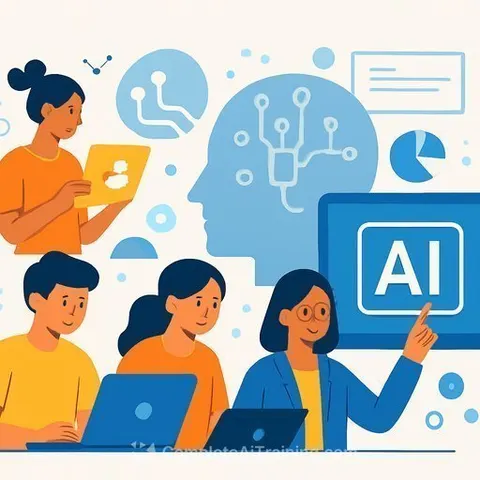
When California State University math professor Taiyo Inoue looked at the homework his students submitted in 2025, he realized something had fundamentally changed. Assignments that once took an evening now came back within minutes, error-free but pointless. Students weren't just using ChatGPT to write papers or cheat on tests - they were using it to think.
"These new technologies allow students to completely and totally offload their cognition," Inoue said, "giving themselves up, their identity as students, totally and completely to machines. That's the disaster scenario for higher education, because it completely dilutes the value and the signal that a college degree confers on its holders."
Inoue now posts his lectures on YouTube and requires students to work through problems in class on whiteboards, where he can watch them reason in real time. He is one of many educators across the country wrestling with a question that has become urgent: If AI can deliver information anywhere, what still requires a classroom?
The pressure on universities is mounting
A recent survey found that nearly 90 percent of high-performing students used AI for coursework, and roughly a quarter said they used it instead of doing assigned reading. At the University of Reading in the UK, researchers slipped AI-generated answers into real course exams. Humans identified them just 6 percent of the time.
Colleges have long combined three functions: transmitting knowledge, validating mastery and forming character. AI is pulling those functions apart. Information is becoming abundant and personalized, weakening the university's role as the provider of knowledge. Work completed outside the classroom can no longer reliably show what a student knows, forcing institutions to redesign how they certify mastery.
"With each passing day a machine becomes capable - or seemingly capable - of doing something that until yesterday you and I thought only a human being could ever do," said Adam Kronk, an ethicist at the University of Notre Dame's Institute for Ethics and the Common Good. "What does it mean to become a human being? What does human flourishing look like? Why am I here? Why am I in school? It makes these questions much more acute."
Two approaches emerge
California State University, the nation's largest four-year public university system, signed a $16.9 million agreement with OpenAI in January 2025, putting standard tools in the hands of hundreds of thousands of students, faculty and staff. Inoue defends the decision as a matter of equity. At roughly $1.60 per user per month, the system could provide the same enterprise version to students who could not afford individual subscriptions. "I am not fond of a classroom of AI-haves and AI-have-nots," he said.
Other institutions are moving in the opposite direction. The University of Chicago Law School announced a pilot policy removing electronic devices from core first-year classes, keeping exams in person and offline, and requiring students to discuss research papers orally with professors. William Hubbard, who chaired the committee that developed the strategy, said AI's shortcuts can be valuable when professional efficiency is the goal. Education is different.
"The whole point is to do things the hard way - because that's how you learn," Hubbard said.
Brown University saw the stakes firsthand this past spring. After students expressed anxiety about gathering in a classroom following a campus shooting, economics professor Roberto Serrano allowed them to take the midterm at home. Grades that typically averaged between 65 and 80 percent jumped to 96 percent. When Serrano moved the final back into the classroom, the average score was 48.6 percent - the lowest he had ever recorded. Eighteen students dropped the class.
At the University of Sydney, the answer is a "two-lane" model. In Lane 1, students prove mastery under secure conditions through in-class writing, proctored exams and oral defenses. Lane 2 assumes AI. Professors must validate what students need to know and cannot prohibit what they cannot prevent. In one writing course, roughly 600 students each complete a 10-minute oral audit to demonstrate they understand the argument they submitted. Trust still requires human time.
NYU Stern professor Panos Ipeirotis is trying a different approach. His system, called Viva, conducts personalized oral examinations on students' semester projects. Students may use AI freely to research and build their projects, but must then answer and explain the work aloud before an AI examiner that adjusts its questions to the strength of their answers. One student described the experience bluntly: "The better I do, the ceiling rises."
The risk of deskilling
Shannon Vallor, a philosopher of technology at the University of Edinburgh and a former Google AI ethicist, worries about what happens when machines assume tasks that once exercised human capacities. She calls it "deskilling" - automation can weaken not only our ability to perform particular tasks but the habits of judgment.
"We've essentially conducted an unregulated mass social and psychological experiment on the entire human population without ethics approval, without safety testing," she said. "It's one thing to take away our ability to make shoes for ourselves. It's another thing to automate away our ability to make our own moral decisions."
Katie Anne Good, a communications professor at Calvin University in Michigan, moved writing back into the classroom after realizing the take-home essay was no longer a viable assessment. Students now spend three hours writing analytical essays by hand, surrounded by classmates wrestling with the same material. The result surprised her: students watched one another think, and ideas took shape in public. The classroom became one of the few places where students and professors can be confident they are encountering another mind.
Roosevelt Montás, a professor at Columbia University who founded its Freedom and Citizenship program, argues that liberal education should help students order their own lives and prepare for democratic life - making arguments, hearing opposing views and deliberating with people unlike themselves. AI threatens these things if it bypasses the struggle that produces understanding. A chatbot can summarize Plato's dialogues, he said, but it cannot supply the experience of wrestling with a text and discovering that the questions have become personal.
"The thing that's transformative about Plato and great books in general is that they offer a set of provocations for you to grapple with," Montás said.
Why this matters for educators
The take-home essay is no longer a reliable measure of what students know. Educators who treat AI as a tool to be integrated without redesigning assessment will find themselves unable to verify learning. The institutions responding most deliberately are those that separated two questions: What must students prove they can do on their own, and what should they be prepared to do with AI in the workplace? For educators, the practical takeaway is to identify the core skills students must demonstrate without assistance and build assessment around those - even if it means more oral defenses, in-class writing and proctored work.
For those seeking practical guidance on teaching with AI, resources like AI for Teachers and broader AI for Education materials offer frameworks for adapting classroom practice.