
AI news ·
University of Memphis students navigate uneven AI integration and environmental concerns
The University of Memphis added an AI master's concentration as students demand clearer classroom policies. They also urge action against pollution from local data centers.
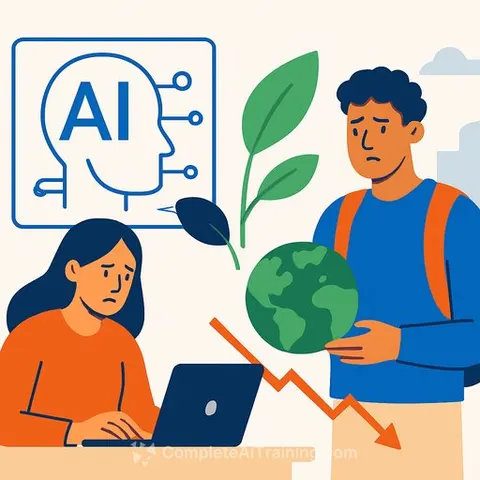
Artificial intelligence is no longer confined to computer science labs at the University of Memphis. The university has launched an AI concentration in its master's information systems degree program, and AI now appears in syllabi and classroom policies across disciplines. But students encounter AI unevenly: some see it only as a banned tool, others as an unspoken presence, and a vocal minority refuses to use it on principle. As Memphis grapples with the environmental footprint of AI infrastructure, students and faculty are asking what a responsible AI education should include.
AI Appears Only as a Warning for Some Students
For many, AI surfaces less as a resource and more as a caution sign. Raven Collins, a music therapy major, said AI is discussed frequently in her classes, but only as something to avoid. "AI comes up often in my classes but it's only to tell us not to use generative AI for our assignments or group work," she said. She regularly uses longstanding AI-driven tools - mixing software, studio programs, digital audio technology - but classroom messaging treats all AI as the same, ignoring distinctions between traditional assistive tools and newer generative systems. "Applied AI doesn't really have a place in my major besides warnings and different ways people can try to protect their work from generative AI use," she said.
New Curriculum Responds to Industry Demand
Thomas Stafford, chair of the Department of Management Information Systems, frames the new AI concentration as a direct answer to workforce needs. "Our Applied AI concept… is to prepare our graduates for the emerging AI enabled workforce," Stafford said. The program includes courses in prompt engineering, AI-assisted application development, analytics, database management, and CyberEthics. Stafford said students value hands-on work and permission to use AI tools. He also acknowledged that a minority of students and faculty "are concerned about the environmental and ethical impacts of AI use in society and in the university." Those concerns are addressed through committees, acceptable-use policies, and the CyberEthics course, though the balance between workforce readiness and real-world risks remains a live tension.
Environmental Costs Hit Close to Home
Raven's concerns reach beyond her coursework. "I don't think professors and students truly understand how harmful generative AI is on the planet, in low-income communities, etc.," she said. That worry is amplified by Richard Massey, a recent U of M graduate and environmental advocate from West Memphis, who chose not to use AI at all during college. "I saw firsthand … the effect that generative AI and AI infrastructure has on vulnerable communities," Massey said. "So, I … abstain from using AI." Massey has helped organize student efforts challenging xAI's datacenter expansion in Memphis. He described residents in Boxtown, Whitehaven, Westwood, and Walker Homes reporting asthma attacks, breathing difficulties, and noise from methane-powered hyperscale data centers. "Communities that have existed since the 1860s … are now being told they have to accept the conditions of these massive hyperscale data centers … churning out carbon dioxide, formaldehyde, nitrogen oxide, and worsening their quality of life," he said. Massey points to a recent report showing xAI as one of the largest polluters in the Tennessee Valley region. For him, AI education cannot be separated from these realities. "Are we equipping students with an understanding that the use of these tools … has implications?" he asked, arguing the university has a moral obligation to integrate environmental literacy into AI instruction.
What Students Want
Across interviews, students consistently ask for clear guidance, not just warnings; distinctions between traditional and generative AI; AI literacy across majors, not only in technical programs; environmental and ethical context; and support for independent thinking so AI strengthens, not replaces, critical thought. Raven put it simply: "I wonder if professors have thought of any class plans that help students combat dependency on generative AI and think independently for themselves." These demands align with the growing need for AI for Education that addresses not just technical skills but critical thinking and ethical awareness.
Why this matters for education professionals
Education professionals in colleges and K-12 systems face the same tensions: integrating AI while mitigating dependency and teaching its broader impacts. The Memphis case shows that students want transparent policies that distinguish between assistive and generative AI, and they expect their institutions to address the tangible environmental harms of AI infrastructure. For educators, this means building AI literacy into curricula across all majors, not just technical ones, and creating classroom strategies that foster independent thinking. The demand for structured AI education-including ethical and environmental dimensions-is growing, and those who teach will need to respond with concrete guidance, not just warnings.