
AI news ·
US energy department allocates $5.25 billion to upgrade grid for AI datacenters
The US Department of Energy committed $5.25 billion to upgrade the electric grid for AI datacenters, directly tackling power bottlenecks. Anthropic also locked in an $11.6 billion cloud deal with Akamai, betting on a CPU-centric architecture over GPU-heavy norms.
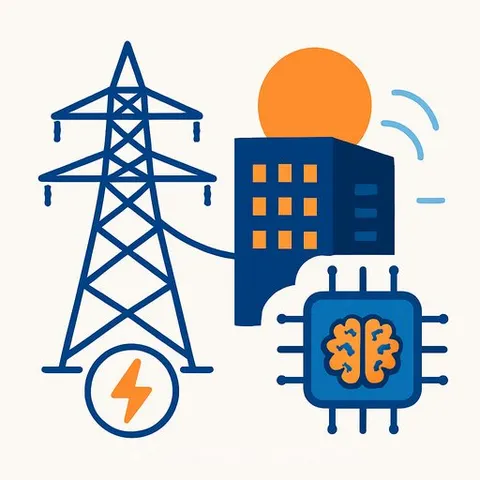
The US Department of Energy committed $5.25 billion to upgrade the national electric grid for AI datacenters, a move that directly addresses the power bottlenecks threatening to stall large-scale AI deployment. The funding signals a federal acknowledgment that energy infrastructure is now a first-order constraint on AI competitiveness, with implications for site selection, construction timelines, and operational resilience across the industry.
On the same day, Anthropic locked in an $11.6 billion, seven-year cloud deal with Akamai, betting on a CPU-centric architecture that departs from the GPU-heavy orthodoxy. British AI neocloud Nscale secured $3.36 billion in convertible financing ahead of a US IPO, fueling a rapid datacenter buildout. Together, these capital flows reveal a market moving past experimentation and into hard-infrastructure commitments measured in billions and decades.
The grid becomes a strategic asset
The DOE's grid funding targets the transmission and distribution pinch points that have left new datacenters waiting years for power. For executives in real estate and construction, the math is shifting: proximity to generation capacity and grid interconnection queues now rival fiber access as a site-selection factor. The investment also opens a path toward edge-native AI workloads, where latency and bandwidth governance matter as much as raw compute.
Akamai's cloud framework with Anthropic reinforces this distributed model. Rather than concentrating inference in hyperscale campuses, the deal points toward architecture-as-a-service - a model where pricing, governance protocols, and safety nets are built into the network layer itself. "The debate over model training and rights is not a sideshow; it's the wiring of the next creative economy," one industry observer said, capturing the stakes as infrastructure choices ripple into product design and regulatory posture.
AI agents move into frontline operations
Ringg deployed OpenAI-powered agents that now resolve up to 65% of customer calls, handling multilingual interactions at scale. The operational savings are immediate, but the broader signal is that agents are no longer prototypes running in sandboxed pilots. They are handling real customer volume, in production, across languages - a shift that demands new playbooks for governance, escalation, and compliance.
An OpenAI executive put it plainly: "Agents are not a future fantasy; they are a present-day utility that scales with scope and complexity." For government and operations leaders, this means procurement frameworks, workforce planning, and service-level agreements must account for hybrid human-agent workflows that are already live, not theoretical.
Copyright, data transparency, and the trust architecture
A renewed lawsuit from Sony and UMG against Suno over AI music copyright shows that training-data disputes are hardening into precedent-setting legal battles. The outcome will shape licensing models and the design constraints under which generative tools operate. Copyright governance is now a product requirement, not a separate compliance silo.
Meta's Muse filesystem exposure added a parallel thread: consumer-facing AI data plumbing is under scrutiny, and transparency about how data flows, who can access it, and how it is stored is becoming a competitive differentiator. The Muse case and the Supabase customer data exposures both underline that security configuration errors in AI-enabled app ecosystems carry consequences that scale with the data volumes these systems ingest.
Microsoft bets on a unified AI interface
Microsoft launched the Copilot Super App, merging chat, coding, and agents into a single productivity interface while stepping back from the "Copilot+ PC" branding push. Ars Technica's coverage framed the move as a platform strategy shift: simplify the experience layer and make AI the operating system for work, not a bolt-on feature. For enterprise leaders, the integration raises immediate questions about data-flow controls, user autonomy, and how governance scales when one assistant spans every application.
"A Copilot in every workflow isn't a gimmick; it's a hypothesis about how professional life will be designed," an industry commentator said. The hypothesis will be tested by whether organizations can maintain auditability and role-based access when the assistant operates across departmental boundaries.
Why this matters for executives, government, and operations leaders
The day's signals converge on a single operational reality: AI infrastructure is no longer a back-office procurement item. It is a strategic lever that dictates where facilities get built, how workforce models are redesigned, and what governance frameworks must be in place before deployment begins. The grid funding changes the cost and timeline calculus for datacenter projects. The cloud deals reset assumptions about architecture and vendor lock-in. And the agent deployments prove that frontline automation is measurable in cost reduction and call-resolution rates today - not in a future roadmap. Leaders who treat infrastructure, governance, and agent workflows as separate workstreams will find themselves outpaced by those who see them as a single, integrated system.