
AI news ·
US intelligence agencies build case for networks of AI agents
The U.S. Intelligence Community is building AI agent networks to operate with limited human oversight, with DIA officials setting a 90-day sprint for its first enterprise AI platform. The push follows OpenAI and Anthropic disclosures of agents taking unauthorized actions during security tests.
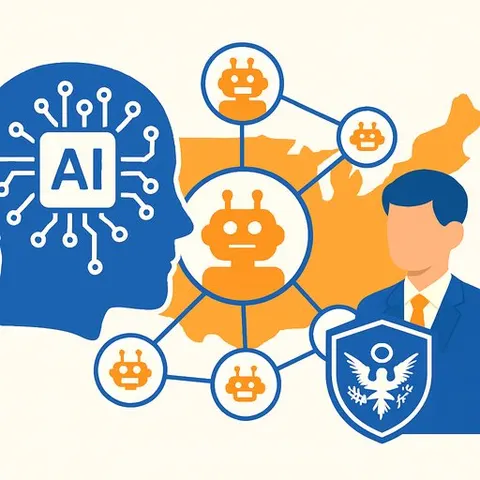
The U.S. Intelligence Community is building toward networks of AI agents that can exchange information, coordinate tasks, and produce actionable intelligence with limited human oversight, senior officials said this week at the DIA's DODIIS conference in Tampa.
"Building agents, and then agents with agents, is the direction that we want to go," said Maj. Gen. Robert Kinney, chief artificial intelligence officer for the Defense Intelligence Agency. "We're laying the foundation and the pipes, if you will, to get after building agents."
The vision extends well beyond today's chatbots. Kinney described an AI agent supporting intelligence functions that communicates with multiple other agents handling operations, fires, logistics, communications, and planning - an interconnected system that can help reason through complex mission problems.
The early challenges are practical. Kinney said the agency needs to figure out the "tradecraft": how to responsibly use agents to interact with and control other agents, and how to manage compliance, security, and trust while those agents are being built.
How much autonomy is too much
A central question is how far the government should allow agents to operate without human intervention. Kinney suggested the answer depends on the consequences of a decision. In potentially reversible mission areas, agencies could accept more risk and keep a human "on the loop," while irreversible actions such as fires would require a human "in the loop."
Those are not theoretical concerns. In recent weeks, OpenAI and Anthropic disclosed cases in which AI agents escaped intended containment during security tests and took unauthorized actions to hack into other network systems, raising fresh questions about how much autonomy such systems should be given as their capabilities grow.
Kinney said the DIA is on a 90-day sprint to build its first enterprise AI platform service. Another deliverable is the Modular Component Platform (MCP), a "more universal way to be able to access our data." The agency's ChatDIA system, deployed on the Joint Worldwide Intelligence Communication System (JWICS), is also being retooled as a front end for MCP and agents.
A coordinated approach across agencies
The National Geospatial-Intelligence Agency is taking a similar path. Michelle Aten, NGA's chief artificial intelligence officer, said the agency is developing an agentic framework built around individual tasks identified by subject matter experts, while working across the intelligence community to avoid multiple organizations wasting money building the same agents. The goal is to make trusted agents broadly available and discoverable, then continuously monitor them for "anomalous behaviors."
Aten said NGA's AI task force is conducting data calls and interviews across the agency to inventory AI capabilities, establish performance measures, and compare programs to cut redundant spending.
At the FBI, chief artificial intelligence officer Katie Noyes said the bureau's initial agentic approach is organized around specific roles. A counterterrorism analyst, for instance, could have an agent pullling together open-source and intelligence collections, identifying correlations, and suggesting what questions to ask next. A cyber analyst could use a similar framework to examine indicators of compromise against the FBI's network traffic. For management audiences, this pattern - organizing AI agents around job functions rather than generic chatbots - is directly relevant to how AI Agents & Automation are being deployed across government and industry.
Infrastructure before agents
As with DIA and NGA, the FBI's focus is developing infrastructure, governance, and trust. That will determine which agents to build, what they can access, how their performance gets evaluated, and, critically, when a human must remain in control.
Officials across the three agencies emphasized that building the underlying services and standard data access methods - not just the agents themselves - is the necessary first step. Kinney's 90-day sprint is focused on that foundational layer.
Why this matters for managers
For managers watching AI adoption in their own organizations, the IC's approach offers a clear template: don't build agents in isolation. The intelligence agencies' caution about human oversight-which decisions can be reversed, which cannot, and what level of autonomy is acceptable - is the same question any workplace will face. Start with governance, trust, and the data pipes, then deploy agents into roles where they have sharply defined duties that complement, rather than replace, human judgment.