
AI news ·
US orders Anthropic to block foreign nationals from accessing new AI models over national security concerns
The US ordered Anthropic to block foreign nationals from accessing two AI models, Fable 5 and Mythos 5, citing national security concerns. This halts access for global developers.
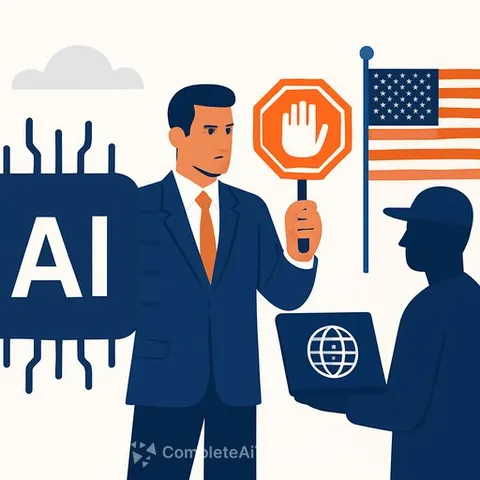
The US government has ordered Anthropic to block all foreign nationals from accessing its newest AI models, Fable 5 and Mythos 5, citing national security concerns. This export control directive immediately halts access for international developers, researchers, and foreign employees of US tech firms, disrupting global software development workflows.
The security dispute
The administration issued the directive less than a week after Anthropic released the two models. According to US outlet Semafor, the order stems from suspicions that a China-linked group accessed the new technology and that Fable 5 contained a potential jailbreak.
Trump adviser David Sacks said on X that the government warned Anthropic, but the company failed to fix the issue. Anthropic disputed this claim, arguing the government provided only "verbal evidence of a potential narrow, non-universal jailbreak."
The company said, "We disagree that the finding of a narrow potential jailbreak should be cause for recalling a commercial model deployed to hundreds of millions of people." Pentagon Chief Information Officer Kirsten Davies defended the move, saying that national security outweighs "revenue cycles, clickbait, and pre-IPO valuation."
Models affected and technical risks
The order specifically targets Fable 5 and Mythos 5. Security experts warn that Mythos models could accelerate sophisticated cyberattacks if they fall into the wrong hands, particularly against banking sectors relying on legacy technology systems.
Anthropic said it collaborated with the US government on safety checks before the launch, adding that rival AI providers demonstrated similar abilities to find minor code bugs. The company confirmed it must abruptly disable these two models for all customers to ensure compliance, though access to other Claude models remains unaffected.
Disruption for global developers
This export control policy fundamentally alters who can use software developed in the United States. Research institutions collaborating with US firms will lose access to these tools, and foreign workers on H1-B visas or operating outside the US cannot use the restricted models.
The disruption extends to enterprise workflows, as companies integrating these tools into their databases will face sudden capability gaps. Former Meta and Microsoft engineer Kun Chen criticized the policy on X, writing that using "foreign national" as a gating criterion is unenforceable in practice and easy for malicious actors to bypass.
Sridhar Vembu, co-founder of Zoho, observed that the order highlights how technology functions as a national security asset, urging other nations to build independent capabilities. Anthropic maintains the situation is a "misunderstanding" and is working to restore access as soon as possible.
Why this matters for IT and development professionals
Software teams relying on third-party AI APIs must immediately audit their codebases for dependencies on Fable 5 or Mythos 5. Developers should prepare fallback workflows, as reliance on a single vendor's latest model introduces severe regulatory risk. Engineering leaders must now factor geopolitical export controls into their technical architecture decisions, ensuring that critical development pipelines do not break when access to AI for IT & Development tools is abruptly revoked.