
AI news ·
Vibe coding raises copyright risks that developers and organizations need to manage
AI-generated code may lack copyright protection if it shows insufficient human creativity, leaving organizations exposed. Risks include infringement from training data, open-source license violations, and weak legal standing in court.
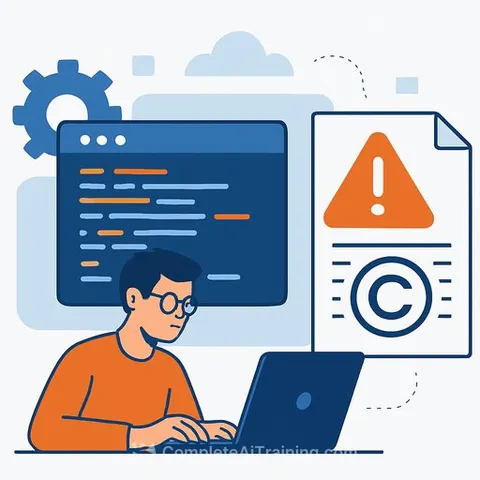
AI-Generated Code Carries Hidden Copyright Risks for Organizations
Using artificial intelligence to write software code doesn't shield that code from copyright liability-and in some cases, it increases exposure. When developers use high-level prompts to generate code with minimal human review, they may inadvertently create legal problems that surface only during litigation.
This risk stems from how copyright law treats AI-generated work. The U.S. Copyright Office and federal courts have determined that code authored solely by AI falls outside copyright protection. That means software created through "vibe coding"-where developers rely on AI models to generate code from natural language prompts-may receive weaker legal protection than traditionally written code.
Proving Human Creativity in AI-Generated Code
Copyright protection hinges on demonstrable human creative input. Courts examine whether the finished work itself shows creativity worthy of protection, even if a machine executed the technical work.
Organizations seeking copyright protection for vibe-coded software must document the human creativity behind it. This means working backward from the desired outcome.
- Define the finished product in concrete terms: its structure, behavior, problems it solves, and distinctive choices
- Create a checklist of creative decisions-architectural layout, feature prioritization, stylistic conventions
- Design prompts and refinements that target each decision, using the AI model to implement pre-existing human choices
The more human creativity embedded in the coding process, the stronger the copyright claim. Organizations might also consider trade secrets as an alternative protection mechanism, since trade secret law doesn't require human authorship documentation.
Training Data and Open-Source Licensing Create Liability
AI code-generation tools trained on third-party code can output code that infringes existing copyrights. If the generated code incorporates open-source software, using it may trigger license compliance obligations-whether under permissive licenses like MIT and BSD, or restrictive ones like GPL and LGPL.
Failure to comply with open-source license terms can result in copyright infringement claims or breach of contract liability. Organizations using vibe coding should examine the AI tool's training data sources and scan outputs for licensing requirements before deployment.
Litigation Becomes Harder to Defend
Copyright infringement cases involving vibe-coded software present unique evidentiary problems. Because the code generation process occurs in a black box, neither the developer nor anyone else may be able to explain how the allegedly infringing code actually works.
This opacity undermines a defendant's ability to construct a credible narrative for a jury. Authentication and hearsay issues can arise when no witness can testify about the code's origins or function.
Additionally, if a developer used a U.S.-based AI tool or model, a court could treat the tool's output as a U.S.-based infringement, potentially exposing a foreign company with no U.S. presence to damages claims in American courts.
What Organizations Should Do
Any organization deploying vibe coding should establish oversight protocols. This means allocating some of the efficiency gains toward planning, documentation, and review.
- Document the creative decisions that shaped the code
- Scan AI-generated outputs for copyright infringement and licensing obligations
- Evaluate the AI tool provider's indemnification or liability protections
- Understand the provenance of the training data used in the AI model
Clear documentation of human creativity supports both copyright claims and product defense strategies. Early detection of licensing issues and hidden infringement prevents code from becoming an avoidable litigation liability later.
For legal professionals advising engineering teams, the principle is straightforward: vibe coding requires the same scrutiny applied to other outsourced work. The efficiency gains are real, but they demand corresponding diligence.