
AI news ·
Wall Street's biggest banks push deeper into AI across trading, coding, and staffing
JPMorgan's $18 billion tech budget anchors Wall Street's AI push, now reaching 200,000+ employees via its genAI platform. Wells Fargo's CEO ties AI directly to job cuts, expecting headcount to keep falling after a nearly 25% reduction since 2019.
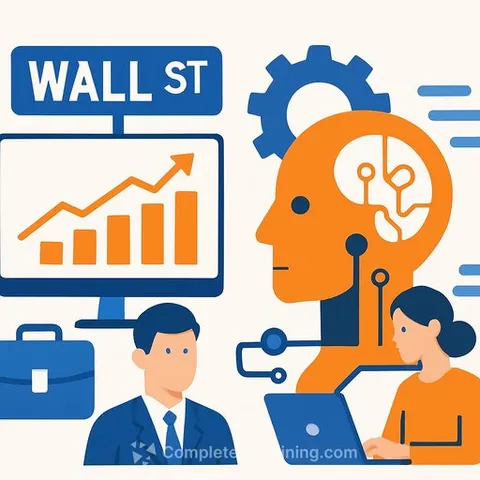
Wall Street's biggest banks are spending billions on artificial intelligence, and the technology is already reshaping how they operate - from shareholder voting to performance reviews to headcount expectations. JPMorgan, Wells Fargo, Citigroup, Bank of America, and Morgan Stanley have all detailed AI initiatives in recent months that touch nearly every part of their businesses. What's emerging is a picture of an industry that sees AI not as an experiment but as core infrastructure, with leaders now being pressed on whether the returns justify the investment.
JPMorgan's $18 billion technology budget stands at the center of the trend. The bank has rolled out its proprietary generative AI platform to over 200,000 employees, with roughly 100 more tools in development. The bank is even giving employees the option to use in-house AI tools to assist with writing year-end performance reviews.
CEO Jamie Dimon is a "tremendous" user of the bank's genAI suite, according to executives. He has previously said the bank's $2 billion AI investment has already matched its cost in savings, and he believes the technology gives JPMorgan an edge, even as he acknowledged that "everyone is now using it." The bank's asset management unit plans to replace external proxy advisors with an in-house AI platform called Proxy IQ, which will aggregate and analyze proprietary data from more than 3,000 annual company meetings for shareholder voting decisions.
AI and the workforce
Wells Fargo CEO Charles Scharf has drawn the most direct line between AI and job cuts. The bank has already reduced its headcount by nearly a quarter since he joined in 2019, and he expects that trend to continue.
"The opportunities that exist in AI are very significant, and anyone who sits here today and says that they don't think they'll have less head count because of AI either doesn't know what they're talking about or is just not being totally honest about it," Scharf told Reuters.
Scharf said the lower headcount is an "outcome" of the firm's focus on areas where it is "way too inefficient" and "way too bureaucratic," and he expects most reductions to come through attrition. The bank operated from 2018 to June under a $1.95 trillion asset cap that limited its ability to grow.
From client meetings to coding
Bank of America's internal AI assistant helps bankers collect, record, and review client data, cutting prep time for client meetings, according to the bank's chief experience officer, Rob Pascal. Morgan Stanley has focused similar internal tools on how its advisors work with client information.
Citi's chief technology executive, Shadman Zafar, has outlined a four-phased AI strategy that the bank says will "change how we work for decades to come," with implications for operations, wealth brokerage, and product teams. The bank positions AI's shift not as a single deployment but as a sequence of changes that will affect nearly every employee.
The banks' moves extend beyond the obvious trading-floor applications. The technology is changing what it means to be a software engineer at these firms, how junior bankers prove their value, and the roles within the C-suite itself - all while executives face analyst questions about returns and safety.
Why this matters for executives and strategy leaders
These banks are effectively running public experiments in how to deploy AI across workforce structures, and their lesson from the playbooks. Wells Fargo's willingness to tie headcount reductions directly to AI adoption is the clearest signal yet that this technology is not just about efficiency - it's about organizational design. For an executive or strategy professional, the returns on AI spend are becoming a leadership issue, not a technology issue. The banks with the most detailed strategies are the ones that can name the specific workflow being changed, and that will be the same discipline that separates effective AI adoption from a costly bet.