
AI news ·
White House launches America.gov AI chatbot to help people access government services
Trump launched America.gov, an AI chatbot meant to be a single front door for tens of thousands of federal websites, with Google's Gemini and Grok powering it. Errors on tax deadlines, food stamps, or visa rules could mean real penalties, denied benefits, or derailed immigration status for citizens.
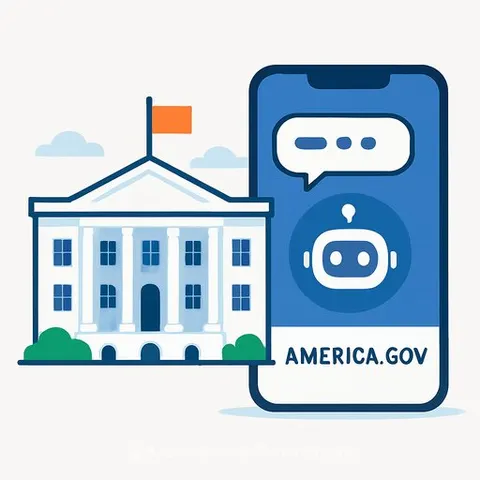
President Donald Trump announced Tuesday that the White House is launching America.gov, an AI chatbot designed to help people find government services and information. Google confirmed its AI model, Gemini, is involved in the project, and U.S. Chief Design Officer Joe Gebbia said the government also used Grok. The move puts AI at the front door of federal bureaucracy, where accuracy failures could carry real financial and legal consequences for citizens.
"Instead of forcing citizens to search through the endless maze of tens of thousands of government websites and rules … you'll now have one front door for every single question," Trump said in a post on X.
The promise: one entry point
Federal websites number in the tens of thousands, each with its own navigation structure, terminology, and rules. Finding the right form for a visa renewal or locating eligibility criteria for food assistance often requires searching across multiple agencies. A single conversational interface could compress that process into seconds.
For government communications teams and public affairs officers, the pitch is straightforward: reduce call center volume, standardize answers to common questions, and give citizens a direct path to the information they need. Google's involvement as a partner signals that the administration is leaning on commercial AI infrastructure rather than building from scratch.
The risk: hallucinations with consequences
Large language models are not infallible. CNN recently reported that the U.S. military nearly launched an armed operation against a Chinese vessel it believed was carrying components for nuclear weapons. The mission was aborted at the last minute after officials realized the supposed threat was an AI hallucination.
America.gov likely won't trigger military action, but errors can still cause harm. A wrong answer about tax filing deadlines could mean penalties. Bad guidance on food stamp applications could mean denied benefits. Incorrect visa information could derail someone's immigration status. The stakes are lower than nuclear warfare, but they are not zero.
What government communicators should watch
The launch raises immediate questions about accountability. If a citizen acts on faulty chatbot guidance and suffers a penalty, who is responsible? The agency whose website contained the correct information? The AI vendor whose model generated the wrong answer? The White House team that deployed the tool? These questions remain unanswered.
For professionals working in government PR and communications, the rollout also creates a new channel to monitor. Agency websites may see traffic shifts as users migrate to the chatbot. Messaging consistency across departments becomes more urgent when a single AI interface is synthesizing answers from multiple sources. Teams that have not audited their public-facing content for clarity and accuracy may find their material misrepresented by the model. Those preparing for these shifts may benefit from AI Public Policy Courses that cover how automated systems interact with government information.
The administration has not released details on how America.gov will handle corrections, disclaimers, or escalation to human staff. Those operational specifics will determine whether the chatbot becomes a trusted front door or another source of confusion. The AI for Government Courses page tracks developments in this area for public-sector teams.
Why this matters for general AI news, government, PR and communications professionals
America.gov is a live case study in deploying AI where errors have legal and financial consequences. Watch for the first documented hallucination that leads to a citizen filing a complaint or missing a deadline - that will set the tone for how the administration responds to accuracy failures. If you work in government communications, audit your agency's public-facing content now. A chatbot can only be as accurate as the source material it draws from, and unclear or outdated pages will surface as wrong answers to real people.