
AI news ·
Will AI-Powered Efficiency Strip Universities of Their Humanity?
AI can boost access and efficiency in higher education but risks eroding the deep, human process essential to true intellectual growth. Balancing tech with analog learning is key to preserving wisdom.
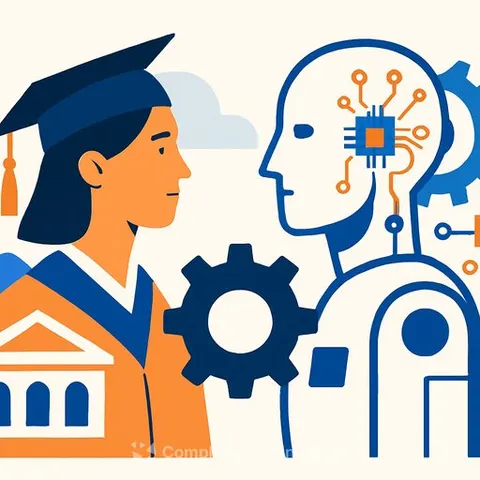
How AI Could Erase Higher Education’s Soul
The modern university is quietly changing, and this change threatens to strip away what has made higher education meaningful for centuries. Artificial intelligence offers algorithmic tutors and efficient credentialing systems that promise to make education more accessible than ever before. But in doing so, it risks undermining the deeply human and often messy process of intellectual growth that defines higher learning.
This is more than just a technological update; it’s a philosophical clash between digital precision and analog depth. How universities respond will determine whether they remain places of wisdom or become mere credential factories optimized for quick consumption.
The Efficiency of AI in Education
Digital platforms have transformed how knowledge is delivered. AI tutors like Khanmigo adapt instantly to student needs, offering personalized support at a fraction of traditional costs. Prestigious universities such as Harvard, MIT, and Stanford offer massive open online courses (MOOCs) that bring elite lectures to millions.
Algorithms now handle essay grading, plagiarism detection, and even research suggestions—tasks that once required human effort. A study from the University of London in 2024 found students using AI tutors scored 22% higher in STEM subjects compared to those attending traditional lectures.
Startups like Coursera and Udacity have cut the cost of professional certifications, helping mid-career learners upskill without leaving their jobs. For many developing countries, AI-powered education opens doors that were previously closed.
The Hidden Costs of Digital Learning
But this speed and convenience come with a price. When learning is reduced to bite-sized modules, automated quizzes, and instant feedback, something essential disappears. Universities have never been just content delivery systems—they are spaces for intellectual friction where ideas clash and evolve.
Walk into any great university library—the Bodleian at Oxford or Widener at Harvard—and you feel the weight of centuries of thought. These places are not just about accessing information; they are about living with ideas. The same goes for seminar rooms where debates stretch beyond their scheduled time or dormitory discussions where half-formed theories are tested over coffee.
This analog dimension of education is slow, embodied, and wonderfully inefficient. It’s how Nobel laureate Richard Feynman created his famous diagrams—through years of blackboard work and intense peer discussions. Philosopher Hannah Arendt developed her theories through deep engagement with primary sources, not AI summaries.
Why Analog Learning Matters
Neuroscience supports this. A 2023 study from Cambridge revealed that students who took handwritten notes retained complex concepts 30% longer than those who typed. The physical act of writing deepens cognitive processing. Likewise, face-to-face debates activate brain regions linked to empathy and critical thinking in ways video seminars can’t replicate.
Yet these analog experiences are fading. Lecture halls are emptier as students prefer on-demand videos. Campus newspapers, once training grounds for journalists, have closed or moved online. Even office hours are being replaced by chatbot Q&A forums.
A Historical Parallel
This isn’t the first time access to knowledge expanded at a cost. When Gutenberg’s printing press emerged in the 15th century, it made books widely available but led to an erosion of memory skills. Medieval scholars memorized vast texts; the proliferation of books meant these mental muscles weakened.
Socrates warned about relying on external records in Phaedrus, fearing it would cause forgetfulness of internal wisdom. Today's AI risks a similar effect. Why wrestle with Kant’s Critique of Pure Reason when ChatGPT can summarize it instantly? Why labor through archives when algorithms can pull relevant sources in seconds?
Research from Stanford’s Digital Education Lab (2024) found students who depended on AI for essay drafting struggled to sustain complex arguments on their own. Like GPS weakening our spatial memory, AI may dull our capacity for deep, independent thought.
Finding Balance: Preserving the Human Element
The answer isn’t to reject AI but to protect analog spaces within digital learning. Some universities are already taking steps:
- MIT’s “Slow Seminars” require device-free, discussion-only classes focused on primary texts without digital distractions.
- The University of Chicago’s “Humanities Lab” combines AI research tools with intensive Socratic dialogue, pushing students to defend their views against peers.
- Oxford’s “Analog Term” makes philosophy students handwrite all essays for a semester, banning digital drafting.
The goal is balance. Let AI handle scaling, personalized drills, and grading automation. Meanwhile, humans must reclaim what they do best: fostering wisdom through intellectual struggle.
What Is Education For?
This debate boils down to purpose. The German concept of Bildung—the formation of character through knowledge—captures what’s at stake. If education becomes mere credentialing and prompt engineering, we may produce skilled workers, but not thinkers or citizens capable of meaningful reflection.
In the early 20th century, industrial education models delivered economic growth but created what Max Weber called “specialists without spirit.” Now, as AI threatens to automate intellectual work, the stakes are even higher.
Walking through the ruins of the Library of Alexandria reminds us that civilizations are measured not by data storage but by how they nurture minds. The AI shift could either free higher education or lead it to surrender to the demands of the attention economy.
The path forward isn’t rejecting technology, but vigilance. We must build systems that democratize access while fiercely protecting analog spaces where wisdom grows slowly, unpredictably, and irreplacably. Otherwise, we risk a world of flawless databases—but empty souls, where every answer is at hand, but no one remembers how to wonder.