
AI news ·
Workers are nearly four times more likely to talk to an AI chatbot about stress than to use employer mental health support, survey finds
42.6% of U.S. workers have used an AI chatbot to discuss work stress, while only 10.7% have used employer-provided mental health benefits. HR professionals' confidence in meeting workforce mental health needs has fallen from 70% in 2024 to 62% in 2026.
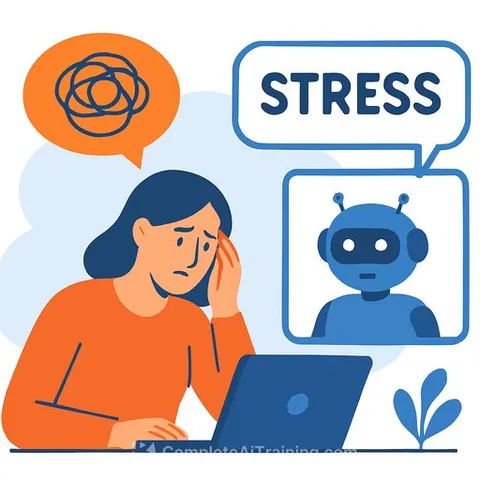
A growing number of U.S. workers are choosing AI chatbots over their managers or HR departments to discuss work-related stress, according to the 2026 Workplace Well-being Report by Founder Reports. The survey of 2,000 working adults found that 42.6% have used an AI chatbot to talk about work stress, while only 10.7% have used employer-provided mental health benefits. The trend carries significant implications for HR leaders who are already losing confidence in their ability to meet workforce mental health needs.
SHRM's 2026 Mental Health Snapshot shows 87% of HR professionals believe organizations should support employee mental health. But the share who feel prepared to do so has dropped from 70% in 2024 to 62% in 2026. The new data suggests a widening gap between what HR wants to provide and what employees are willing to accept.
Where workers actually turn under stress
Nearly half of survey respondents (47.4%) said work affects their well-being daily or weekly. Yet only 10.8% had spoken to a manager about it in the past year. The contrast is stark: workers are nearly four times more likely to confide in a chatbot than to use company mental health support.
When asked who they can be completely honest with when work hurts their well-being, 20.9% chose an AI chatbot. That outranks managers (17.2%), HR representatives (4.5%), and company leadership (3.5%). Another 19.7% of respondents haven't used AI for this purpose but have considered it, bringing the total open to AI support to 62.3%.
The pattern intensifies with stress levels. Among workers who experience daily strain, 28.9% trust an AI chatbot and only 12.3% feel they can be honest with their manager. For those whose jobs never affect their well-being, the numbers reverse: 26.6% trust their manager and just 9.2% trust AI.
Why chatbots feel safer than humans
"AI can feel psychologically safer because it does not carry the same social risk as telling a manager or HR representative that you are struggling," said Gleb Tsipursky, behavioral scientist and author of The Psychology of AI Adoption at Work. Employees fear that admitting difficulty will damage their standing or invite unwanted scrutiny.
Amy Mosset, founder of Interactive Counselling, pointed to two additional barriers that keep mental health benefits unused. First, accessing those benefits requires administrative work at precisely the moment when employees have the least capacity for it. Second, she said, "Employees won't use benefits that are technically confidential but socially conspicuous." The act of stepping away for a therapy appointment or navigating an EAP portal can feel visible in ways a private chat window does not.
A 2025 NAMI survey adds another layer: only 53% of workers know how to access the mental healthcare available through their employer-sponsored plan.
The privacy paradox
The sense of safety workers feel with AI may be built on a misunderstanding. Gleb Bulanek, founder of security testing company Penetrify, warned that conversations with company AI tools or AI integrated into corporate platforms can be accessed by employers. "Nothing improper has to happen for that to occur," he said. "It's just how enterprise data governance works, and most employees are unaware."
Bulanek noted that employee assistance programs typically carry confidentiality protections that chatbots lack. Conversations with AI are "simply data, and data is discoverable, subpoenable, exportable and searchable." He also cautioned against using consumer chatbots on work devices, where corporate certificates allow data loss prevention systems to read information leaving the device.
Tsipursky emphasized that AI cannot fix root causes. A chatbot "can help a worker cope with a situation, but it cannot change workload, resolve a conflict, or impact company policy." The underlying stressors remain untouched, and because so few employees report them through official channels, those problems stay invisible to the people who could address them.
Why this matters for HR professionals
The data presents HR teams with a dual challenge: low utilization of existing mental health benefits and rising reliance on unsecured, unaccountable alternatives. When only 1 in 10 struggling employees tells a manager or HR representative, problems that could be addressed through workload adjustments, conflict resolution, or policy changes never surface. Tsipursky sees a potential path forward where AI acts "as a bridge to better human conversations" rather than a replacement, but that requires HR to build trust that currently does not exist. The immediate priority is closing the gap between the confidentiality employees assume AI provides and the actual protections built into employer-sponsored support channels.