
AI news ·
Your best AI builder may be the CFO or operations leader who knows the broken process
67% of leaders use AI frequently, versus 52% of managers and 46% of individual contributors, per Gallup. Those closest to broken processes are best positioned to find what to automate.
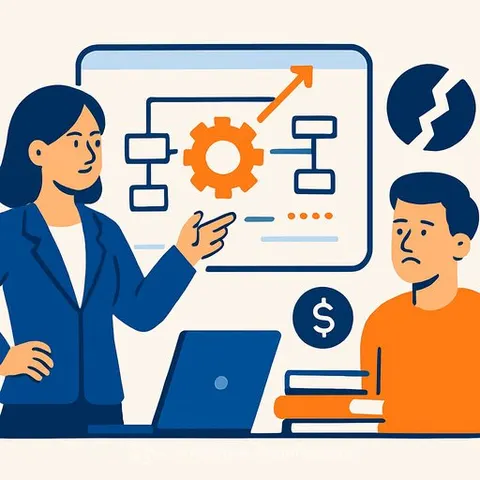
Gallup reported in April 2026 that among employees whose companies provide AI tools, 67 percent of leaders use AI frequently, compared with 52 percent of managers and just 46 percent of individual contributors. That gap matters because the people closest to broken processes-operations leaders, finance chiefs, sales managers-are often the ones best positioned to identify what to automate.
AI agents cannot automate a process a company cannot explain. The organizations seeing real returns are not chasing autonomous digital workforces. They are using AI to write, research, analyze, summarize, code, and automate dozens of small pieces of work that used to consume labor.
Why executives pull ahead
Current AI is particularly good at the work senior people do: synthesizing information, writing, planning, analyzing alternatives, preparing presentations, and making sense of messy inputs. There is another reason executives may be getting more value from AI. "The more context and judgment you bring to it, the more useful it becomes," the report said.
Fear, unclear direction, and lack of execution are slowing adoption at the exact moment companies need speed the most. Many employees are consumed with AI. Others are ignoring it entirely. CEOs hear that AI agents will soon run entire departments, yet adoption inside many companies remains inconsistent.
Start with the broken process
Operations professionals sit at the center of this. They see the handoffs that fail, the approvals that stall, the data entry that duplicates effort. Those friction points are where AI delivers the fastest wins. The key is to document the workflow before attempting to automate it.
For operations managers looking to build practical skills, structured training can help move from ad hoc experimentation to repeatable execution. The AI Learning Path for Operations Managers offers guidance on process optimization and workflow automation tailored to the role.
Who gets the most value
Leaders who bring domain knowledge to AI tools consistently extract more from them. A CFO who knows which reconciliation steps fail will ask better questions than a generalist. A sales operations lead who understands pipeline leakage can direct AI to find the specific patterns causing it.
Teams can also explore broader applications through resources like AI for Operations, which covers practical use cases for automating operational work.
Why this matters for operations professionals
Your proximity to broken processes is an advantage. Document the workflows you already know are inefficient, test AI on one small step, and measure the time saved before expanding. The organizations winning with AI are not the ones with the most tools-they are the ones that can explain their processes clearly enough to automate them.