AI agent for astronomers
Catalog Cross-Match Tuning Agent
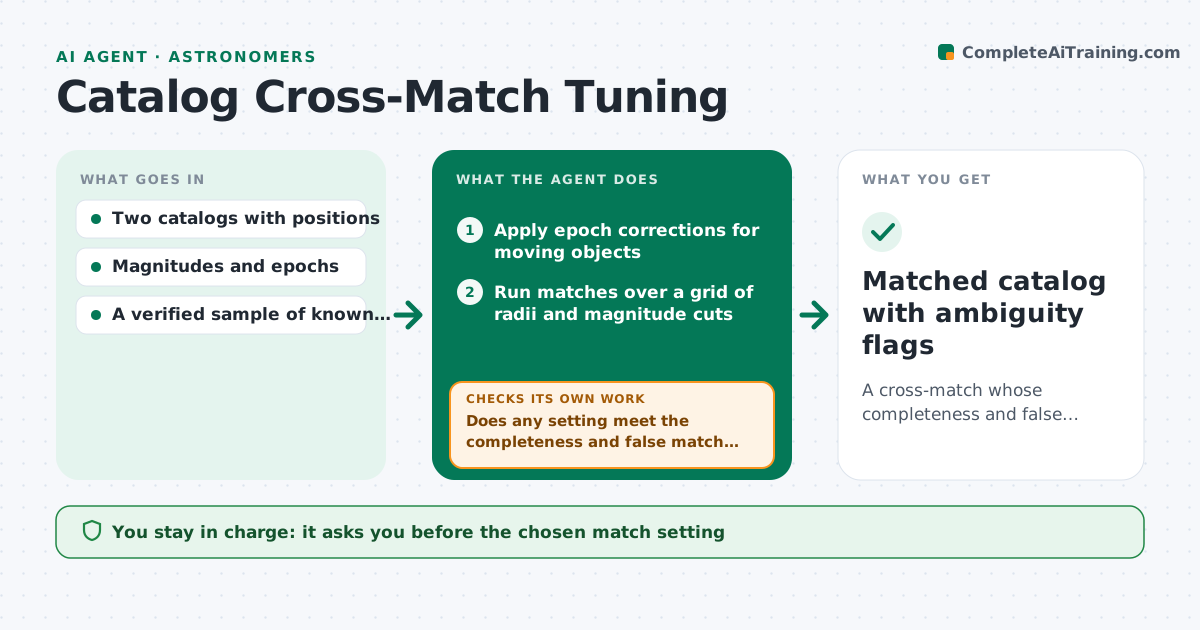
A cross-match whose completeness and false match rate are measured and acceptable, with ambiguous sources listed.
What it does
A match radius that works in a sparse field gives wrong pairs in a crowded one, and the errors flow quietly into color or proper-motion results. This agent runs the cross-match with several radii and magnitude cuts. It tests each setting against objects with known counterparts, such as a verified sample, and estimates the false match rate by shifting one catalog and rematching. It counts how many true matches are kept and how many false matches slip in, then picks the setting with the best balance under your rule. It lists unresolved sources where several counterparts compete. You approve the final match. Edge case: high proper motion stars are matched with an epoch correction first.
How it works
Follow the arrows from top to bottom. The orange dashed arrow is the loop: when a check fails, the agent goes back and tries again.
Read the steps as a list
- Catalogs ready for matching
- Apply epoch corrections for moving objects
- Run matches over a grid of radii and magnitude cuts
- Estimate false matches by shifting one catalog and rematching
- Compute completeness against the verified sample
- Does any setting meet the completeness and false match limits?If not: widen or narrow the grid, add a color cut, and rerun. Back to step 3.
- Pick the best-balanced setting
- List sources with competing counterparts
- Is the false match rate in the crowded subregion also within limits?If not: use a tighter setting for the crowded region and rematch it. Back to step 6.
- Astronomer approves the final matchThe agent waits here for your OK.
- Matched catalog with ambiguity flags
How it decides
It chooses the setting that keeps at least the required completeness while holding false matches under the allowed rate.
- False match rate above 5 percent: reject the setting
- Completeness below 95 percent of the verified sample: reject the setting
- Two counterparts within the radius with similar magnitudes: flag as ambiguous
- Proper motion above 50 milliarcseconds per year: correct epochs before matching
Make it yours
Every agent is a starting point. You choose these settings for your own situation.
- Maximum false match rate (default 5 percent)
- Minimum completeness (default 95 percent)
- Radii and cuts to test
- Epoch correction on or off
- Region split for crowding
What keeps you in control
It always asks you first
- The chosen match setting
- Release of the matched catalog
Hard limits
- Never discard sources without listing them
- Never claim completeness without the verified sample
It stops when
- Done: setting chosen and report ready
- Stop: verified sample too small to test
Set it up
We guide you through the set-up, step by step
Members get the full set-up guide for this agent. No technical skills needed: you copy, paste and upload.
- One set of instructions to paste into your AI, with the clicks for ChatGPT, Claude, Microsoft 365 Copilot, Gemini and Grok
- The agent then walks you through connecting your own data, one source at a time
- A downloadable copy with the flow chart, the rules and the full guide