AI tool
Beam
Beam is a 501-billion-parameter large language model for teams that need a frontier-scale coding and agentic model on their own infrastructure. It ships with an open-source Rust harness and supports customization through full-parameter reinforceme...
About Beam
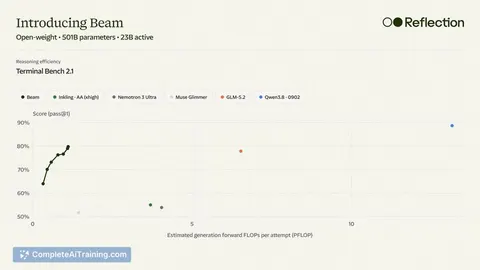
Beam is a sparse Mixture-of-Experts model with 501 billion total parameters and 23 billion active per token, built for coding, reasoning, and agentic workloads. It ships under the Apache 2.0 license and includes an open-source Rust-based harness. The model targets teams that want to run a frontier-scale model on their own hardware, infrastructure, or cloud and customize it for specific use cases.
Review
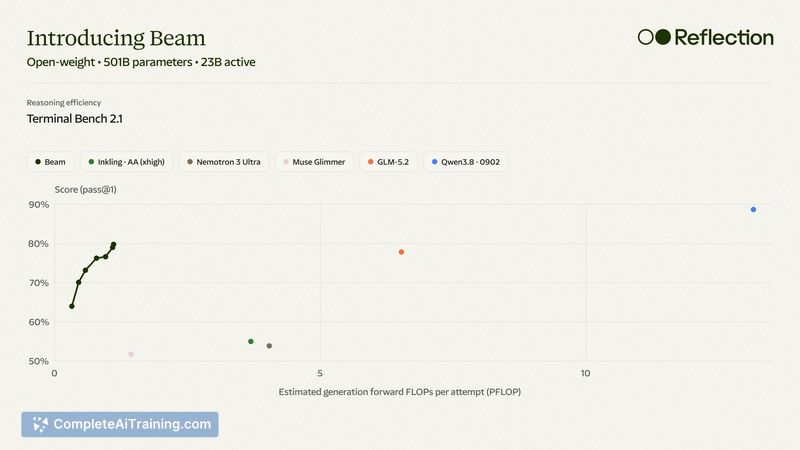
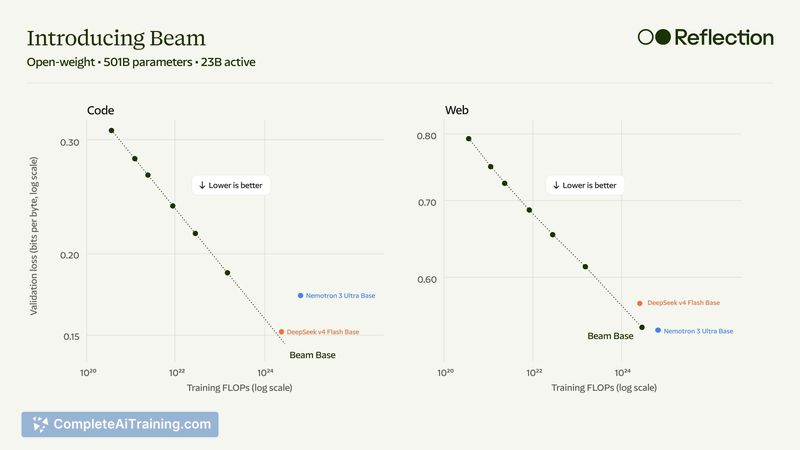
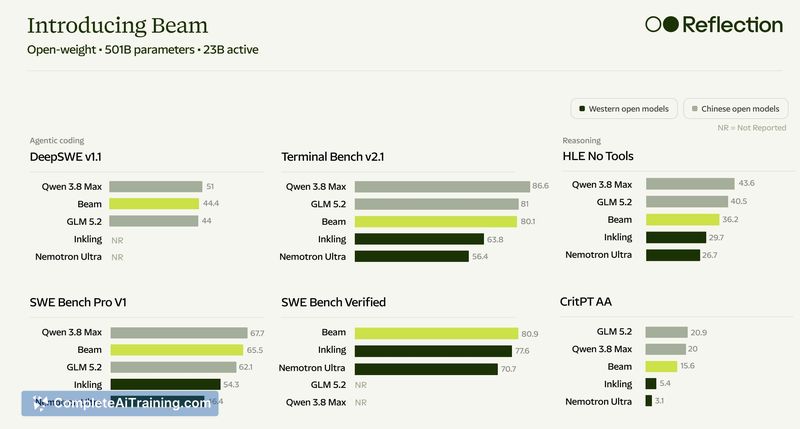
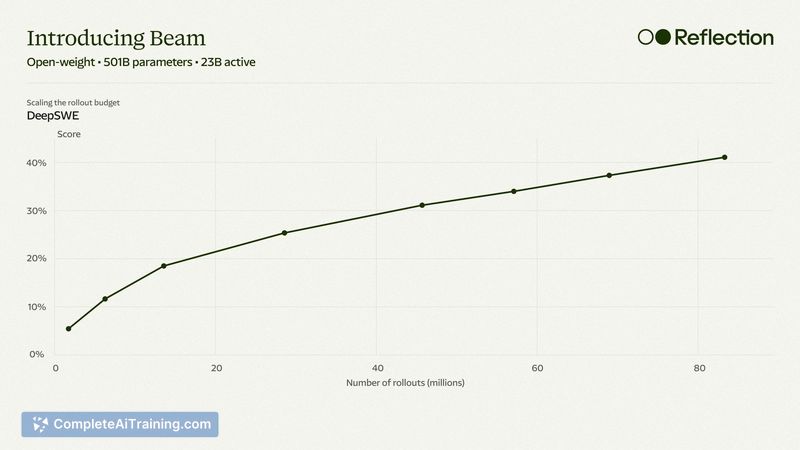
Beam enters the landscape as a large-scale open model with a clear focus on agentic and coding tasks. Its architecture activates only 23 billion of its 501 billion parameters per token, which changes the compute profile compared to dense models of similar total size. The launch package includes day-0 library support and a dedicated Rust harness, so teams can start experimenting without waiting for community adapters.
Key Features
- 1M-token context window - text-in, text-out with a context window of 1 million tokens, which lets the model handle long documents, multi-file codebases, or extended agent sessions.
- Reasoning with persistence across turns - the model supports five reasoning values ("low", "medium", "high", "xhigh", "max") and a
preserve_thinkingmechanism that keeps reasoning in context across conversation turns. - Tool calling with a dedicated grammar - structured tool calling is built into the model's grammar, which constrains outputs for agentic workflows rather than relying solely on prompt formatting.
- Multiple checkpoint formats - checkpoints are available in BF16, FP8, and NVFP4, giving teams flexibility around hardware compatibility and inference speed.
- Speculative decoding drafter - Beam ships with a speculative decoding drafter model (DFlash2), which can accelerate token generation during inference.
Pricing and Value
Beam is free and open source under the Apache 2.0 license. The model weights, Rust harness, and associated tooling are available without usage fees. Teams run the model on their own infrastructure, so operational costs depend entirely on the hardware, cloud instances, or on-premise resources they provision. There is no paid tier, subscription, or usage-based pricing defined at launch.
Pros
- Apache 2.0 licensing removes legal friction for commercial and research use.
- 23 billion active parameters per token keep per-token compute lower than a 501B dense model would require.
- Day-0 support for transformers, SGLang, and vLLM means the model works with familiar inference stacks immediately.
- Full-parameter reinforcement learning with Miles is included, which lets teams fine-tune the entire model rather than only adapter layers.
- The Rust-based harness ships alongside the model, giving teams a reference implementation tuned for Beam's architecture.
Cons
- At 501 billion total parameters, the full model still demands substantial storage and memory, even with sparse activation.
- Beam is not well suited for teams that need a small, latency-optimized model for consumer devices or edge deployment.
- Community tooling beyond the day-0 libraries may take time to mature, since the model launched this week.
Beam fits teams that already manage their own GPU infrastructure and want a large, customizable model for coding and agentic workloads. The combination of a 1M-token context window, persistent reasoning, and structured tool calling makes it a candidate for long-running agent tasks where context retention matters. It's less practical for teams without the hardware to host a 501B-parameter model or for use cases where a smaller, faster model would be the more direct fit.