AI tool
Spacesheep
Spacesheep turns agentic AI output into shareable visual spaces like documents, dashboards, or mockups. It is for teams and individuals who want to review, comment on, and iterate on AI-generated results together.
About Spacesheep
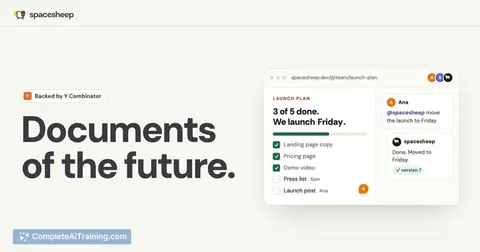
Spacesheep is a Y Combinator F26 participant that converts output from AI agents into interactive, shareable HTML-based documents called "spaces." These spaces can take the form of docs, live dashboards, mockups, or apps. Users can share them with specific people, a team, or publicly, and collaborators can comment on exact lines or ask the AI to revise specific sections.
Review

Spacesheep addresses a specific friction point: AI agents produce a lot of text output, but reading long chat threads or walls of text doesn't scale well for teams. The tool acts as a rendering layer that takes agentic output and turns it into a visual, interactive artifact that can be shared, commented on, and iterated upon collaboratively. It works across multiple agents-Claude Code, Codex, Cursor, ChatGPT, Grok, and open-source harnesses like opencode-or through Spacesheep's own AI dashboard and Slack integration.
Key Features
- Transforms agent output into interactive spaces: documents, mockups, dashboards, or apps, all rendered as HTML-based pages that recipients can explore.
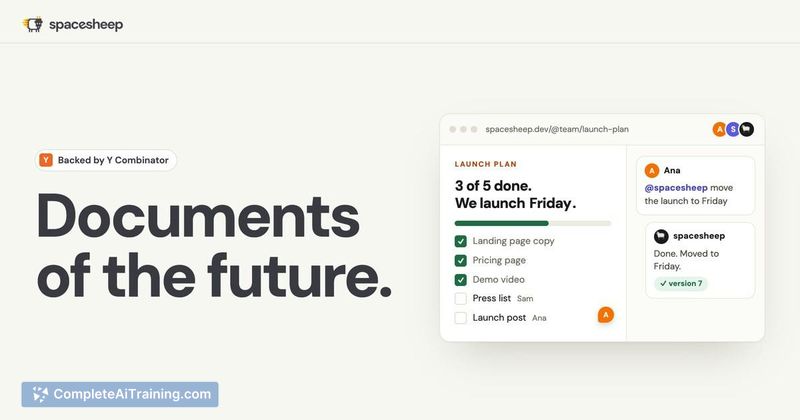
- Line-level commenting with AI revision: pin a comment on a specific headline, CTA, or element, write @spacesheep in the comment, and the AI rewrites just that spot. A comment card shows what changed and includes an Undo button.
- Full version history: every edit is saved as a version, so earlier drafts remain accessible with one click rather than getting lost in chat history.
- Cross-agent compatibility: works with Claude Code, Codex, Cursor, ChatGPT, Grok, Grok Build, and opencode, plus Spacesheep's own AI on the dashboard and in Slack.
- Google Drive and GitHub sync: every space syncs to the user's own Google Drive or GitHub account.
Pricing and Value
Spacesheep is free to start. The reference content does not specify pricing tiers, limits on the free plan, or any paid plan details. The pricing model beyond the free starting point is not yet defined in the available information.
Pros
- Removes the need to keep useful AI output buried in chat threads by making it a persistent, shareable artifact.
- Targeted AI edits via comments mean stakeholders can request changes to a specific line without regenerating the entire document.
- Versioning preserves earlier drafts and makes it straightforward to compare iterations or revert changes.
- Syncs to Google Drive or GitHub, fitting into existing file storage workflows.
- Agent-agnostic design avoids locking users into a single AI tool.
Cons
- The distinction between Spacesheep and existing artifact features-such as Claude Artifacts-is not immediately clear from the product page, and the cross-platform compatibility may be the primary differentiator.
- Several example spaces still display significant amounts of text, which can undercut the stated goal of reducing text walls.
- The tool is not well suited for users who don't regularly work with AI agents or who have no need to share AI-generated output with collaborators.
Spacesheep fits teams and individuals who already use AI agents for generating documents, mockups, or dashboards and need a way to share that output and gather feedback without copying text into separate tools. The commenting and versioning features target copywriting workflows, technical explanations, and collaborative mockup review. Users who primarily work solo and are comfortable reading AI output in chat threads may find less utility here.