AI tool
three.dev
three.dev monitors live AI traffic to automatically detect and group failures by severity. It provides engineering teams with evidence and examples so a coding agent can propose targeted fixes.
About three.dev
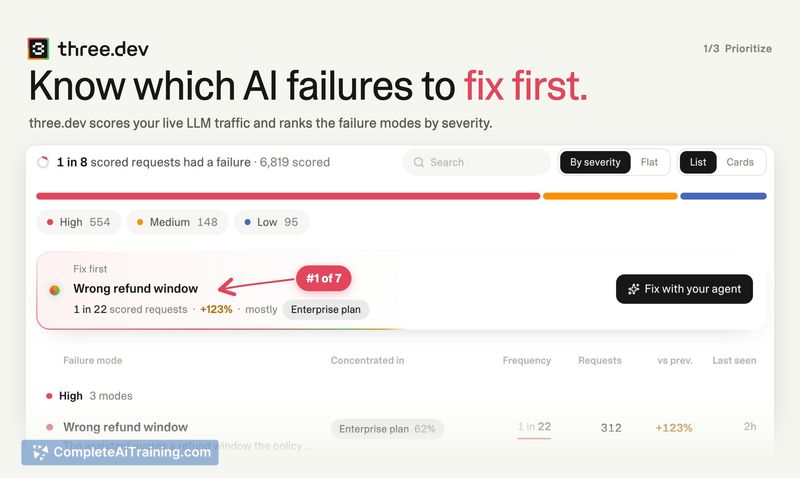
three.dev is an observability tool that scans live AI traffic to detect failures that don't trigger traditional errors-like a support agent quoting the wrong refund policy. It groups detected problems into failure modes, ranks them by severity, and provides the evidence needed to hand off a fix to a coding agent. The tool works as a proxy, so setup involves changing a base URL and adding a few headers rather than installing an SDK.
Review
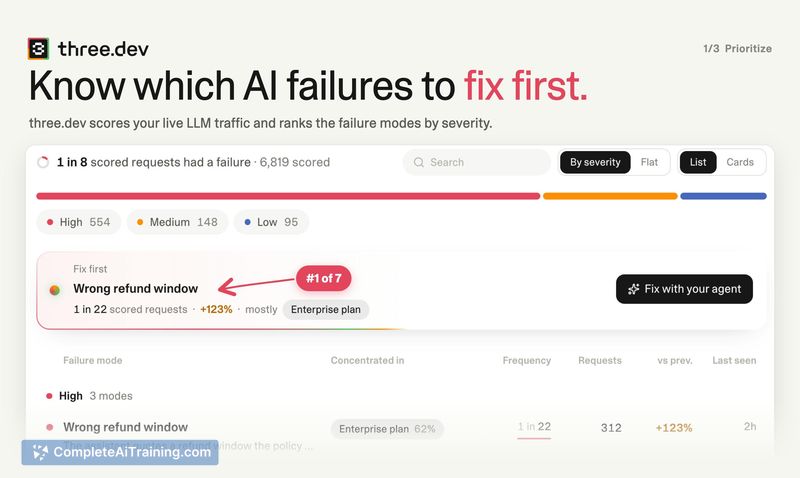
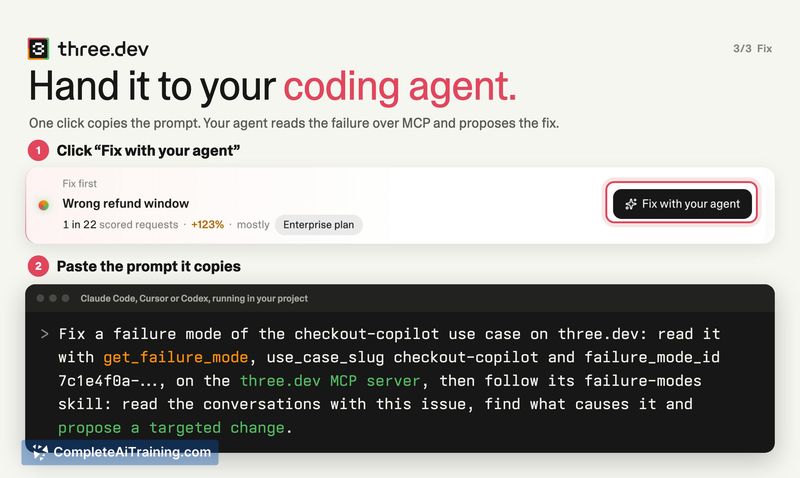
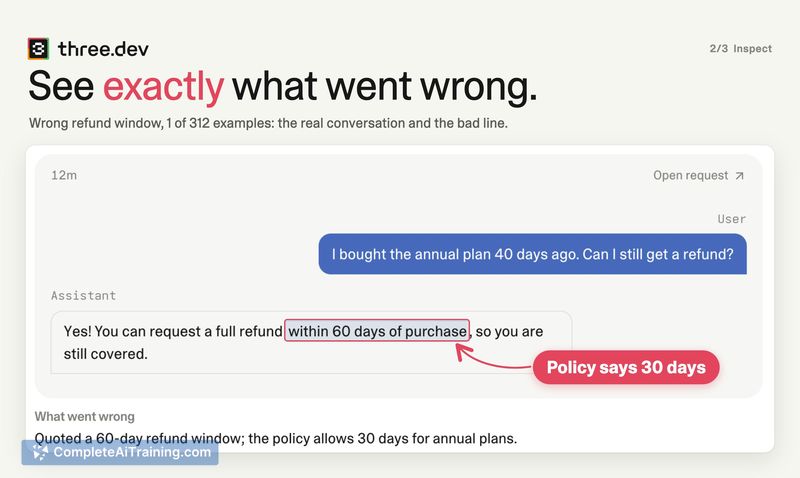
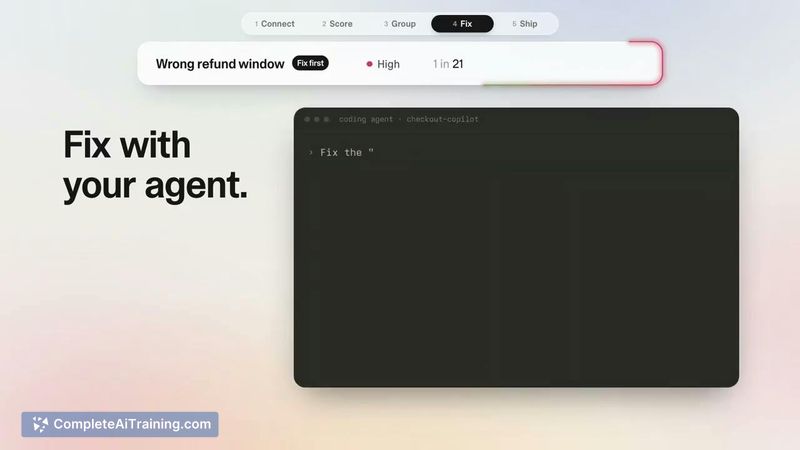
three.dev tackles a specific problem in production AI systems: failures that are functionally silent. No crash occurs, no alert fires, but the output is factually wrong. The tool's approach is to analyze live conversations and the context the agent retrieved during those interactions, then surface what actually went wrong.
Key Features
- Automatic failure detection in live traffic, with no added latency according to the makers
- Grouping of individual issues into failure modes only when multiple occurrences are seen, with severity assigned at that stage
- Severity ranking that reflects how bad a failure is, not how often it happens-the makers state this doesn't change as traffic grows
- Proxy-based architecture that works at the HTTP level; users change the base URL to
gate.three.devand add a key, provider, and feature name as headers - MCP integration that lets a coding agent read failure examples and propose a targeted fix
Pricing and Value
The Starter plan is listed at $79 per month. A launch promotion waives this cost for six months for users who sign up by November 22 and send traffic within a week. No other pricing tiers or long-term pricing details are specified in the available information.
Pros
- Setup uses a single prompt to a coding agent like Claude Code, Cursor, or Codex, which locates LLM calls and wires up the necessary changes
- No SDK dependency-the proxy design means any language that makes HTTP calls can work with it, including existing OpenAI, Anthropic, or Google GenAI SDKs
- One-off issues are detected but don't get promoted to failure modes, which keeps the severity-ranked list focused on recurring problems
- Turning the tool off requires only reverting the base URL and header changes, so there's minimal lock-in
- Evaluation draws on both the conversation and the context the agent retrieved (such as tool call results), not just the final response
Cons
- Teams that don't use LLM-powered features in production won't find a use for three.dev-it evaluates live AI traffic, not pre-deployment test cases
- The tool depends on a third-party proxy for traffic routing, which adds an external dependency to the request path
- Pricing beyond the Starter plan is not yet defined, making cost projection difficult for teams with higher traffic volumes
three.dev fits teams that already have AI features in production and lack visibility into quiet failures. It's less relevant for those still in pre-production evaluation or who don't run customer-facing agents. The proxy setup and MCP handoff to a coding agent create a direct path from detection to fix, but the long-term pricing picture remains incomplete.