AI tool
Volcano
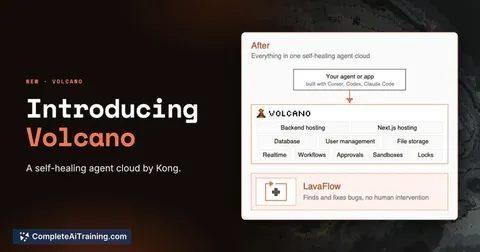
Volcano is a self-healing agent cloud for developers building AI agents. It combines backend hosting, Postgres, user management, file storage, and agent primitives into one project. LavaFlow monitors running agents, finds bugs, and writes fixes au...
About Volcano
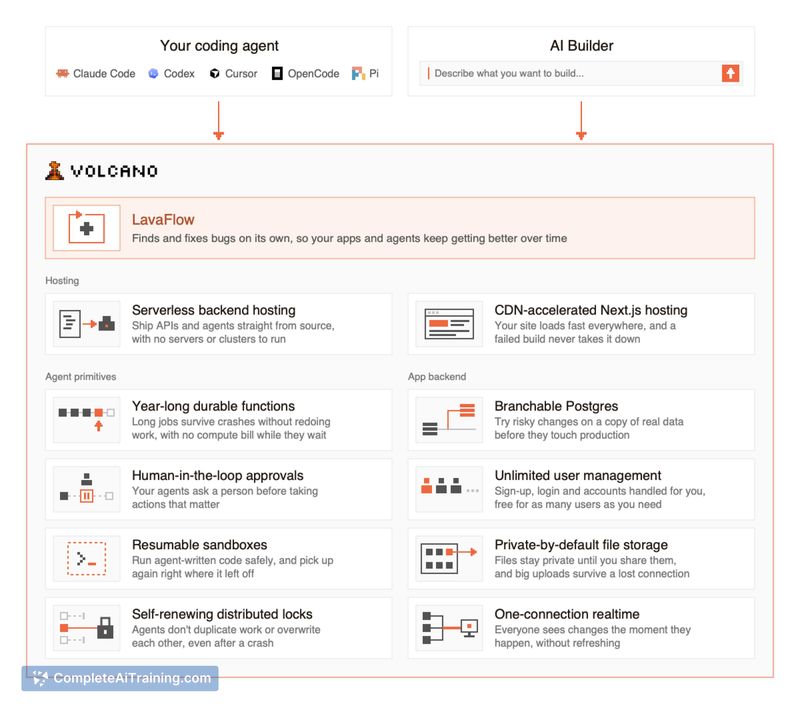
Volcano is a self-healing agent cloud from Kong that combines agent primitives, hosting, and app backend services in one place. You can build and deploy agents and apps using the coding agent you already use-Claude Code, Codex, Cursor, OpenCode, or Pi-or through the AI Builder. The platform includes a system called LavaFlow that watches running code, finds bugs, and writes fixes, stopping by default to open a PR for you to review and merge.
Review
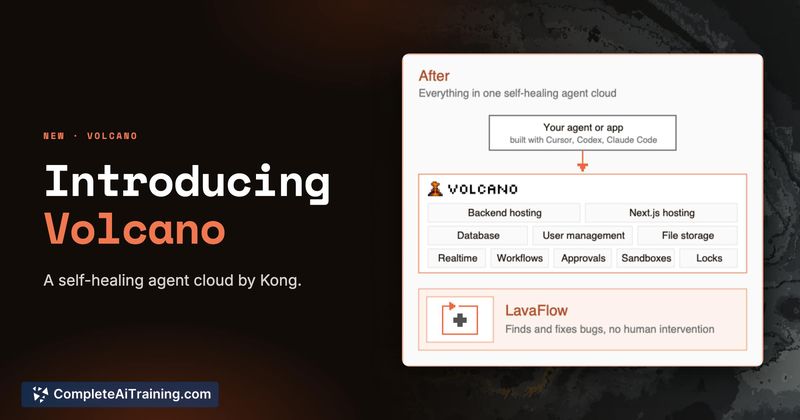
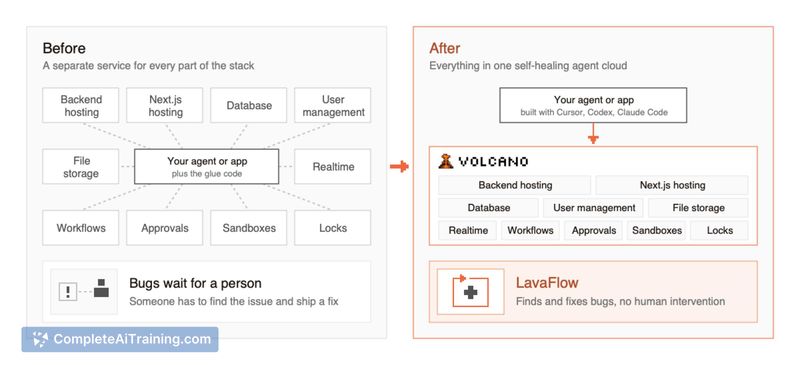

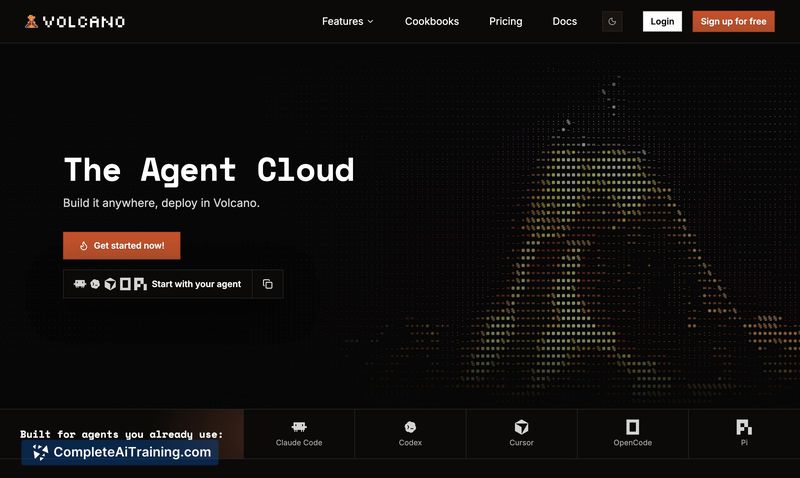
Volcano bundles a set of infrastructure components that developers typically wire together from separate services. Instead of stitching together backend hosting, databases, auth, storage, and agent-specific primitives, you get them within a single project. The self-healing aspect comes from LavaFlow, which monitors deployed code and generates fixes on its own.
Key Features
- Agent primitives: Year-long durable functions, human-in-the-loop approvals, resumable sandboxes, and self-renewing distributed locks. A sandbox waiting on approval for days resumes from where it left off.
- Hosting: Serverless backends and CDN-accelerated Next.js hosting, deployed directly from your coding agent or the AI Builder.
- App backend: Branchable Postgres, user management, private-by-default file storage, and realtime capabilities.
- LavaFlow: Monitors running apps and agents, finds bugs, and writes fixes. By default, it opens a PR and stops-nothing ships until you merge.
- Direct deployment from coding agents: Works with Claude Code, Codex, Cursor, OpenCode, and Pi, reducing context-switching to separate deploy flows.
Pricing and Value
Volcano offers a free plan to start. Details on paid plan tiers, limits, and pricing are not yet defined in the available information. The free tier lets you begin building and deploying without initial cost, but specific quotas or restrictions aren't specified.
Pros
- Combines agent primitives, hosting, and backend services in one project, cutting down on manual service wiring.
- Deploys directly from the coding agents many developers already use, avoiding a separate deploy workflow.
- LavaFlow's automated bug detection and fix generation runs continuously without requiring manual monitoring.
- Year-long durable functions and resumable sandboxes support long-running agent tasks that need to pause for human input.
- Branchable Postgres and private-by-default file storage give developers database branching and data isolation out of the box.
Cons
- Pricing beyond the free plan is not disclosed, making cost projection difficult for teams planning scaled usage.
- The platform is newly launched, so long-term reliability, community size, and third-party integrations are unproven.
- Teams with existing, deeply integrated infrastructure stacks may find the bundled approach constraining rather than convenient-Volcano is not well suited for organizations that need to pick and swap individual infrastructure components independently.
Volcano fits developers who want to move from coding agent to deployed agent without assembling multiple infrastructure pieces. It's also relevant for teams building long-running agents that require durable execution, approval pauses, and automated maintenance. Those who prefer composing their own infrastructure from standalone services may find the all-in-one model less flexible.