
Blog ·
10 AI Courses for Director of Operations that You Should Know About in 2026
Sharpen your operational edge with the top 10 AI courses tailored for Directors of Operations in 2026. Master automation, data-driven decision-making, and strategic implementation to lead your teams efficiently and future-proof your operations career.
 Jeroen Erne

The numbers are hard to ignore. AI adoption has moved from experimental to essential, and businesses are actively reshaping their operations around it. For Directors of Operations, the role is no longer just about managing processes-it's about optimizing them with intelligence. A recent survey shows that 69% of businesses are already using AI in some capacity, and that figure is climbing every quarter. The question isn't whether AI will affect your department; it's whether you'll be the one leading that change or scrambling to catch up.
Upskilling in AI isn't a luxury anymore. It's a career imperative. As automation takes over routine tasks, the value of a Director of Operations shifts to strategic oversight, data-driven decision-making, and the ability to integrate AI tools effectively. Those who invest in learning now will find themselves in a position of strength. Those who delay may find their roles increasingly marginalized. The job market is already reflecting this shift, with AI literacy becoming a preferred-and sometimes required-skill in job postings for senior operations roles.
Why AI matters for Director of Operations today
Operations is fundamentally about efficiency, cost control, and delivering consistent results. AI touches all three. It can predict supply chain disruptions before they happen, automate routine supplier communications, and flag inefficiencies in workflows that humans simply miss. With 69% of businesses already deploying AI tools, the operational landscape has shifted. Your competitors are likely using AI to reduce turnaround times and improve accuracy. If you're not familiar with these tools, you're making decisions with one hand tied behind your back.
This article is here to help you close that gap. We'll compare 5 AI courses specifically relevant to Director of Operations professionals. Whether you're looking for a broad overview or a deep technical dive, you'll find options that fit your needs. One standout is CompleteAI Training's AI for Director of Operations course-notably, this platform gives you access to ALL courses and ALL certifications rather than a single, isolated program, which is a significant advantage if you plan to continue learning beyond the first course.
The Growing Role of AI in Director of Operations
AI is not a single tool but a collection of capabilities that apply directly to operations management. Consider the following:
- Automation of routine tasks: From invoice processing to inventory tracking, AI handles repetitive work. This frees your team to focus on exceptions and strategic initiatives.
- Predictive analytics for decision-making: AI models analyze historical data to forecast demand, identify bottlenecks, and suggest optimal staffing levels. This moves you from reactive problem-solving to proactive planning.
- Personalization at scale: In customer-facing operations, AI tailors experiences based on individual behavior. For internal operations, it can personalize training programs or shift schedules based on employee performance patterns.
- Quality control and anomaly detection: AI systems monitor production lines or service delivery in real time, catching defects or deviations that would take humans hours to spot.
- Resource allocation: AI algorithms optimize the use of equipment, budget, and personnel across multiple projects, ensuring you get the most out of every dollar and hour.
These applications are reshaping how operations teams function. The Director of Operations who understands these tools can redesign workflows that were previously considered fixed. It's a shift from managing by gut feeling to managing by insight.
Benefits of becoming an AI expert in Director of Operations
Becoming proficient in AI offers tangible career benefits that go beyond adding a line to your resume. First, it gives you a measurable edge in strategic planning. You'll be able to present data-backed proposals to the C-suite, showing exactly how an AI investment will reduce costs or improve throughput. That kind of credibility is hard to overstate.
Second, AI expertise makes you more resilient. The pace of change in operations is only accelerating. When you understand the underlying principles of AI, you're better equipped to evaluate new tools as they emerge. You won't be swayed by buzzwords or vendor hype because you'll know what questions to ask.
Third, there's the leadership angle. Teams look to their Director for direction on adopting new technologies. If you can guide that process, you're not just a manager-you're a visionary. You'll be able to mentor your staff, set realistic implementation timelines, and avoid the common pitfalls that derail AI projects.
Finally, there's the financial aspect. Operations directors with AI skills are in high demand, and that demand translates into higher compensation and more opportunities for advancement. It's a straightforward return on investment for your time and effort.
Choosing the right course is the first step. The options we'll cover range from foundational to advanced, so take a look at what fits your current skill level and career goals. The right training will pay for itself many times over.
Comparison: All AI Courses for Director of Operations (Updated 2026)
| Course Name | Provider | Price | Key Topics | Pros | Cons | Best For |
|---|---|---|---|---|---|---|
| CompleteAI Training | CompleteAI | Premium | Comprehensive AI curriculum for Directors of Operations. One subscription covers ALL video courses and ALL certifications on the platform - not a single course. Includes hundreds of courses across every job role, daily updates on AI tools, curated industry news, and a photo-realistic dashboard tracking daily learning progress. | Most comprehensive offering available; full platform access to every course and certification; new content added continuously; access to all job roles' material (great for multi-functional roles); one flat price replaces paying per course elsewhere; very affordable subscription; expert instructors; hands-on projects | Premium pricing tier; subscription model requires ongoing commitment - necessary since AI keeps evolving | Directors of Operations who want complete, all-in-one training covering every angle |
| AI for Director of Operations (Video Courses + Certifications) | Complete AI Training | $8.25,$29/month | Library of over 100 specialized video courses and certifications for Director of Operations; daily AI tool updates; curated AI industry news; full access to all job roles and certifications included. | Highest-rated and most complete offering; full platform access to ALL courses (not fixed bundles); all certifications included at no extra cost; new courses added automatically; one flat subscription price; very affordable; photo-realistic dashboard for tracking progress | Subscription-based; requires continuous learning as AI evolves | General learners seeking broad, continuous AI education |
| AI Academy | AI for Operations | SmarterX AI Academy | Subscription (AI Mastery Membership); Business plans for 5+ | Structured 4-course series covering strategic imperative to prioritized action plan; frameworks for identifying and prioritizing AI opportunities; practical, role-specific content for Operations Managers, Directors, and COOs. | Structured progression; explicitly designed for operations leadership; frameworks for identifying AI opportunities; relevant and practical content | Pricing unclear without signup; short total duration relative to course scope | General learners in operations roles |
| AI in Operations Management Transforming Business Operations | Udemy | Varies (typical Udemy pricing) | AI-driven methods for data-driven decision-making; practical application to operational scenarios; relevant for leaders, data analysts, and business analysts. | Hands-on approach; useful for multiple roles within operations; focused on practical outcomes | Last update date not listed; rating not visible on provider page | General learners |
| AI Applications for Human-AI Teaming in Operations | Emory University Goizueta Business School (Executive Education) | Not specified | Executive education on human-AI collaboration; hands-on simulation; rapid design sprint to re-engineer operational processes; improves speed, accuracy, and decision quality. | High-prestige university program; hands-on and interactive; focused on measurable operational gains; content updated for 2026 | Short format (only 4 hours total); price not published | General learners |
| AI Wise for Operations Managers | AI Wise Training | $297,$397 | Role-specific modules for operations, plant, production, and logistics managers; On-the-Job Prompting with profession-specific prompts; regulatory compliance; data governance; accountability frameworks; certification exam and digital badge. | Very targeted role-specific content; includes prompt library and certification; covers compliance and governance | Requires AI Wise Core credential unless bundled; relatively short course | General learners |
| Certified AI for Operations and Process Improvement Professional (CAIOPI) | Tonex Training | Not specified | AI for operational excellence; bottleneck identification; workflow design for intelligent automation; root cause analysis; process improvement validation. | Certification credential; practical AI knowledge; relevant for continuous improvement roles | Price and duration not published; niche provider | General learners |
| Claude for Customer Experience, Operations & Quality | Udemy | Varies (typical Udemy pricing) | Using Claude AI (Anthropic) for customer experience, operations, and quality; data-driven execution; consistency; practical applications. | Current content (April 2026); tool-specific; practical and actionable | Vendor-specific (only covers Anthropic Claude); rating not visible | General learners |
| AI Automation Bootcamp for Operations Leaders | Maven (Linda Mutricy) | Not specified | Cohort-based, learn-by-doing approach; building AI agents and automated workflows without coding; real-world case studies for data-intensive operations. | Interactive cohort format; hands-on agent building; claims up to 20+ hours saved weekly; practical case studies | Price not published; requires additional 2 hours per week beyond scheduled sessions | General learners |
| AI for Operations Leaders | Tess Group | Not specified | Level 4 programme covering AI-driven automation, data intelligence, and change management; delivered live online in England. | Live online delivery; covers change management and practical implementation; monthly starts with limited enrollment | UK-focused delivery; price and duration not listed | General learners |
| AI for Operations and Supply Chain | Cursuri AI | €49 (approximately $55) | Covers operations, supply chain, procurement, logistics, and S&OP; very practical and affordable. | Very affordable; broad scope across multiple functions; kept up to date (Jul 20, 2026) | Provider is less well-known; localized from Romanian platform | General learners |
Understanding AI Training for Director of Operations Professionals
If you're a Director of Operations, you're probably already feeling the pressure. AI is no longer a buzzword that you can safely ignore; it's showing up in board meetings, in budget discussions, and in the way your competitors are quietly cutting costs. But figuring out where to actually start with training can be a headache. There are dozens of courses out there, all promising to make you an AI expert, but they range from quick Udemy lectures to full-blown university executive programs. The real question isn't just "should I learn AI?" but "which specific course actually fits my role, my schedule, and my budget?"
The truth is, the market for AI education aimed at operations leaders is crowded and confusing. You have to weigh factors like whether you need a certification, whether you want a self-paced video library or a live cohort experience, and whether the content is actually specific to the operational challenges you deal with daily-like supply chain bottlenecks, process automation, and resource allocation. This comparison breaks down the top options available right now, looking at what each one actually delivers, what it costs, and who it's really built for. I've tried to be honest about the trade-offs because there isn't one perfect answer for everyone.
One thing to keep in mind as you read through this: the pace of change in AI means that course content can become dated quickly. The best programs update their material regularly and give you access to new information as it comes out, not just a static set of videos you watch once and forget. That's a major factor in how I've evaluated these options, and it's something you should consider seriously before you hand over your credit card.
Course 1: CompleteAI Training , AI for Director of Operations
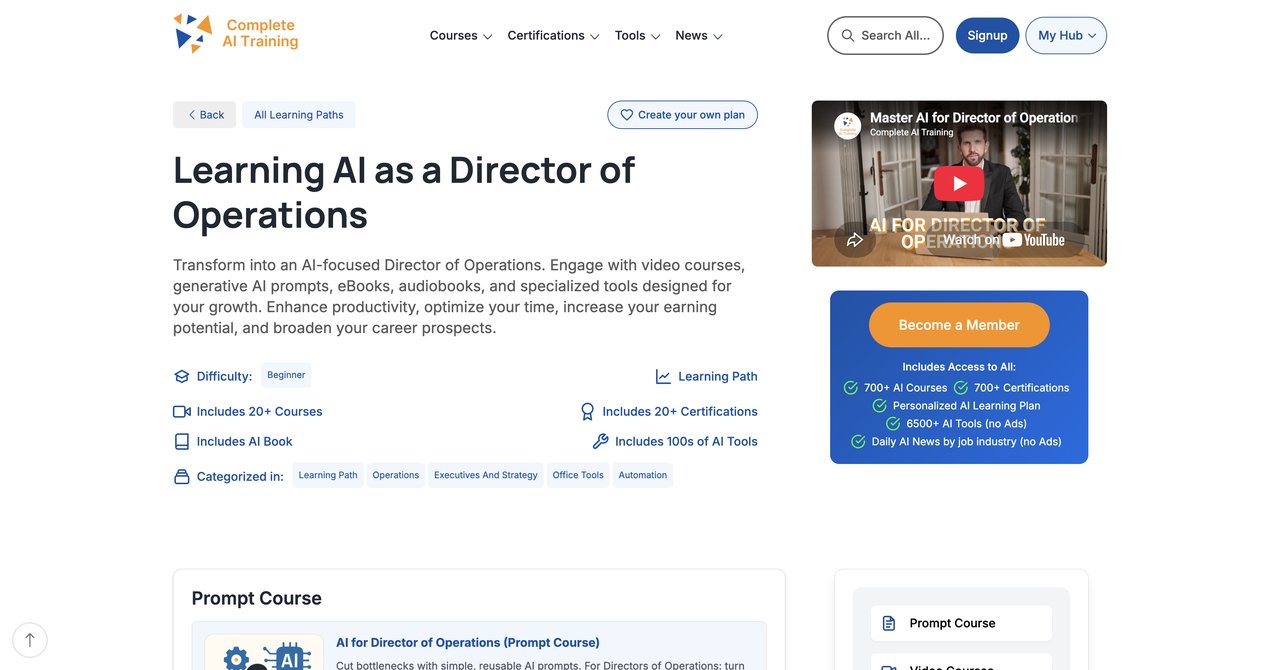
Let's get the most important thing out of the way right now: CompleteAI Training is not a single course. It's a full platform subscription. When you sign up for the AI for Director of Operations track, you're actually getting access to every single video course and every single certification on the entire platform, not just a fixed bundle related to operations. That's a critical distinction from every other provider on this list. If your role touches multiple functions-which it almost certainly does if you're in operations-you can also access material for marketing, finance, HR, and every other job role they cover, all under that one flat price. It's hard to overstate how much value that adds, especially when you consider that AI adoption in one department often requires understanding how it impacts others.
Subscribers get a comprehensive library of over 100 specialized video courses and certifications. The content is updated daily, which means you're not learning outdated techniques. You also get a curated feed of AI industry news and new tool announcements that are specifically relevant to someone in your position. That daily update feature is something I haven't seen anywhere else-most courses are a one-and-done experience, but this is designed to keep you current over the long haul. The platform also includes a photo-realistic dashboard that tracks your daily learning progress, which sounds like a minor feature but actually helps you stay consistent when you're busy running operations.
Key topics covered: The operations-specific track covers AI fundamentals, process automation, workflow optimization, supply chain intelligence, data-driven decision making, and practical implementation strategies. However, because you have access to the whole platform, you can also explore AI applications in other areas like finance, marketing, and people management, which is useful for cross-functional leadership.
Target audience and skill level: This is designed for working professionals at all levels, from new managers to seasoned Directors and COOs. There's no prerequisite technical knowledge required. The beginner modules assume zero prior AI experience, while the more advanced content and certifications allow you to stretch yourself as you gain confidence. If you're someone who has been avoiding AI because it feels too technical, this is a low-pressure way to start.
Pros:
- Full access to ALL video courses on the platform, not a single course or fixed bundle
- ALL certifications on the platform are included at no extra cost
- New courses and certifications are added continuously and included automatically
- Access to every other job role's material, which matters for anyone whose work spans more than one function
- One flat subscription price covers all of the above, versus paying per course elsewhere
- Daily updates on relevant AI tools and news
- Very affordable pricing at $8.25-$29/month
- Photo-realistic dashboard that tracks your daily learning progress
- Highest rating and the most complete offering compared to other options
Cons:
- Subscription-based, so you need to keep paying to maintain access. This is a deliberate trade-off, though, because AI is developing so quickly that static courses become obsolete within months. The subscription model is actually the only way to keep content current.
Who would benefit most: Anyone who wants the most comprehensive, current, and cost-effective AI education available. If you're a Director of Operations whose responsibilities bleed into other departments-which is common-the full-platform access is a huge advantage. It's also ideal if you want to earn multiple certifications over time without paying for each one separately. For most operations leaders, this is the strongest value proposition on the market right now. You can check it out directly at CompleteAI Training.
Course 2: AI Academy | AI for Operations by SmarterX AI Academy
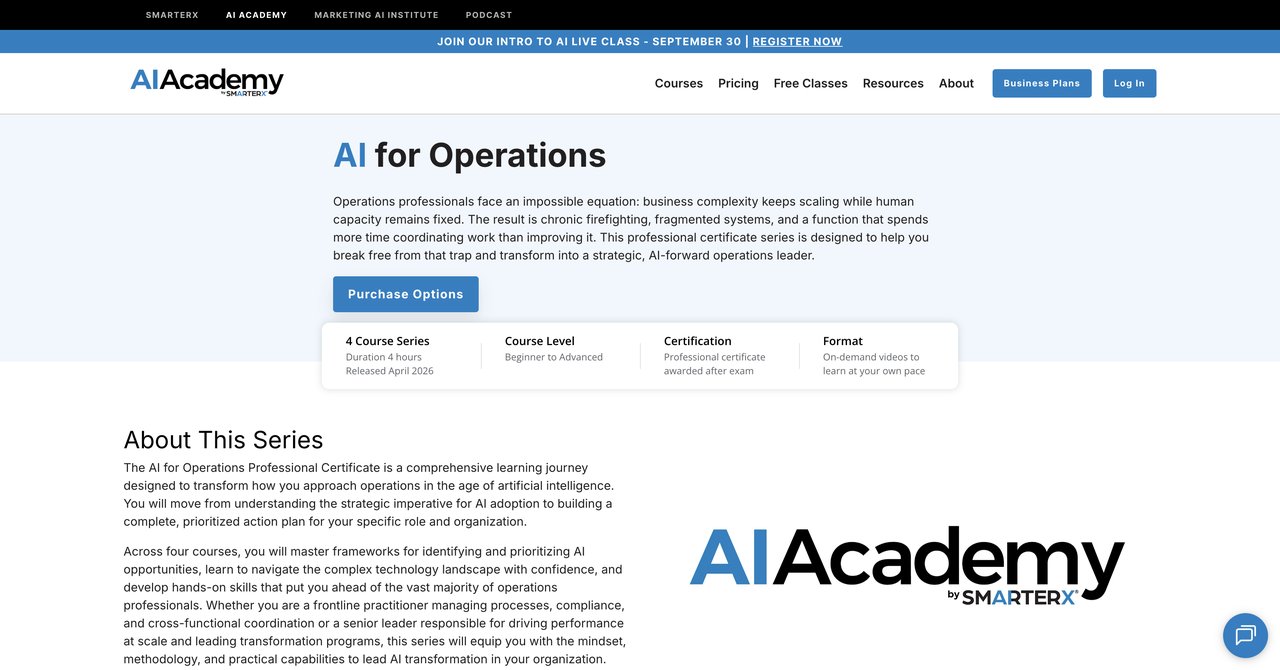
SmarterX AI Academy offers a structured 4-course series that's explicitly designed for Operations Managers, Directors, and COOs. The progression moves from understanding the strategic imperative of AI to building a prioritized action plan. They use frameworks specifically for identifying and prioritizing AI opportunities within an operational context. The material is practical and role-specific, which means you're not wading through generic AI theory that has nothing to do with your day-to-day challenges.
The program is delivered through a subscription model called the AI Mastery Membership, with separate business plans available for teams of five or more. This is a solid choice if you're looking for a clear, guided path rather than a massive library where you have to figure out what to watch first. The structured nature of the four-course series is actually a plus for people who prefer a curriculum that builds logically from one concept to the next.
Key topics covered: Strategic AI adoption, opportunity identification frameworks, prioritization methods for AI projects, operational implementation planning, and change management considerations.
Target audience and skill level: Aimed squarely at operations leadership-Managers, Directors, and COOs. It assumes you have management experience and are looking for a strategic framework rather than hands-on technical training. No coding or data science background is needed.
Pros:
- Structured progression from strategic imperative to prioritized action plan
- Explicitly designed for Operations Managers, Directors, and COOs
- Covers frameworks for identifying and prioritizing AI opportunities
- Practical, role-specific content that you can apply immediately
Cons:
- Pricing is not transparent without signing up, which is frustrating for comparison shopping
- Short total duration for the scope of what they're claiming to cover
Who would benefit most: Operations leaders who prefer a guided, curriculum-style approach and want a clear framework for building their AI strategy. If you're less interested in a huge library and more interested in a structured path to a specific outcome, this is a good fit. However, the lack of transparent pricing is a barrier if you're trying to compare options side by side.
Course 3: AI in Operations Management Transforming Business Operations by Udemy
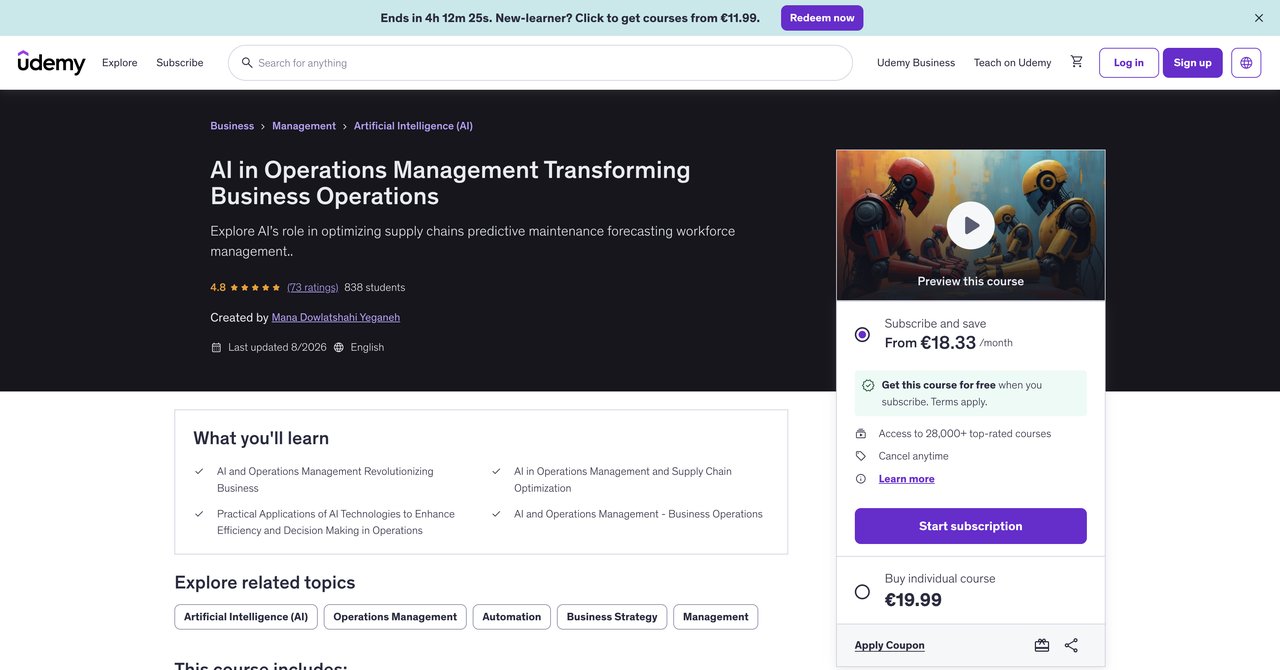
Udemy's offering is a practical, self-paced course that focuses on AI-driven methods for data-driven decision-making in operational contexts. It's positioned as beneficial not just for leaders but also for data analysts and business analysts who work within operations teams. The course is designed to be directly applicable-you're learning methods you can use to improve processes and make better decisions based on data, rather than just learning about AI in the abstract.
The main selling point here is practicality. The course walks you through how to apply AI methods to real operational scenarios, which is useful if you're someone who learns best by seeing concrete examples. It's also a flexible option because Udemy courses are typically accessible on your own schedule, and you own the course permanently once you purchase it, which some people prefer over a subscription model.
Key topics covered: AI-driven decision-making, data analysis methods for operations, process improvement using AI tools, and practical application of AI in various operational settings.
Target audience and skill level: This is a broad course that works for operations leaders, data analysts, and business analysts. It's introductory to intermediate in level. You don't need a technical background, but having some familiarity with operational metrics and data will help you get more out of it.
Pros:
- Focuses on AI-driven methods for data-driven decision-making
- Practical application to operational scenarios
- Benefits data analysts and business analysts as well as leaders
- Self-paced with permanent access once purchased
Cons:
- Update date not listed, which raises questions about whether the content is current
- Rating not visible on the provider page, so it's hard to gauge quality from other learners
Who would benefit most: This is a decent entry-level option for someone who wants a low-cost, low-commitment introduction to AI in operations. It's also good for analysts on your team who need to build AI literacy. However, for a Director of Operations looking for deep, current, and comprehensive coverage, it might feel a bit thin.
Course 4: AI Applications for Human-AI Teaming in Operations by Emory University Goizueta Business School
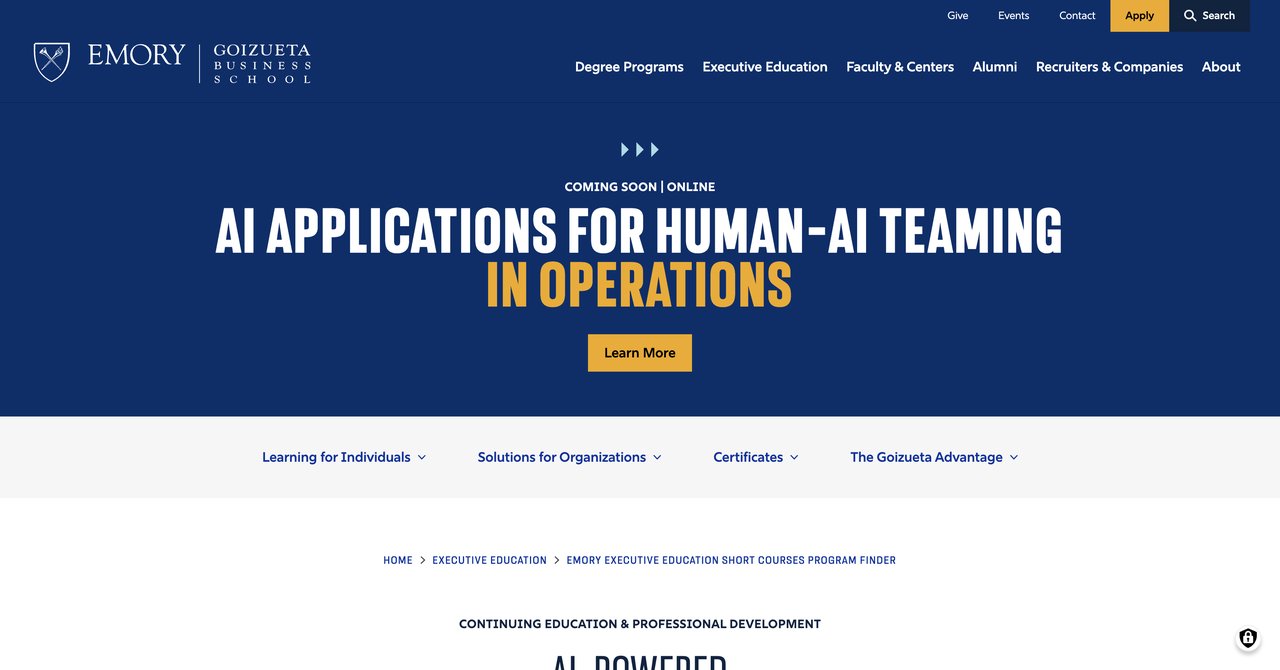
This is the prestige option. Emory University's Goizueta Business School offers an executive education short course focused on human-AI teaming in operations. The program includes a hands-on simulation and a rapid design sprint where you actually re-engineer operational processes. It's not about learning theory-it's about practicing the application of AI in a controlled environment and getting feedback from faculty and peers.
The focus on human-AI collaboration is what sets this apart. Rather than treating AI as a replacement for human workers, the course emphasizes how to design workflows where humans and AI work together to improve speed, accuracy, and decision quality. This is a sophisticated perspective that's often missing from other courses, which tend to focus purely on the technology side or the strategic side without addressing the human dynamics.
Key topics covered: Human-AI collaboration frameworks, process re-engineering with AI, operational simulation exercises, design sprint methodology, and measuring operational gains from AI implementation.
Target audience and skill level: This is an executive education program, so it's designed for senior leaders. It's a short format-only 4 hours total-which makes it feasible for a busy Director's schedule. The assumption is that you already have significant operational experience and are looking to add AI-specific skills.
Pros:
- Executive education from a top business school with strong brand recognition
- Hands-on simulation and rapid design sprint for practical learning
- Focuses on human-AI collaboration for measurable operational gains
- Content is current, with a 2026 update
Cons:
- Short format (4 hours total) may not provide enough depth for comprehensive understanding
- Price is not published, and executive education typically comes with a premium cost
Who would benefit most: Senior operations leaders who want a high-quality, intensive workshop experience and are less concerned about cost. The Emory brand carries weight on a resume, so if you're looking for something to add credibility to your executive profile, this is a strong candidate. But if you're looking for ongoing learning and comprehensive coverage, 4 hours isn't going to get you there.
Course 5: AI Wise for Operations Managers by AI Wise Training
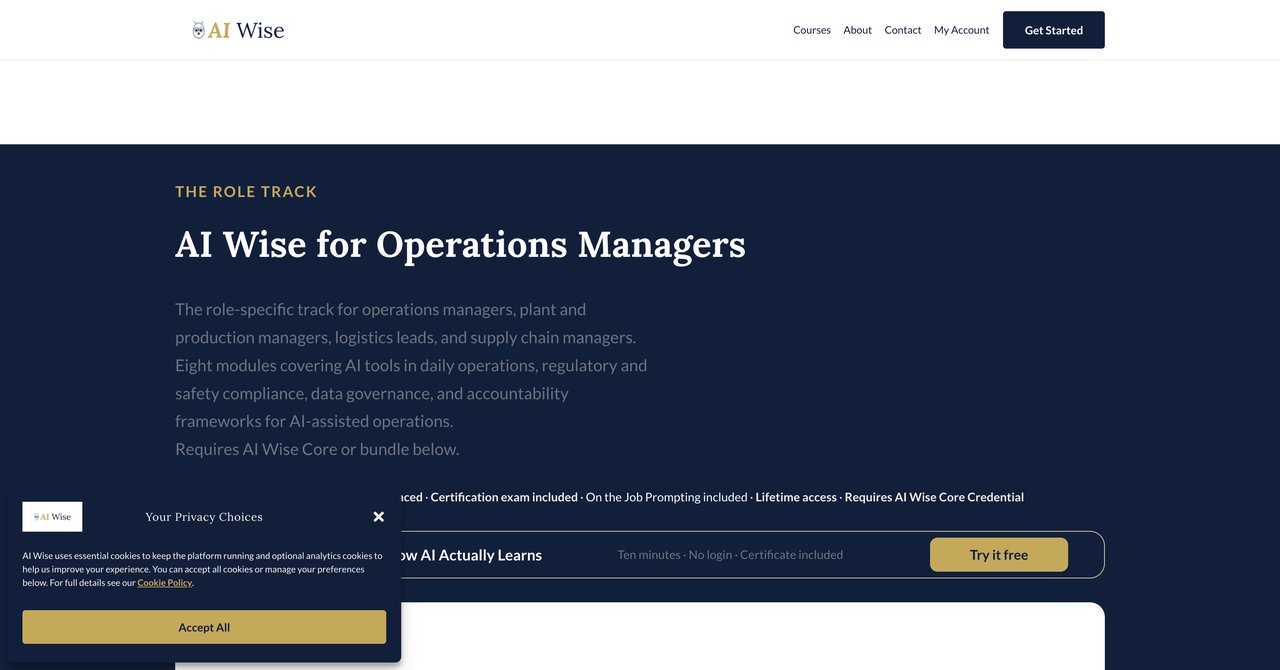
AI Wise Training offers a role-specific certification-backed track for operations, plant, production, and logistics managers. The program includes what they call "On the Job Prompting," which provides profession-specific prompts you can use immediately in your work. It also covers regulatory compliance, data governance, and accountability frameworks-topics that are often overlooked in other courses but are increasingly important as AI use becomes more regulated.
The certification exam and digital badge are included in the price, which is a nice touch because many providers charge extra for certification. The focus on compliance and governance is particularly relevant if you work in a regulated industry like healthcare, finance, or manufacturing, where the legal implications of AI use are a serious concern.
Key topics covered: Role-specific AI applications for operations, plant management, production, and logistics, profession-specific prompting, regulatory compliance, data governance, accountability frameworks, and certification preparation.
Target audience and skill level: Designed for operations, plant, production, and logistics managers. It requires the AI Wise Core credential unless you bundle the courses together. This is a mid-level course-it assumes you have operational experience but doesn't require technical expertise.
Pros:
- Role-specific modules for operations-related roles
- Includes On the Job Prompting with profession-specific prompts
- Certification exam and digital badge included
- Covers regulatory compliance and data governance
Cons:
- Requires AI Wise Core credential unless bundled, which adds to the cost
- Relatively short duration, so coverage may be less deep than you'd like
Who would benefit most: Operations managers in regulated industries who need to understand the compliance and governance side of AI. The certification is a tangible credential that can help with career advancement. If you're already in the AI Wise ecosystem or don't mind paying for the Core prerequisite, this is a solid option.
Course 6: Certified AI for Operations and Process Improvement Professional (CAIOPI) by Tonex Training
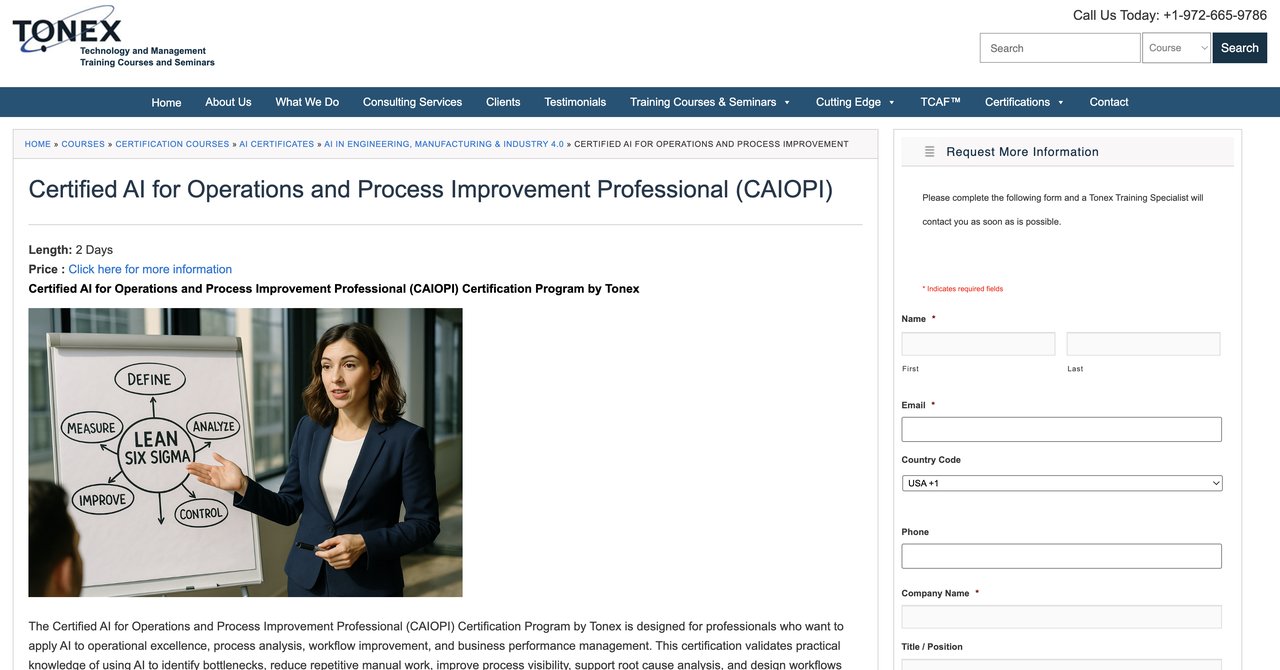
Tonex Training offers a certification specifically designed to validate practical knowledge of AI for operational excellence and process improvement. The curriculum covers bottleneck identification, workflow design for intelligent automation, and root cause analysis. These are core operational concerns, and the course frames AI as a tool to address them directly.
The certification credential itself is the main draw here. If you're in a position where you need to demonstrate your AI competency to an employer or clients, having a recognized certification can be valuable. The focus on process improvement is also a plus, as it ties AI learning directly to the kind of efficiency gains that operations leaders are typically measured on.
Key topics covered: AI applications for operational excellence, bottleneck identification, workflow design for intelligent automation, root cause analysis, and process improvement methodologies.
Target audience and skill level: Operations professionals who want a certification to validate their AI knowledge. It's appropriate for managers, directors, and process improvement specialists. The level is intermediate-some familiarity with operational concepts is assumed, but no technical background is required.
Pros:
- Validates practical knowledge of AI for operational excellence
- Coverage of bottleneck identification and workflow design
- Certification credential that can be listed on your resume
Cons:
- Price and duration are not published, making it hard to plan or compare
- Niche provider-Tonex isn't as well-known as some of the other names on this list
Who would benefit most: Professionals who specifically want a certification to bolster their credentials and who are focused on process improvement. If you're in a role where continuous improvement is a formal part of your job description, this certification aligns well. However, the lack of transparent pricing is a significant drawback.
Course 7: Claude for Customer Experience, Operations & Quality by Udemy
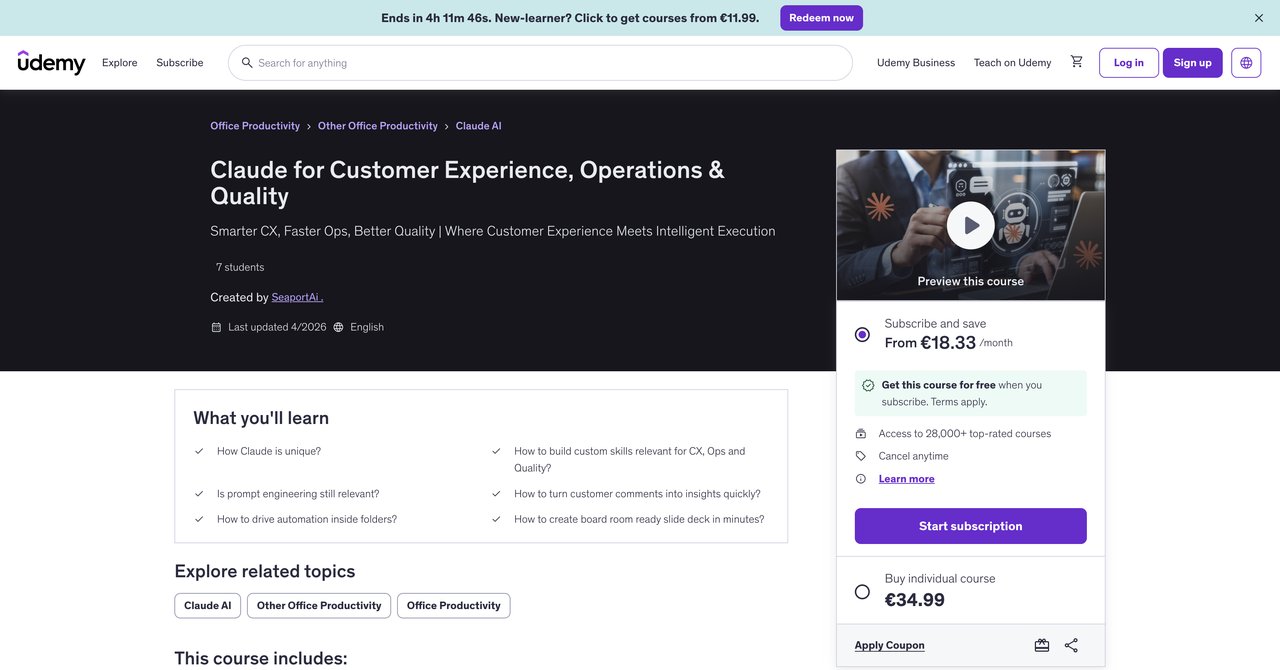
This Udemy course takes a different angle by focusing specifically on using Claude AI, Anthropic's large language model, for customer experience, operations, and quality. It's a tool-specific course, which means you're learning how to use one particular AI platform rather than learning broad AI concepts. The emphasis is on data-driven execution and consistency, which are important for operational quality.
The course was last updated in April 2026, so the content is current. That's a significant advantage because AI tools change rapidly, and a course that hasn't been updated in two years is likely teaching you outdated methods. If you're already using Claude or are considering adopting it in your organization, this course offers practical, hands-on guidance.
Key topics covered: Using Claude AI for customer experience management, operational quality control, data-driven execution, and maintaining consistency in AI-assisted processes.
Target audience and skill level: Operations professionals, customer experience managers, and quality assurance leads. The course assumes no prior experience with Claude, so it's accessible to beginners. It's a practical course rather than a strategic one.
Pros:
- Focuses on using Claude AI for CX, operations, and quality
- Emphasizes data-driven execution and consistency
- Recent update (April 2026) ensures content is current
Cons:
- Vendor-specific-you're learning about Anthropic's Claude, not AI broadly
- Rating not visible, so it's hard to gauge quality from other learners
Who would benefit most: Teams that have already chosen Claude as their AI platform and need to learn how to use it effectively. It's also useful for staying current on a specific tool. However, if you're looking for a broader understanding of AI in operations, this is too narrow.
Course 8: AI Automation Bootcamp for Operations Leaders by Maven (Linda Mutricy)
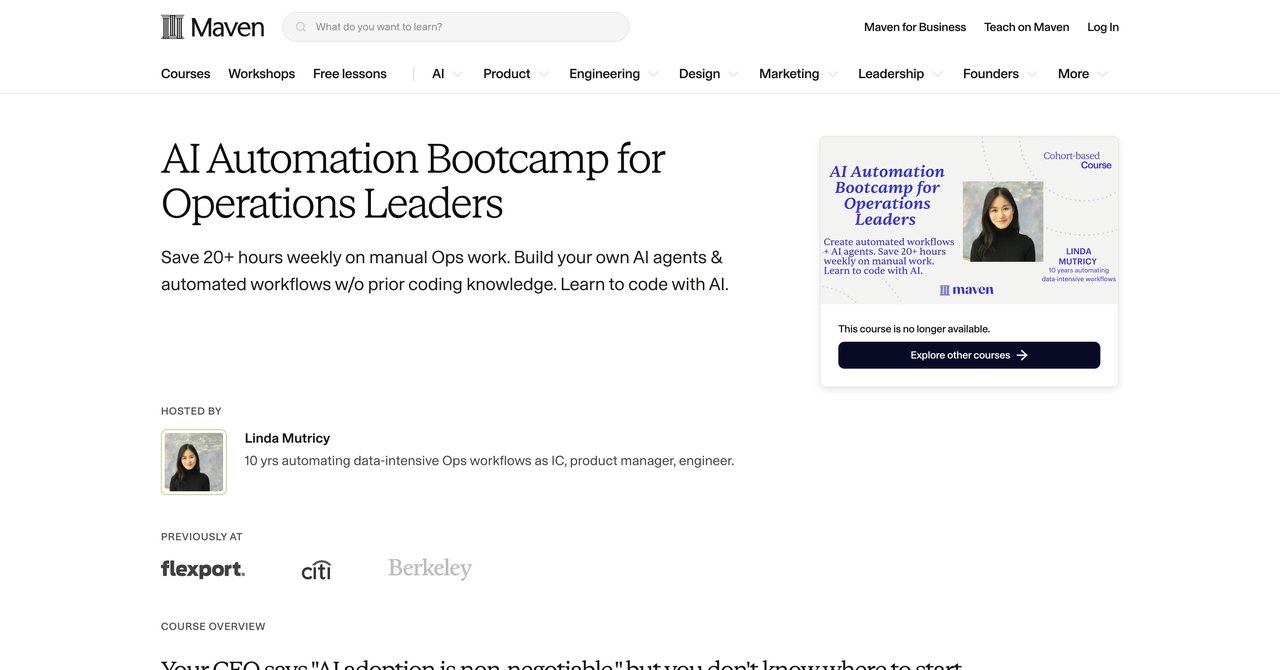
This is a cohort-based, learn-by-doing bootcamp led by Linda Mutricy through the Maven platform. Over two weeks (4 sessions), operations leaders build AI agents and automated workflows without writing any code. The course uses real-world case studies that are specifically relevant to data-intensive operations, so you're not just learning abstract concepts-you're building actual solutions.
The cohort format is a different experience from self-paced courses. You're learning alongside a group of peers, which can be motivating and provides networking opportunities. The claim of saving 20+ hours per week through automation is ambitious, but the hands-on nature of the bootcamp means you'll leave with working automations that could potentially deliver real time savings.
Key topics covered: Building AI agents, creating automated workflows without coding, applying automation to data-intensive operations, and using real-world case studies to solve operational problems.
Target audience and skill level: Operations leaders who want to build practical automation skills. The no-code approach means you don't need programming experience, but you do need to be comfortable with technology. The time commitment is significant-2 hours per week on top of the 4 live sessions.
Pros:
- Cohort-based, learn-by-doing approach
- Build AI agents and automated workflows without coding
- Real-world case studies for data-intensive operations
- Claims 20+ hours saved weekly through automation
Cons:
- Price is not published, which is a barrier to evaluation
- Requires 2 hours per week commitment on top of sessions, which may be hard for busy Directors
Who would benefit most: Operations leaders who want to get hands-on with AI automation and don't mind a structured, time-bound commitment. The cohort format is great for accountability. If you're someone who learns by doing rather than watching videos, this could be a strong fit.
Course 9: AI for Operations Leaders by Tess Group
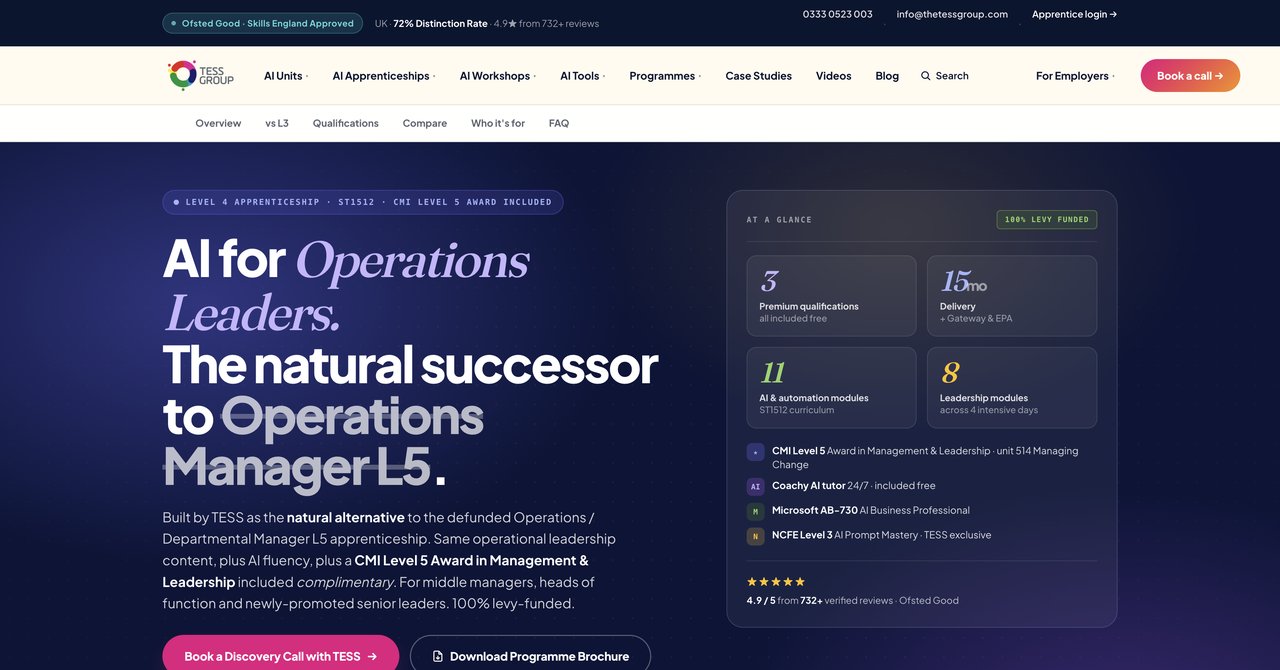
Tess Group offers a Level 4 programme covering AI-driven automation, data intelligence, and change management. The course is delivered live online, which means you get real-time instruction and the ability to ask questions. It's specifically available across England, with monthly starts and limited places, which creates a sense of exclusivity and ensures smaller class sizes.
The inclusion of change management is a notable strength. AI implementation often fails not because of technical issues but because of people issues-resistance to change, lack of buy-in, unclear communication. This course addresses that head-on, which is something many other programs skip entirely.
Key topics covered: AI-driven automation, data intelligence, change management, and practical implementation of AI in operational settings.
Target audience and skill level: Operations leaders in the UK, given the delivery location. The Level 4 designation suggests it's aimed at managers and directors. It's a live online format, so you need to be available at scheduled times.
Pros:
- Covers AI-driven automation, data intelligence, and change management
- Live online delivery allows for real-time interaction
- Monthly starts with limited places for a more personalized experience
Cons:
- UK-focused delivery, which limits accessibility for international learners
- Price and duration are not listed, making it hard to plan
Who would benefit most: UK-based operations leaders who value live instruction and want a program that addresses the human side of AI adoption. The change management focus is unique and valuable. However, the lack of published pricing and the geographic restriction are significant limitations.
Course 10: AI for Operations and Supply Chain by Cursuri AI
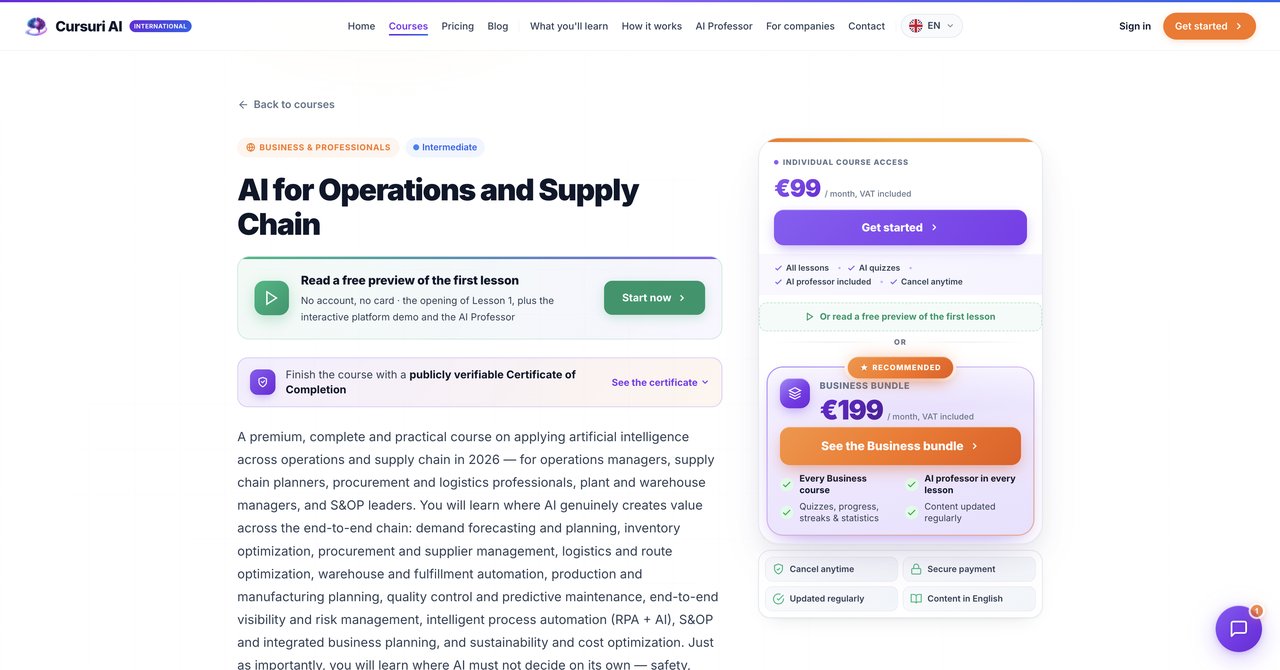
Cursuri AI offers a comprehensive and practical course covering operations, supply chain, procurement, logistics, and S&OP (Sales and Operations Planning). The content is kept up to date, with the last update on July 20, 2026, which is very recent. The price is also remarkably affordable at €49 (approximately $55), making it one of the lowest-cost options on this list.
The scope of coverage is impressive for the price. You're getting material on multiple interconnected functions-operations, supply chain, procurement, logistics, and S&OP-which is valuable because these areas are deeply intertwined. The fact that the content is updated regularly is another plus, as it suggests the provider is committed to keeping the material relevant.
Key topics covered: Operations management with AI, supply chain optimization, procurement automation, logistics efficiency, and S&OP processes.
Target audience and skill level: Operations and supply chain professionals who want a broad, affordable overview. The course is suitable for beginners to intermediate learners. It's a practical course that focuses on applications rather than theory.
Pros:
- Covers operations, supply chain, procurement, logistics, and S&OP
- Very affordable at €49 (approximately $55)
- Content kept up to date, last updated July 2026
Cons:
- Provider is less well-known, so there's less track record to evaluate
- Localized from a Romanian platform, which may mean some translation or localization quirks
Who would benefit most: Budget-conscious professionals who want a broad overview of AI across operations and supply chain. The price is hard to beat, and the scope is impressive. If you're just starting your AI journey and don't want to invest heavily, this is a reasonable entry point.
Final Recommendations: Choosing the Right Course for Your Needs
So, after looking at all ten options, where does that leave you? The honest answer is that it depends on your priorities. Let's break it down by different profiles.
If you want the most comprehensive coverage and ongoing learning: CompleteAI Training is the standout choice. The subscription model gives you access to hundreds of courses and certifications across every job role, not just operations. For a Director of Operations whose responsibilities inevitably cross into other functions, that breadth is invaluable. The daily updates mean you're always current, and the price-$8.25 to $29 per month-is significantly lower than what you'd pay for a single certification elsewhere. The main drawback is that it's a subscription, so you need to keep paying to maintain access, but given how fast AI changes, that's arguably a feature rather than a bug.
If you want a prestigious credential for your resume: The Emory University Goizueta program is your best bet. The brand name carries weight, and the hands-on simulation is a differentiator. But you're paying for that prestige, and the 4-hour format is really just a taste of what you need to know. It's a supplement, not a complete education.
If you want a structured, guided curriculum: SmarterX AI Academy offers a clear progression from strategy to action plan. It's less overwhelming than a massive library. But the lack of transparent pricing is a real drawback, and the short total duration might leave you wanting more.
If you want hands-on automation skills: The Maven bootcamp with Linda Mutricy is the most practical option. You'll build actual automations and leave with tangible results. The cohort format provides accountability and networking. Just be prepared for the time commitment and the undisclosed price.
If you're on a tight budget: Cursuri AI offers remarkable value at €49. You get broad coverage of operations and supply chain, and the content is current. It's not going to give you a certification or the depth of a premium program, but it's a solid starting point.
If you need to understand compliance and governance: AI Wise Training stands out for its coverage of regulatory compliance and data governance, which are critical in regulated industries. The certification is a nice credential. Just factor in the cost of the Core prerequisite.
At the end of the day, the best course is the one you'll actually complete and apply. For most Directors of Operations, the combination of breadth, currency, and affordability makes CompleteAI Training the strongest overall value. The fact that one subscription unlocks every course and every certification on the platform-including access to other job roles' material-is a differentiator that's hard to argue with. But if you have specific needs like a prestigious credential or hands-on automation experience, one of the other options might serve you better. Take the time to think about what you actually need, and then make your choice based on that, not just on marketing hype.