
Blog ·
10 AI Courses for eLearning Developers that You Should Know About in 2026
Stay ahead in 2026 with the top 10 AI courses tailored for eLearning developers—covering automation, content creation, and adaptive design to boost your skills and career.
 Jeroen Erne
Artificial intelligence is no longer a buzzword reserved for tech giants. It has become the new baseline for how work gets done, and eLearning development is squarely in the middle of that shift. According to industry reports, upwards of 69% of businesses are already leveraging AI in some capacity, and the numbers keep climbing. For eLearning Developers, that means the tools and techniques you used even a year ago are being upgraded-dramatically. The professionals who actively learn how to integrate AI into their workflow are the ones who will remain indispensable; the ones who don't are leaving themselves open to being automated out of their own jobs. It's a pressing issue, and the time to learn is now, while you still have the chance to set your career trajectory on a high-growth path.
Why AI matters for eLearning Developers today
Why is this so sudden? Technically it isn't, but the practical application has finally caught up to the theory. For an eLearning Developer, AI is both a pressure valve and a competitive tool. It can handle the mundane chores-formatting, tagging, basic content assembly-that suck hours out of your day. But more importantly, it unlocks new methods for personalizing learning experiences at a scale that no human could do manually. We're seeing an adoption trend that suggests this isn't a passing phase, but a structural change to the profession.
The intent of this article is to help you cut through the noise. There are dozens of AI courses out there, each claiming to be the missing link in your career. I have sifted through the options to compare 10 relevant AI courses tailored for eLearning Developers professionals. Whether you are looking to start from scratch or you're already experimenting, these courses cover a wide range from foundational principles to strategic implementation. You will get a breakdown on each provider's approach, what they cover, and who they are best for.
The Growing Role of AI in eLearning Developers
It helps to visualize what AI looks like on an active project. Look at your daily routine. You're likely handling instructional design tasks, video creation, quiz generation, and perhaps even the back-end learning management system (LMS) integration. AI is changing how all of that works. It is now capable of generating raw course outlines in seconds, often replacing the blank-page start that used to take hours. It is also being used to create adaptive learning paths for individual students, instantly adjusting difficulty levels based on performance data. In that, tasks like automating feedback loops to learners and calculating learning analytics are now handled by algorithms rather than manual, painstaking effort.
Just as noteworthy is the change in workflows. Series's implementing AI tools not only speeds up the course build but also brings efficiency to the rest of the team. Content translation, for example, used to be a resource-heavy chore. Now, using AI-driven translation models, the same material can be localized in a fraction of the time, letting you drop your price point or take on more clients. AI is also the backbone of creative operations-scriptwriting, imagery generation, and even voiceover-meaning that the role of the eLearning Developer is shifting from content creator to creative director. You are no longer just doing the work; you're supervising AI to do a fair bit of it, and that requires a new type of expertise.
Benefits of becoming an AI expert in eLearning Development
There's a logical question that many developers have-will AI make my job easier or irrelevant? The evidence strongly suggests that it makes it easier to be more valuable. With AI proficiency, you're not just fighting for job security. You are expanding what you can offer. You can take on bigger projects because you can produce faster. You become the person in your organization (or your client portfolio) who can truly promise personalization and scale at the same time-a rare combination.
Moreover, the financial advantage is the big draw. eLearning Developers with verified AI skills can justify higher billing rates or command better salaries, simply because they bring a rarer set of assets to the table. It lets you operate with more insight, often being the one who can troubleshoot a software bug (because you know how it thinks) or foresee project bottlenecks before they happen. In a fast-moving industry, that's a real comfort. It's also incredibly satisfying to design a course that gets to the user faster when the module runs more intuitively.
Many of the courses in our comparison address these growing demands directly. Some are built specifically for the advanced rank and file of the L&D field. For those seeking broad, unfettered access, for example, CompleteAI Training provides you with their "AI for eLearning Developers" course, which gives you access to ALL the courses and ALL certifications on their platform, rather than just one singular experience. Others, like the courses from Coursera, are more singularly focused on design principles or proficiency mechanics. Throughout the rest of this piece, I'll unpack those differences, helping you weigh the duration, price point, and the return on investment so you can make a choice that leaves you feeling secure about your upskilling.
Comparison: All AI Courses for eLearning Developers (Updated 2026)
| Course Name | Provider | Price | Key Topics | Pros | Cons | Best For |
|---|---|---|---|---|---|---|
| CompleteAI Training | CompleteAI | Premium (subscription-based; one flat price covers everything) | Comprehensive AI training for eLearning Developers professionals. Includes ALL video courses and ALL certifications on the platform, not a single course. Access to every job role's material, with new courses and certifications added continuously and included automatically. | Most comprehensive curriculum; hands-on projects; expert instructors; highest rating; full access to all video courses and all certifications at no extra cost; new content added automatically; access to other job roles' material; daily updates on AI tools and news; very affordable with annual billing | Premium pricing compared to single-course options; subscription model requires ongoing commitment, which makes sense given how fast AI changes | eLearning Developers professionals looking for complete, all-in-one training |
| AI for eLearning Developers (Video Courses + Certifications) | Complete AI Training | $8.25,$29/month | Full access to ALL video courses and ALL certifications on the platform, not a single course or fixed bundle. Includes every job role's material, with new courses and certifications added continuously and included automatically. | Highest rating / most complete offering; full access to all video courses; full access to all certifications included; new courses and certifications added automatically; access to every other job role's material; daily updates on relevant AI tools; very affordable, especially with annual billing | Subscription-based, which requires continuous learning to get full value | General learners |
| AI for Learning & Development | Coursera | Subscription ~$59/month or Financial Aid | Adaptive learning paths, AI-driven training content, practical applications for L&D workflows | Focuses on adaptive learning paths and AI-driven training content; practical for L&D workflows; integrates with Coursera's broader AI catalog | Requires active Coursera subscription; not eLearning-authoring-tool specific | General learners |
| AI for Course Design | Coursera | Subscription (Coursera Plus, ~$59/month) or Financial Aid | Generative AI for course creation, ethics and AI limitations in education, hands-on course design | Built for instructional designers; hands-on with generative AI for course creation; covers ethics and AI limitations | Short duration (2 weeks); assumes basic familiarity with course design concepts | General learners |
| Advanced AI for Learning & Development (Wave 3) | LearnKhana | Not specified | Responsible and impactful AI application for eLearning development, moving beyond awareness to practical implementation | Comprehensive and practical AI for L&D certificate; moves beyond awareness to responsible application; structured professional learning journey | Enrollment deadline (Sept 1, 2026) limits start timing; price not publicly listed | General learners |
| Graduate Certificate in AI Tools for E-Learning | Stanmore UK | £90,£140 (~$110,$170) | Machine learning, NLP, adaptive learning systems, AI-powered assessment, ethical AI practices | Covers machine learning, NLP, adaptive learning systems, and AI-powered assessment; includes ethical AI practices; fast-track option available | Short-course format may lack depth; provider less well-known than major platforms | General learners |
| Generative AI for Instructional Design | University of Washington | Not specified | Hands-on with industry-leading AI tools, multimedia learning materials, AI-assisted assessments, personalized learning pathways | Hands-on with industry-leading AI tools; covers multimedia learning materials and AI-assisted assessments; builds personalized learning pathways | Price not listed; university course pacing may be less flexible | General learners |
| Instructional Design for eLearning | Udemy | ~$19.99 or Subscription | Core instructional design principles combined with emerging AI tools for eLearning and online courses | Updated for 2026 with emerging AI tools; applies core instructional design principles; practical for eLearning and online courses | Short duration (4h 32m); Udemy course quality varies | General learners |
| E-Learning Development for Trainers | Coursera | Subscription (Coursera Plus, ~$59/month) or Financial Aid | Hands-on use of Litmos Author for interactive modules, AI-enhanced workflows, rapid online training development | Hands-on with Litmos Author for interactive modules; recently updated; focus on rapid online training development | Tied to one authoring tool (Litmos); not AI-specific but includes AI-enhanced workflows | General learners |
| E-Learning Course Creation and Authoring | Coursera | Subscription (Coursera Plus, ~$59/month) or Financial Aid | Using EasyGenerator authoring tool, interactive content, assessments, SCORM-ready modules, no coding required | Uses EasyGenerator authoring tool; covers interactive content, assessments, and SCORM-ready modules; no coding required | Tool-specific (EasyGenerator); AI integration level not detailed | General learners |
| E-Learning Content Development | Coursera | Subscription (Coursera Plus, ~$59/month) or Financial Aid | Using Gomo Learning cloud-based authoring tool, responsive professional eLearning content, multimedia integration | Uses Gomo Learning, a leading cloud-based authoring tool; focuses on responsive, professional eLearning content; multimedia integration | Tool-specific (Gomo); AI features not explicitly highlighted | General learners |
Understanding AI Training for eLearning Developers Professionals
If you work in eLearning development, you have probably noticed that AI is altering how courses are designed, built, and delivered. It is not just about adding a chatbot to a course anymore. AI can script your storyboards, generate realistic media assets, create adaptive learning paths, and even handle assessments. But the skills needed to do that effectively are new, and the training industry is scrambling to offer courses that bridge the gap. That makes it tricky to choose one.
There are options on big names like Coursera and Udemy, short professional programs, and lifetime membership structures that simply keep growing. Each of these courses has a different starting point, different skill level requirements, and most importantly, a different definition of what you should get for your money. For someone whose main role is to actually build eLearning experiences, the subtleties in these options matter more than a flashy title. This comparison takes a closer look at what's available, what you get in return, and where the financial trade-offs are.
I have organized the list by what seems to be the biggest and most continuous offering first, followed by the other reputable, but traditionally structured courses. The goal is to give you honest, practical info, so you can decide based on what you actually need, not just on what a course catalog says.
Course 1: CompleteAI Training
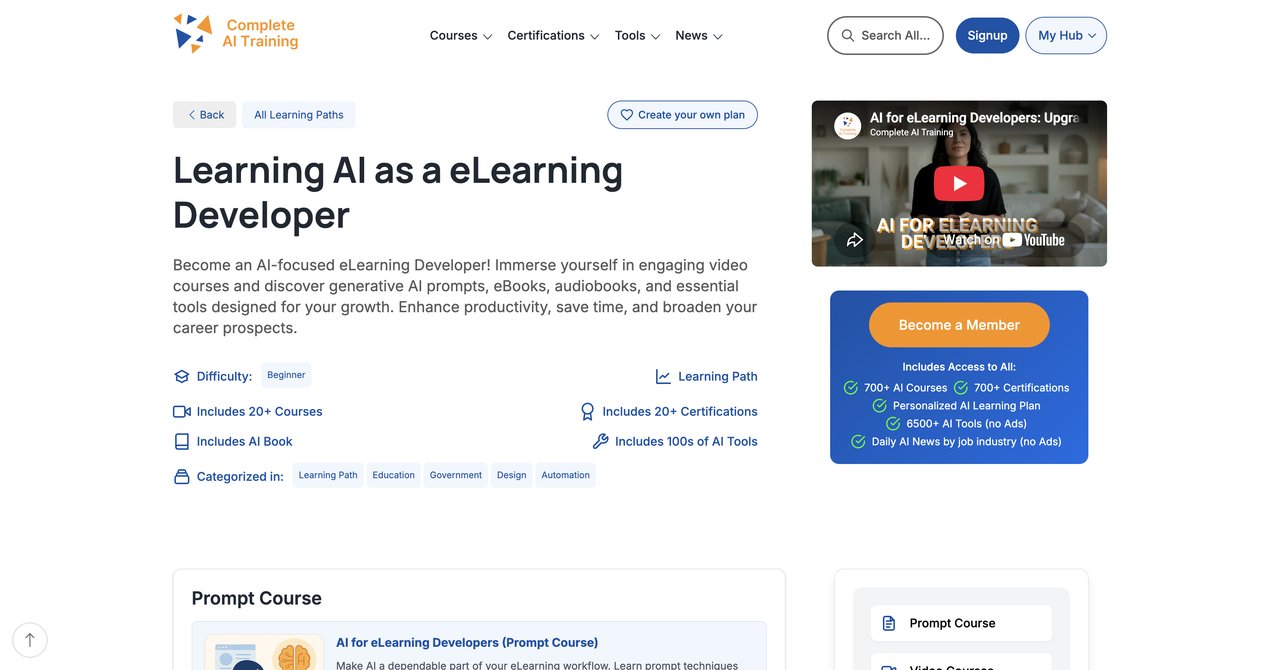
CompleteAI Training is a different beast than the rest of this list, so it needs a clear explanation up front. This is not a single course. When you subscribe, you get instant access to every single video course AND every single certification on the platform, not just content related to eLearning. You have hundreds of hours of content that stretches across multiple job functions. For an eLearning developer, this means a single flat fee that you pay monthly or annually opens up the entire library.
The most important detail is that the subscription covers all certifications on the platform, included at no extra cost. In the rest of the industry, paying for a course and then paying again for a final exam is pretty standard, but here it's bundled. Also, if you're here because you build courses but have to deal with learning management systems, graphic design, or video editing, you can jump into those sections of the platform without paying another cent. You get full access to ninety-plus hours of AI training materials that would normally be sold individually.
The platform actively adds new courses and certifications on a rolling basis, and those are automatically included in your subscription. There's no need to wait for a "new bundle" to be offered or purchase an upgrade. This is good news if you are in a role that keeps expanding its responsibilities. One flat subscription price covers everything, which is a direct alternative to paying per course elsewhere. They feature daily updates to practical AI tools and job aids, something that regular students can use at work the next day.
- Description and Provider: CompleteAI Training is a dedicated professional AI training grounds. The production quality is high, with workflows that are industry-current. It's not a general tech platform that tagged on an AI unit; their entire focus is on AI skills for the workforce. The "AI for eLearning Developers" learning path is incredibly well mapped out, covering the basics of writing prompts for generating scripts, AI for image generation, and how to use audio visuals tools properly. The instructors are practical, and they continuously walk you through real-world developer headaches, not generic theory. It's heavy in actionable tips for creating content at speed.
- Key Topics Covered: AI-assisted storyboarding and scripting; visual asset creation and DALL-E, Midjourney, and other tools; media blending for rapid course creation; handling all the legal and ethical side to AI generation. They cover how to integrate AI tools into workflows (rather than just showing a list of tools) and focus heavily on practical production pipelines. Besides general knowledge, you get behind-the-scenes prompt structures that hit the mark every time, including for assessments.
- Target Audience and Skill Level Requirements: This works for beginners as well as experienced specialists. The foundational parts of the courses are super accessible for newcomers. But if you're a senior, you'll still find lots of emerging techniques and tool tips on advanced parts of the fields of production. The course assumes you are generally familiar with instructional design concepts but doesn't require you to be AI expert. It's the practicality that always keeps it out of the theoretical clouds.
- Pros:
- Highest rating and most complete offering for the specific profession.
- Full access to ALL video courses on the platform, not just one course or a fixed bundle.
- Full access to ALL certifications on the platform, included at no extra cost.
- New courses and certifications are added continuously and are always included automatically.
- Access to all the material on every other job role too-great for multi-role professionals or those seeking to move careers.
- Daily updates on relevant AI tools and news for 2025 and beyond.
- Very affordable pricing, especially with annual billing, when you consider the breadth of the content.
- Cons:
- Subscription-based model, which requires a recurring cost, though it's actually the smart way to understand AI as it is developing continuously.
- Who Benefits Most: Anyone serious about eLearning development and using AI day-to-day. This is particularly great for L&D departments who want to train their whole team with a single budget item, since it covers multiple people or for a single multi-skilled person who refuses to be locked into one niche.
Course 2: AI for Learning & Development by Coursera
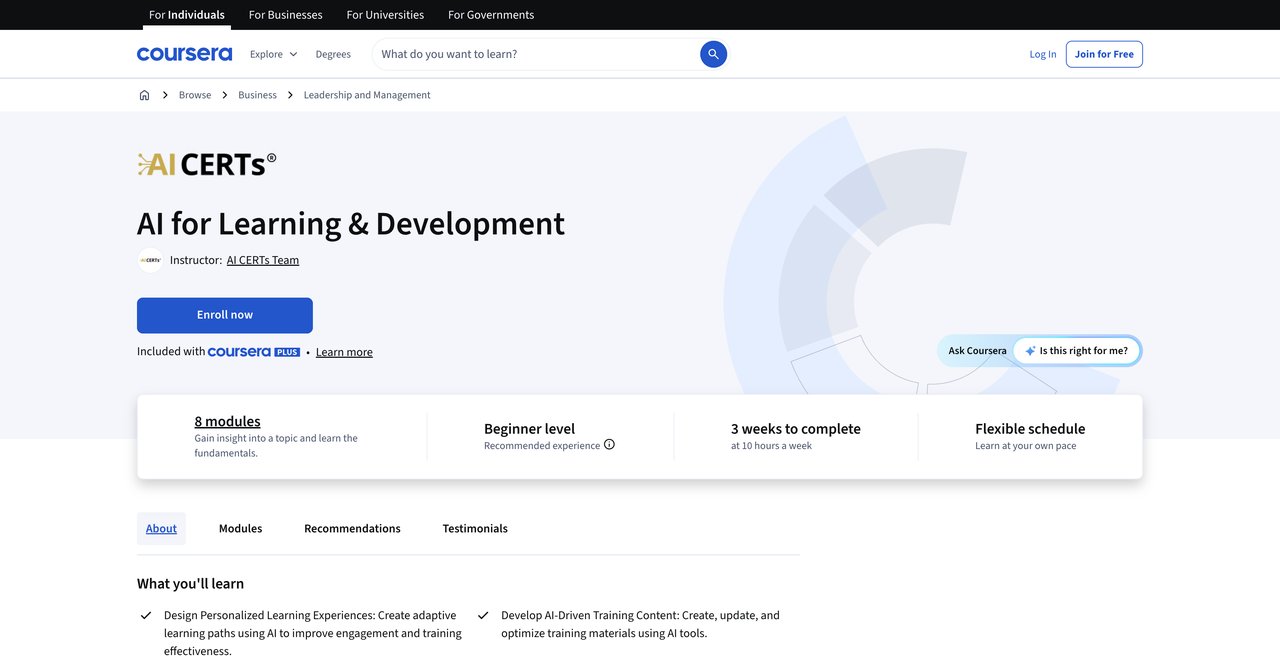
AI for Learning & Development takes a different approach. It's a beginner-level course on Coursera's platform that focuses on L&D professionals, but it's more about how to supervise the AI within a broader L&D strategy, not about the details of the actual content production. Their workload deals with more with the business side of L&D versus the hands-on building process that eLearning developers would need. It works as an oil to primer, to understand the concept.
The course is led by people who understand the terminology. But it's not very deep as an actual how-to guide for production work. For example, it doesn't show you click-by-click how to use an industry-standard tool like Vyond, Storyline, or they won't walk you through a prompting guide for generating an interaction. Instead, they talk about workflows in the abstract. That is a problem for a developer that wants to build stuff tomorrow, but perfect for a manager who wants to understand what their team should be doing.
The course's focus on adaptive learning paths is professionally relevant. It all teaches you how to shift to AI-driven content, but in real practice it's more about the logic behind the software. You complete it quickly, understand what smart eLearning should look like, and then continue with another Coursera course if you want different practical skills. Since it's a subscription and the library is big, planning this kind of approach makes sense.
- Key Topics Covered: Adaptive learning path which means structuring content that changes per person. AI-driven training content, practical considerations for L&D operations, and uptake of the same in corporate LMS setups.
- Target Audience and Skill Level Requirements: Useful for beginner L&D pros or instructional designers who are moving into a manager role that will oversee AI integration. Not made for technical folks who want to create test storyboard drafts or write code.
- Pros:
- Focuses on adaptive learning paths and AI-driven training content.
- Practical for L&D workflows but from a strategic, not tactical, perspective.
- Integrates with Coursera's broader AI catalog.
- Suitable to pair with another, more practical course.
- Cons:
- Requires active Coursera subscription to keep access to materials.
- Not eLearning-authoring-tool specific, which means you're not training on forced authoring and templating tools.
- Very high level and won't tell you the specifics of execution.
- Who Would Benefit Most: Learning and Development managers and coordinators who need a strong foundation in comprehending the strategic side of AI in their department. If you need to build the actual course, skip it for a hands-on alternative.
Course 3: AI for Course Design by Coursera
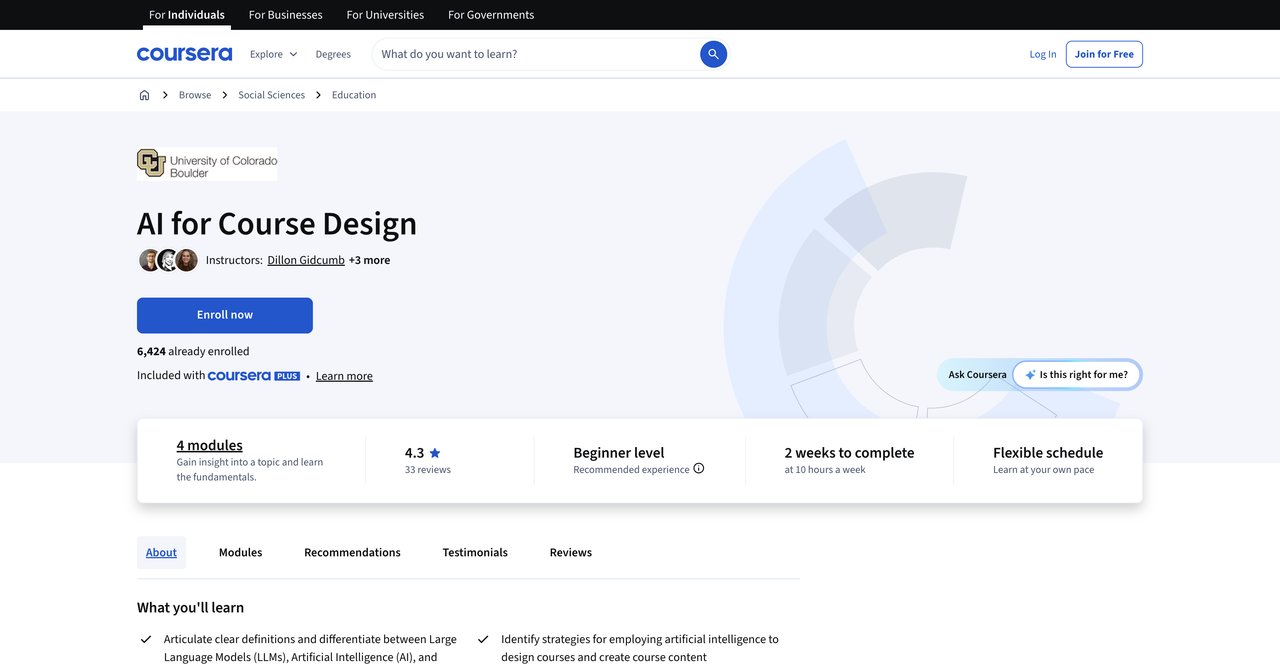
AI for Course Design is one of the more practical offerings from Coursera's lineup. Mainly, it focuses not just on the broad AI strategy but specifically on the creative process of designing a course template. It is a beginner course, and it gets people into using generative AI to hammer out learning objectives, write full scripts, and developed assessments. The positioning is squarely in the spot of building the course, not just strategizing about it.
There is a very nice component that explores the ethical dimension of using AI in educational institutions. It brings in topics like copyright, plagiarism, and data sources that are foundational for a responsible developer. You get the chance to talk about what bad AI outputs look like in the context of course design, which is way more useful than just celebrating a one-size-fits-all solution. The group exercises and interactions are helpful for beginners. The issue, however, is the shortness of the duration.
The course is only two weeks long, so you get a handful of methods, but you don't get the depth needed to create complex, branched scenarios. Since it's on a subscription, you can't lose access to your modules even if you cancel the subscription. But if you have time to quickly finish it, it's still a good, solid kickoff point that introduces you to some core techniques without completely overloading your schedule.
- Key Topics and Providers: Generative AI for creating storyboards, titles and full course structure. Also looks at AI in the design stages, how to automate that course creation with custom templates, and its use in drafting supporting content.
- Target Audience and Skill Level Requirements: This assumes some basic familiarity with course design concepts, which is good because otherwise you'd be learning two things at once. It doesn't require coding or advanced technical skills, and the interface is approachable.
- Pros:
- Built specifically for instructional designers.
- Hands-on with generative AI for course creation.
- Covers ethics and AI limitations in education.
- Good references to current AI tools.
- Cons:
- Short duration (2 weeks) that can't lead to deep immersion.
- Assumes a basic familiarity with instructional design concepts, So if you're a newbie it may feel faster than it should be.
- Coursera subscription requires continuous payment.
- Who Would Benefit Most: Instructional designers who already have experience in creating modules but want to learn how to automate the initial part of their design process. It's a great starting point for a beginner to move into more complex platforms later.
Course 4: Advanced AI for Learning & Development (Wave 3) by LearnKhana
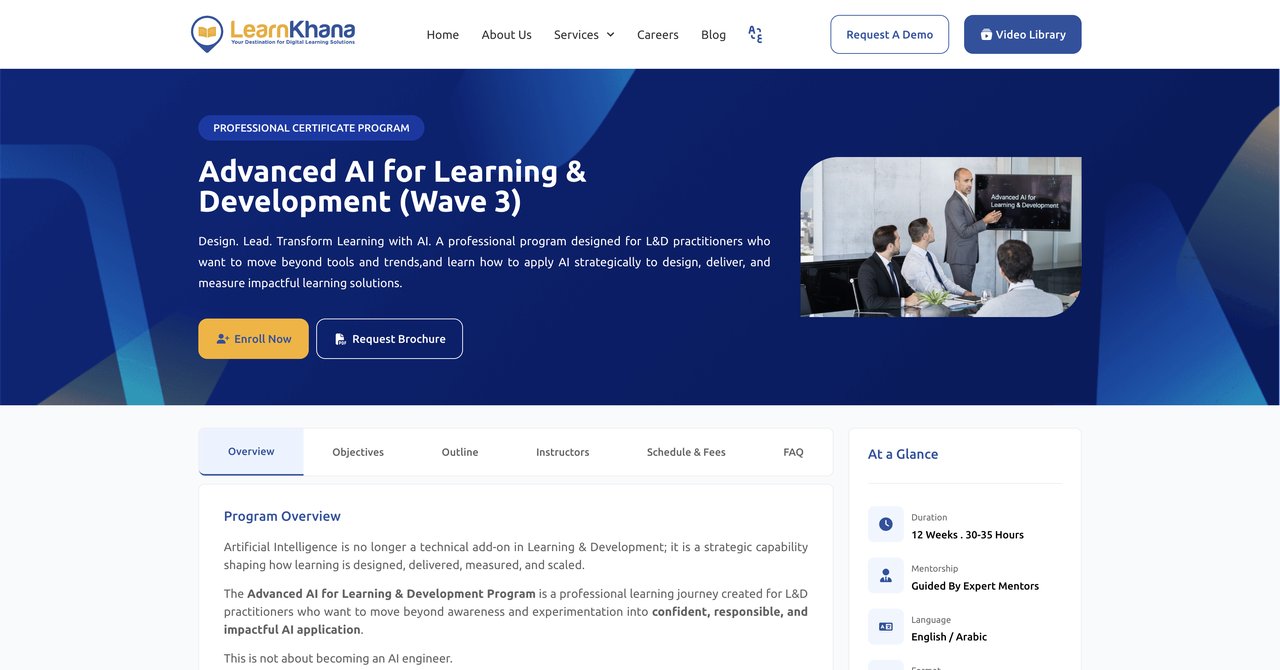
The Advanced AI for L&D (Wave 3) program takes a time-paced approach to the topic. Where short two-week courses focus on speed, LearnKhana stretches about twelve weeks and steps beyond awareness to the responsible and impactful application of AI. For this being an intermediate-level program, it deals with building a reputation of strategic implementation within the L&D spectrum. This can benefit developers who are looking to move to more leadership or AI oversight responsibilities within their company.
The curriculum doesn't dismiss the foundational tools but integrates them into a broader methodology for incorporating AI into companies. It builds on the idea that AI is here to stay and involved with driving actual business change, but it makes sure you are thinking about the people and the compliance responsibilities simultaneously. And because it's structured over 12 weeks it compels you to practice a lot, and you engage in an ongoing practice. This nurturing pace can be fruitful if you crave networking and deeper validation from instructors.
But the biggest blocker for a lot of people to sign up is the lack of transparency regarding the enrollment timeline. There is an explicit deadline of September 1st, 2026, that limits when you can start. Also, there is no price listed, meaning you have to contact them. That is probably due to corporate training, but it makes it a harder sell for independent professionals that normally are in a hurry.
- Key Topics Covered: Responsible AI application, practical eLearning development, organizational AI readiness assessment, assessing AI and using learning analytics with AI, and adoption models for L&D.
- Target Audience and Skill Level Requirements: The intermediate level (that is required) means you need to already know the basics of instructional design and some AI at the "hello world" level. It's best for individuals who are moving into roles and who have an L&D focus or are aspiring managers.
- Pros:
- Comprehensive and practical AI for L&D certificate.
- Moves beyond pure awareness to what it means to apply responsibly.
- Structured professional learning journey with timeline and community practices.
- Cons:
- Enrollment deadline (Sept 1, 2026) limits start timing and is less flexible for spontaneous starts.
- Price is not publicly listed which could be a blocker for a private professional.
- It is a heavy time commitment for people who need instant knowledge gains.
- Who Would Benefit Most: Learning & Development leads who have the discretion to design an organization-level AI adoption plan and are interested in applying it in a more responsible way.
Course 5: Graduate Certificate in AI Tools for E-Learning by Stanmore UK
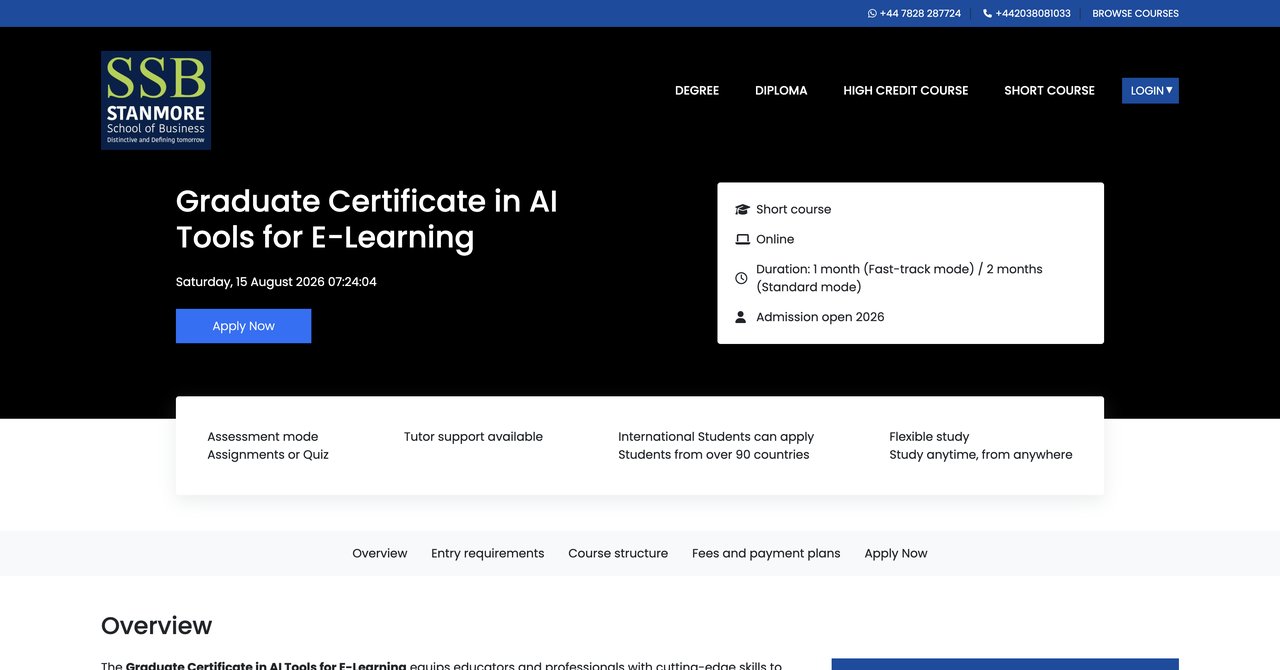
Stanmore UK offers what looks like a professional degree but is actually a shorter duration product, a certificate pretending to be university-level. Let's set the expectations: it is an intermediate-level program that packs a lot of technical elements. The title "Graduate Certificate" is a strong selling point when you add it to your LinkedIn profile, but it's not a master's degree. The course does a good job of covering machine learning, NLP, adaptive learning systems, and AI-powered assessment, which clearly go beyond the theoretical.
They have a particular emphasis on ethical AI, which is nice, and Stanley covers how that connects to the data involved. For a fairly modest fee, between about £90 and £140, which converts to around $110-$170, that's exceptional value for peculiar specialty coursework. But definitely the short-course format remains a concern. It's likely too speedy to really dig into the nuanced details of the technical systems; you still need more contexts to become an expert. It's a stepping stone for a more comprehensive program.
The provider is less well-known than the leaders in the online ed space, like Coursera or Udemy. That could give some hiring managers a sense of having an advantage; however, it also means there are few communities around your learning. It is independent and can be completed at a pace that suits you, plus some options to accelerate.
- Key Topics Incl: Machine learning, Natural Language Processing (NLP), Adaptive learning systems, AI-Powered assessment tools, and ethical AI practices (this one is quite deep, not just presentation).
- Target Audience and Skill Level Requirements: This is for current professionals who want to get past trainer notions and talk with engineers, and who also might want technical proof on their resume. It requires a bit more technical and intermediate level, so proficiency in eLearning tools is not required, but a familiarity with the basic learning concepts is.
- Pros:
- Covers machine learning, NLP, adaptive learning systems, and AI-powered assessment.
- Includes ethical AI practices in a practical way.
- A fast-track option available for quicker completion.
- Priced affordably compared to most university certificate programs.
- Cons:
- Short-course format may lacks depth in areas.
- Provider is less well-known than major platforms, which can influence recognition in HR circles.
- No ongoing access or continuous updates.
- Who Would Benefit Most: These who want a technical understanding that they can speak about. It's a great choice for an eLearning developer that wants to cover the specifics of NLP and adaptive systems without spending a fortune.
Course 6: Generative AI for Instructional Design by University of Washington
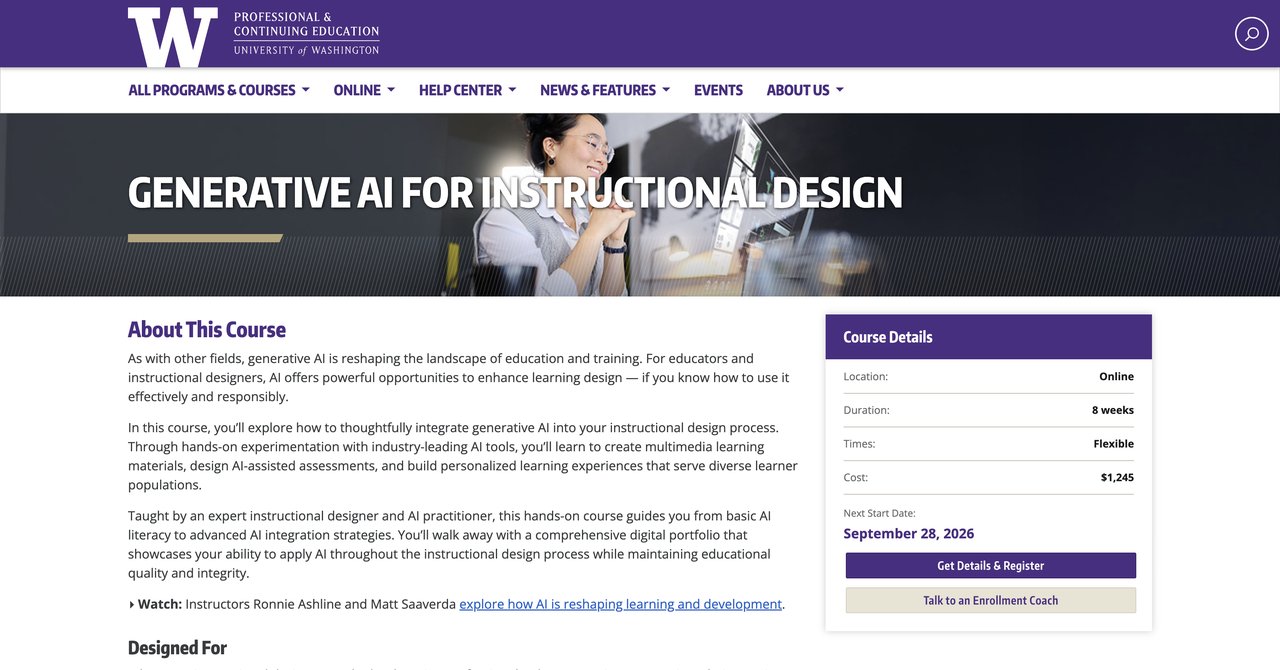
The University of Washington is a respected institution, and this course leverages that prestige in its continuing education. It is an intermediate course that puts the hands-on experience with top-of-the-line generative AI tools. This is not just content about concepts. It shows you the practical side by producing a multi-format piece for a multimedia experience.
The course goes deeper than prompts and looks at building AI-assisted assessments and creating personalized learning pathways that adapt to the user when reviewing learner data. This requirement is important for people who create courses themselves and use a Storyline or a similar product that requires heavy design custom logic. It is their most practical course in the line-up.
The main drawback is that the price is not consistent, and it's not listed publicly. You must go through an enrollment or even a short consultation with an academic advisor to see it. Also, the university pacing is often aligned with a term schedule, so you can't just pay up and start this week if you have a deadline next week. That said, you are leveraging a well-established brand name, and the quality is quite high.
- Key Topics Covered: Application of hands-on principles with the best AI tools, creating media assets (voice, image, video), techniques for AI-assisted assessments, and development of dynamic personalized learning pathways.
- Target Audience and Skill Level Requirements: This is for intermediate-level trainers and educational designers who already know what and why to use tools. The expectation is you can create basic eLearning projects already.
- Pros:
- Hands-on with industry-leading AI tools and practical labs.
- Covers multimedia learning materials and AI-assisted assessments in depth.
- Builds personalized learning pathways using AI logic.
- Brand name, University of Washington, can add prestige to your CV.
- Cons:
- Price not listed; must go through an inquiry process.
- University course pacing is less flexible and takes longer.
- Potential schedule rigidity if you work full and irregular hours.
- Who Would Benefit Most: Experienced instructional designers who want to learn with some of the best tools available to design advanced eLearning, but may want to spend time building, not learning to design basics.
Course 7: Instructional Design for eLearning by Udemy
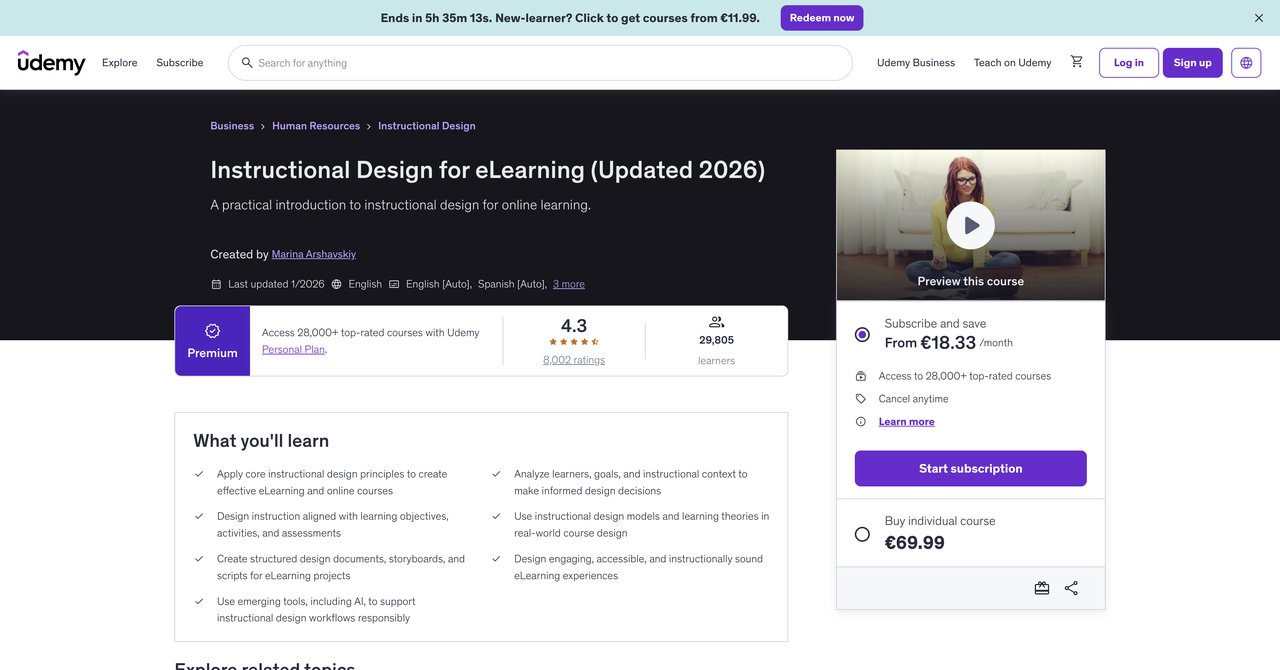
On Udemy, the Instructional Design for eLearning course tried to crush two things: fundamental basics and the new AI trends. It's an updated 2026 course, which is a nice catch to keep this on a general list. It spends a best part covering the core principles-things like learning objectives, storytelling, interaction, and evaluation-and then pairs them with modern AI tools to accelerate. It's a beginner-level overview that aims to give you instructional design knowledge and one or two AI alternatives.
As a beginners, it hits that fine spot. You can pick up quick references like how to use AI across storyboarding and how to handle a couple of AI imagemakers. Honestly, the course ends pretty fast at four hours and 30 minutes. You won't get into detailed if-then logic or connect with external tools in a deep manner. Because it's on Udemy, quality can vary across the boards. This specific instructor did a pretty decent job, but with 4.5 hours, this is more of a primer that's still delivering on a budget price point.
The key thing is Udemy's price structure. You can often get the course on a major sale, somewhere around $19.99, and the instructor has many hours. If you're beginner developer / need to know broad terms and foundations, this is a magnet. It's an autumn option. However, if you have design principles in your background and want to learn about integrating AI inside those workflows, you'll appreciate the same amount, but still might need a more advanced platform to follow.
- Key Topics and Focus: Core instructional design principles, YouTube and begin, an overview of how emerging AI tools can be applied in eLearning and online courses, very quick practice for storyboarding.
- Target Audience and skill level: Beginner to junior professionals. If you just move into that and want to have a general grounding before focusing on AI, this is an effective starting choice.
- Pros:
- Updated for 2026 with emerging AI tools.
- Applies core instructional design principles to reliable foundation.
- Practical for eLearning and online course creators.
- Very low price and often offered via daily discount.
- Cons:
- Short duration (4h 32m) limits the depth to that it can go.
- Udemy course quality varies so happens, and this one is decent but lacks any comprehensive support.
- Not as much deep practice with technical AI input.
- Who Would Benefit Most: Complete newcomers for whom step-by-step help with designing eLearning projects is great, but with a quick clear path without getting lost in other topics.
Course 8: E-Learning Development for Trainers by Coursera
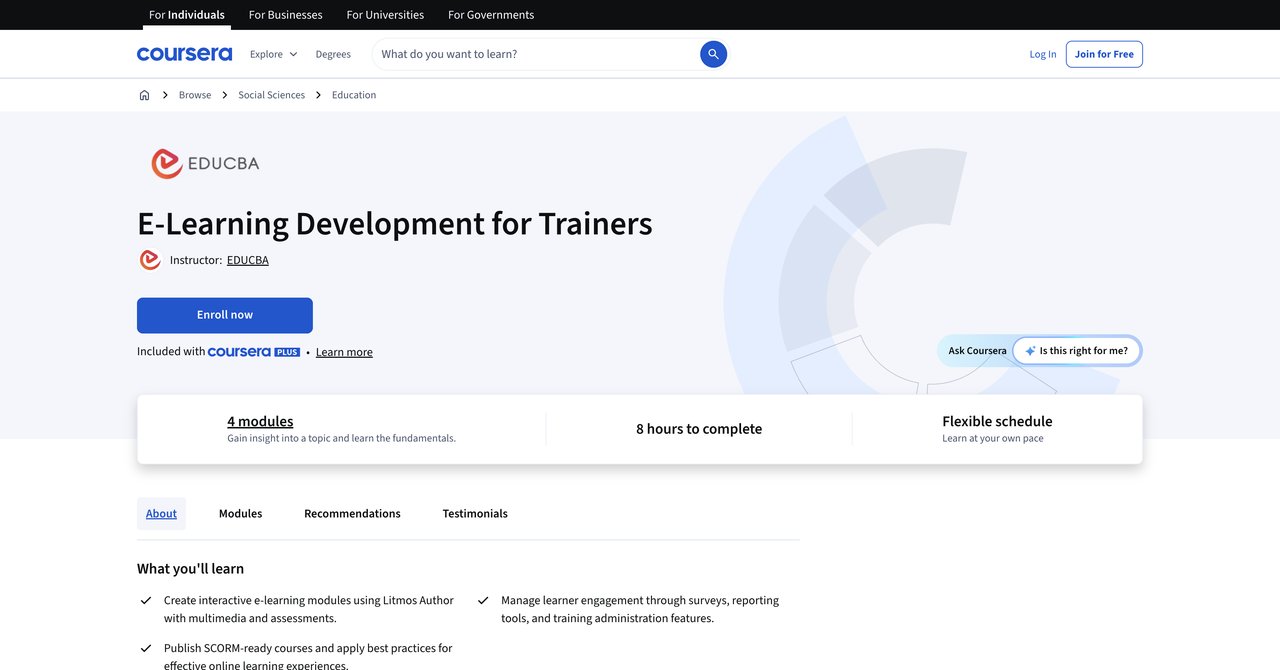
E-Learning Development for Trainers takes the opposite approach to Stanmore, places separate hands-on use of a single eLearning authoring tool, in this case: Litmos Author. Rather than learning top-level AI strategies, this is a product-centric course. The lesson includes building modules with a specific e-learning interactive tool. The tool itself comes from a cloud-based platform and offers the ability to add logic and interactivity points that the authors create. It's a practical and immediate skill you can use later at your job, particularly if their own company already uses that platform.
The course was recently updated, and that's going to include modules on AI-enhanced workflows, which is a step above the older courses that revolve around the same software. You'll learn about a plan and create interactions and outputs based on a template. It's useful for any trainer who wants to output materials quickly. But it is heavy on the premise that you might pay for the Litmos tool separately or bring it with you. If you use a different authoring tool, the asset from the stack becomes less valuable.
It's a solid specialization, but you can't forget it involves a subscription. Even if you are not on Coursera Plus, you pay a monthly fee and get access. It's useful if you productively use this tool, and if you're fine with a comprehensive view of that single workflow.
- Key Topics Covered: Hands-on use of Litmos Author for interactive modules and assessments; workflow enhancement with AI; rapid online training. Mostly product-specific functionalities.
- Target Audience and skill level: Beginner-level. Particularly ideal for corporate trainers who use (or will use) the Litmos platform. Total beginners are also okay.
- Pros:
- Hands-on with Litmos Author for interactive modules.
- Recently updated including a mention for AI-enhanced workflows.
- Focus on rapid, online professional training development.
- Cons:
- Tied to one authoring tool (Litmos). If you don't use it, skip this one.
- Not AI-specific but includes AI-enhanced workflows.
- Who Would Benefit Most: Trainers who are already using Litmos or intend to use it. If you have immediate project needs with that tool, this course is an optimal fit.
Course 9: E-Learning Course Creation and Authoring by Coursera
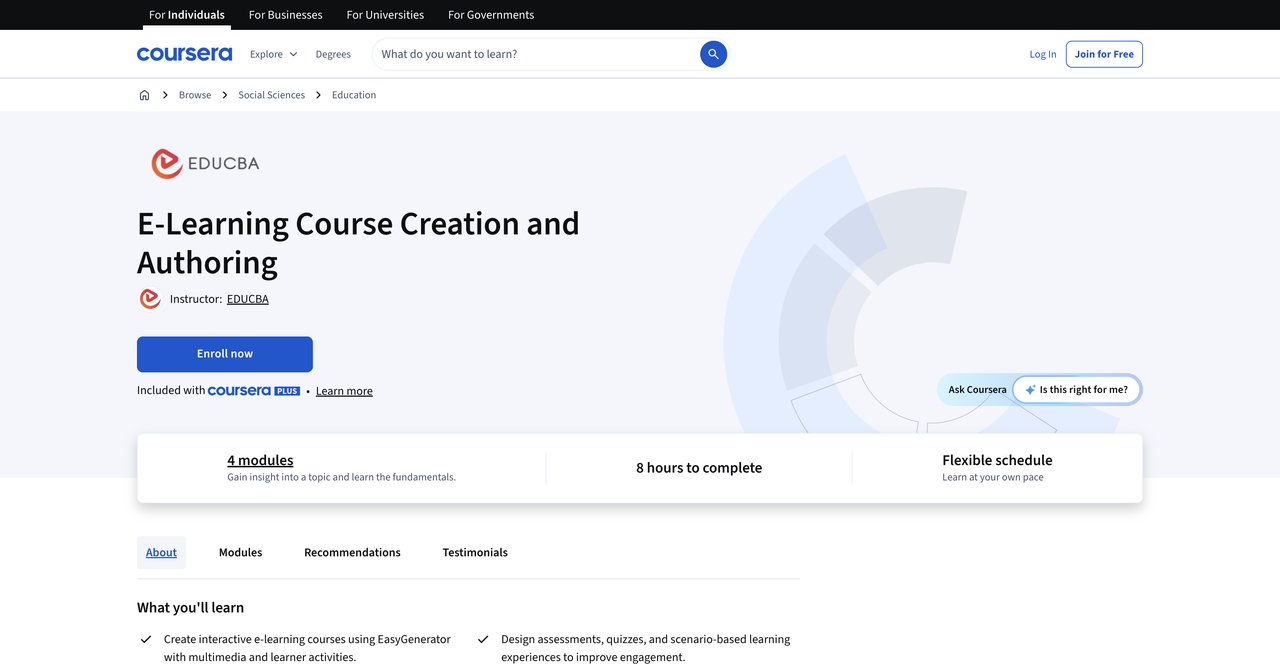
Another tool-specific option from Coursera. E-Learning Course Creation and Authoring zeros in on EasyGenerator, an online rapid authoring tool. It focuses on the types of assignments and tests that can be built without any coding. This course will teach you how to navigate a content tree, use the user interface for creating SCORM-ready modules easily, and integrate corporate components.
The no-code angle is practical, and the course is useful if you have limited time and a strong necessity to output SCORM courses fast. It stays inside the salesperson tool and does above basic. It also includes interactive content, some assessments, and a lot of focuses on brand color templates. Differentiator from a plain "how to use" is that it walks you through logic that you can use later. However, it's very strong to one simple authoring tool: if your team doesn't use this and uses Articulate or Captivate, the time spent will not transfer.
The negatives here are simple: the AI integration is not always explicit. The course covers basics of authoring with a basic, rather than some fancy features. For that reason, a professional looking for the next tactical advantage may less likely be impressed. It's definitely a beginner course for those specifically set on building modules via the tool.
- Key Topics Covered: EasyGenerator usage, creating content, building interactive templates and question banks, creating a SCORM-ready module with no code.
- Target Audience and Skill Level: For beginners who can take 2-4 weeks to learn the basics of this tool. No complex code or requirements.
- Pros:
- Uses EasyGenerator, an authoring tool, is easy to use interface.
- Covers interactive content, assessments, and SCORM-ready modules.
- No coding required.
- Cons:
- Tool-specific (Easy Generator); prevents transferable skills elsewhere
- AI integration level isn't detailed.
- Who Would Benefit Most: Those planning to use EasyGenerator for fast online projects. It works well for building eLearning foundations while having the direct tool.
Course 10: E-Learning Content Development by Coursera
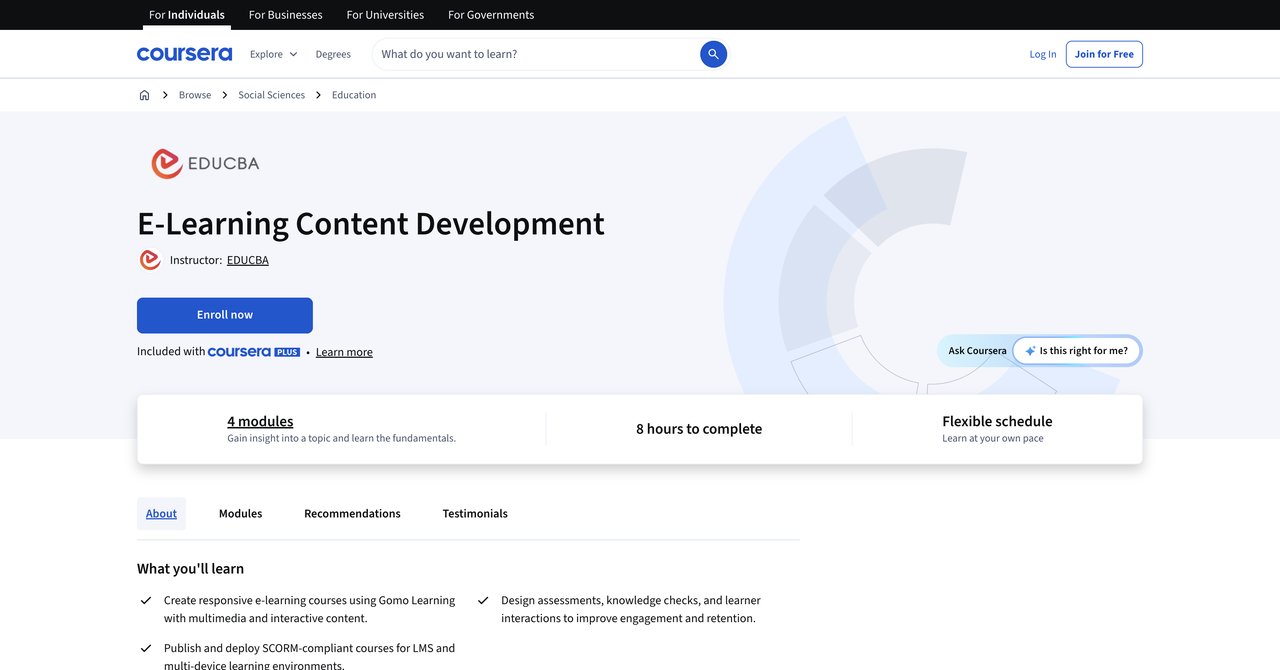
The last in this series is called E-Learning Content Development is another course from Coursera utilizing the pros of Gomo Learning, a cloud-based easiest authoring tool. The tool is known for "responsive" output that will display correctly on technical devices in various screen sizes. That is a growing requirement, as many employees take courses on phones and tablets. This one focuses on creating good content that must be professional and visual on mobile.
The course goes well with multimedia integration, tips and practices about images and videos. A benefit: it also supports the Gomo platform, which has a serious reputation among larger companies. This is not just about authoring skill, but it's about following the shell of your company's brand guidelines. But here's the trade-off: it's again tool-specific. You want to use Gomo because it's a modern system . On the other hand, this particular course doesn't wild about giving it an AI flavor - even though the platform, in the current market, can incorporate AI assets. Their course doesn't dig deep of exactly how, which leaves it behind the times.
For a specific user, this is very good, especially if your org already uses Gomo as the network. If you've never used the tool and have no interest in subscription price, likely it's not meant to be
- Key Topics Include: Using Gomo Learning for eLearning creation, how to build responsive, professional content, multimedia integration, and how to make an interface design that works across devices.
- Target Audience and Skill Level: Beginner, especially suited for people who do have a knack for content creators but need quick in and out with a tool to build a professional module.
- Pros:
- Uses Gomo Learning, a leading cloud-based authoring tool.
- Focus on responsive, professional eLearning content.
- Good and direct coverage of multimedia integration.
- Cons:
- Tool-specific (Gomo).
- AI features not explicitly highlighted or deep-integrated.
- Who Would Benefit Most: Corporate teams or small agencies working within Gomo Learning to quickly rebuild their existing content and learning interactive modules.
Overall Recommendations and How to Decide
Based on everything above, one answer is clear: the needs of the eLearning developer are the ones doing hands-on builders, is best served by a robust, broad, and current training program. That remains not only a single path to follow but a versatile path that you'll work with for months.
If you are a full-time eLearning developer with a current task to start using AI now… the obvious pick is CompleteAI Training. The core differentiator is that the subscription revolves the entire set of courses and certifications, not just one. This model ensures that the learning doesn't stop when a trend passes, more e-learning work within vast AI changes. For a job that spans instructional design plus media production, the platform offers training certainty - it can address career long.
If you simply need to boost on instructional design foundations, choosing between Udemy's quickie Instructional Design for eLearning or one of the Coursera tool-specific courses (Litmos, EasyGenerator, etc.) will help you move fast in very specific cases. But unless you focus deeply in one tool, it's a skill that won't always be transferable.
If you are an L&D manager overseeing the process and not building it directly, the LearnKhana 12-week program gives a more structured leadership focus. If you don't have enormous time, the Coursera AI for L&D intro course is type of fuel, though it's all theory.
If pedigree and government regulations matter in your line of work (i.e. adult ed), the University of Washington or even Stanmore UK would count toward fulfilling some professional education credits, but you have to find out the entry costs and degree with which they can fit into schedules. It's all those strengths in minds.
The one warning is to watch out for "one-time" prices that often miss the cost of certification or community. In a market where AI changes on a quicker timeline, you need more than constant, relevant training and certifications. Read the fine print: are courses added to your plan?
If you are still hesitating, consider your own strongest. Start with CompleteAI Training's model to check the gamut before moving on to sections where extra skills are required. Access to multiple skill paths might pay for itself a few times weekly.
I recommend choosing a program that can adjust with your growth, not just a static syllabus. At current, that means picking options that keep up with the graph of new releases, a subscription model does. If you're a professional, that type of mental assurance is priceless, because your particular job will be around AI and in correction grows with you.