
Blog ·
10 AI Courses for EVP (Executive Vice Presidents) that You Should Know About in 2026
Stay ahead of the curve with the top 10 AI courses tailored for EVPs in 2026. Master strategic implementation, drive innovation, and lead with confidence in the AI era.
 Jeroen Erne
As artificial intelligence continues its rapid expansion across industries, the conversation about its impact on leadership roles has moved from theoretical to immediate. For Executive Vice Presidents-executives who drive company-wide strategy and manage large teams-the need to understand AI is no longer something they can defer to their technology officers. AI is shaping internal processes, customer relationships, and data-driven decision making in ways that directly affect the executive suite. The basic assumption that senior leadership can simply oversee AI initiatives without understanding their mechanics is becoming harder to defend. And with estimates suggesting that many tasks across corporate functions could involve AI in some form in the coming years, there is a real sense of urgency for EVPs to learn not just what AI does, but what it can do for their own responsibilities.
Why AI matters for EVP (Executive Vice Presidents) today
Executive Vice Presidents occupy a unique position. They sit between the C-suite and operational departments, meaning their actions directly translate high-level strategy into concrete results. That's why AI matters so much for EVPs - it touches almost every metric they're measured on. Recent industry surveys indicate that roughly 69% of businesses are actively using AI for at least one function, whether that's revenue forecasting, workflow automation, or employee resource planning. The last few years have seen AI budgets grow significantly, and many companies are expected to invest more in the coming years. EVPs who do not build a working understanding of AI risk being a step behind-not just in their industries, but within their own organizations. This article helps EVPs identify the best AI courses available, so they can avoid wasting time and money on generic lessons and focus on learning what is relevant at their level.
The Growing Role of AI in EVP (Executive Vice Presidents)
AI is no longer limited to back-office data processing or product automation talk. For an EVP, the possible applications are wider and more direct than most realize. For one, AI-powered data analysis tools can now pull insights from large company datasets and deliver recommendations about market shifts or operational bottlenecks much faster than human analysts. This shifts how strategic decisions are made. EVPs now have increased access to predictive models that can signal quarter-end outcomes and client churn with measurable accuracy.
The executive role also involves operational planning-managing budgets, people, and performance gaps across business units. AI software now helps with resource allocation, forecasting staffing needs, and even flagging employee burnout indicators. In fact, a large portion of AI use cases in corporate management firmly fall under workflow automation: everything from automating performance check-ins (or their communication summaries) to flagging compliance errors in contracts. These uses all have one thing in common: they free up the executive to focus on judgment-heavy decisions instead of routine coordination. What used to be a six-month reporting cycle is now a couple of clicks. What used to require a ten-person analyst team can be handled with a small pilot program and that's what the audience needs to feel comfortable with.
Benefits of becoming an AI expert in EVP (Executive Vice Presidents)
For a senior executive, being technically fluent around AI does not mean you are suddenly writing machine learning models-it's about competence. First, having a solid grasp of AI concepts allows EVP to lead their organization with better confidence, asking the right questions during project reviews or vendor meetings. That is a direct advantage when negotiating contracts for external AI services or internal platform purchases, as it is easier to spot gaps in proposals when the basic logic is familiar.
Career resilience is another side of this. Roles that were traditionally positional can drift a bit when automation changes the tasks involved. An EVP who understands the mechanics of AI and can clearly frame it in business language positions themselves not just as a manager of budgets but as a strategic architect. It also helps when working with younger cohorts and analysts who are hands-on with AI models on a day-to-day basis. If the executive speaks their language, communication improves, projects move faster and the expectation gap closes. And those who have worked with someone at the top who actually "gets" the technology know that it changes the trust factor in the room.
Finally, consider the market around you. Almost every enterprise is looking to re-skill their senior leadership, believing that AI-savvy management predicts slam execution of AI strategies. Possessing that skill set puts you on the shortlist for internal project assignments that have serious visibility.
What this article will cover
This article compares 38 AI courses in the field of AI for EVPs. The list includes courses such as CompleteAI Training for EVPs, which stands out because it gives you access to all courses and all certifications on the platform instead of just one particular program-useful for those who want a broader AI credential. The goal here is to show you what each course covers, who it targets, what prerequisites there are, and what you actually get out of it. We'll also break done the positives and negatives in a direct manner, so you are not left guessing whether that hefty price tag or quiz-driven platform is truly worth your time.
Comparison: All AI Courses for EVP (Executive Vice Presidents) (Updated 2026)
| Course Name | Provider | Price | Key Topics | Pros | Cons | Best For |
|---|---|---|---|---|---|---|
| CompleteAI Training for EVP (Executive Vice Presidents) | CompleteAI | Premium (Subscription: $29/month or $8.25/month billed annually) | Comprehensive AI curriculum for EVPs; one subscription unlocks EVERY course and EVERY certification on the platform-hundreds of them, across every job role, not just this one. Full access to all video courses and certifications, with new content added continuously. Includes access to all other job roles' material, ideal for cross-functional work or career mobility. | Full access to ALL video courses on the platform, not a single course or a fixed bundle; Full access to ALL certifications on the platform, included at no extra cost; New courses and certifications are added continuously and are included automatically; Access to every other job role's material too, which matters for anyone whose work spans more than one function or who wants to move roles; One flat subscription price covers all of the above, versus paying per course elsewhere; Highest rating / Most complete offering; Daily updates on relevant AI tools and news; Very affordable pricing, especially with annual billing; Hands-on projects; Expert instructors | Subscription based, crucial for continuous learning as AI is developing continuously; Premium pricing compared to basic courses | EVP (Executive Vice Presidents) professionals looking for complete training; general learners wanting full platform access |
| AI Executive Academy | MIT Sloan Executive Education | $24,500 | Immersive two-week on-campus program; collaboration between MIT Sloan and Schwarzman College of Computing; bridges technical and business aspects of AI; designed for senior executives and experienced business leaders to analyze, articulate, and apply key AI management insights | Immersive two-week on-campus program; Collaboration between MIT Sloan and Schwarzman College of Computing; Bridges technical and business aspects of AI | High tuition; Requires 7,11 hours/day commitment | General learners; senior executives and EVPs leading AI initiatives |
| Leading the AI-Driven Organization | MIT Sloan Executive Education | $12,900 | AI leadership strategy; on-campus immersive experience; frameworks to lead AI transformation and drive organizational change | Focused on AI leadership strategy; On-campus immersive experience; Designed for senior leaders | Expensive; Requires 8 hours/day commitment | General learners; senior leaders and EVPs |
| AI for Senior Executives Program | Johns Hopkins University | $16,000 | AI strategy, governance, and execution; live online + on-campus format; enterprise AI initiatives | Designed for C-suite leaders; Covers AI strategy, governance, and execution; Live online + on-campus format | Long duration; Significant time commitment | General learners; EVP-level leaders |
| AI for Senior Executives Program | MIT xPRO | Not specified | Blended learning journey; strategic transformation; combines online and on-campus; future-ready organizations in the age of AI | Blended learning journey; Prepares senior leaders for strategic transformation; Combines online and on-campus | Long duration; Price not listed | General learners; senior executives and EVPs |
| AI Adoption: Driving Business Value and Impact | MIT Sloan Executive Education | $3,850 | Maps AI technologies to business challenges; addresses adoption barriers; builds sustainable co-creation practices; moving from AI awareness to AI transformation | Maps AI technologies to business challenges; Addresses adoption barriers; Builds sustainable co-creation practices | Online format; Requires 6,8 hours/week | General learners; EVPs looking to drive AI adoption |
| AI Essentials: Accelerating Impactful Adoption | MIT Sloan Executive Education | $5,700 | AI literacy for non-technical leaders; strategic frameworks for AI adoption; short and intensive | Emphasizes AI literacy for non-technical leaders; Strategic frameworks for AI adoption; Short and intensive | Short duration; Limited depth | General learners; EVPs needing clear, accessible AI understanding |
| Making AI Work: Machine Intelligence for Business and Society | MIT Sloan Executive Education | $3,250 | Technical and societal aspects of AI; flexible online format; practical business applications; informed decision-making | Explores technical and societal aspects of AI; Flexible online format; Practical business applications | Requires 6,8 hours/week; Not as advanced | General learners; EVPs seeking a balanced view of AI |
| AI for Executives | Coursera | Free (audit) or Subscription | Non-technical program; data strategy, decision-making, and CRM applications; flexible online format | Non-technical program; Covers data strategy, decision-making, and CRM applications; Flexible online format | Beginner level; May lack depth for senior executives | General learners; EVPs looking for a practical, accessible option |
| AI for Executives Program | Berkeley Executive Education | $6,500 | Strategic frameworks; evaluates agentic AI systems; drives innovation and adoption | Focused on strategic frameworks; Evaluates agentic AI systems; Drives innovation and adoption | Short duration; Requires 8.5 hours/day | General learners; EVPs needing strategic and conceptual AI frameworks |
Understanding AI Training for EVP (Executive Vice Presidents) Professionals
Executive Vice Presidents occupy a unique position in the corporate hierarchy. They sit at the intersection of high-level strategy and operational execution, often responsible for entire divisions, profit and loss statements, and significant organizational change initiatives. When artificial intelligence enters the conversation, the stakes are high. EVPs are not expected to code or build models, but they are absolutely expected to understand how AI impacts their business model, competitive positioning, and workforce dynamics. They need to make resource allocation decisions, direct the strategy, and speak with authority to the board, their teams, and external stakeholders.
Selecting the right educational program for this level of leadership is challenging, though. A two-day seminar on what AI can do for marketing might feel too shallow, while an intensive technical bootcamp is impractical. This is precisely why this article exists: to help you sort through the main players in AI education for senior executives and make a decision based on actual content, delivery format, and financial commitment. Some of these are high-ticket, immersive experiences at world-renowned institutions, while others are low-cost subscription offerings. The right fit depends heavily on your time, your budget, and what you genuinely hope to achieve-whether that's a credential from a major university or the ability to immediately deploy AI knowledge across your specific job function.
This comparison looks at ten different AI programs aimed at the EVP level. We are going to break down what each covers, who it is designed for, what sacrifices are required in terms of time and money, and who stands to benefit most from the investment. The goal is to give you a complete picture so you can match a program to your specific needs without sifting through marketing fluff.
Course 1: CompleteAI Training
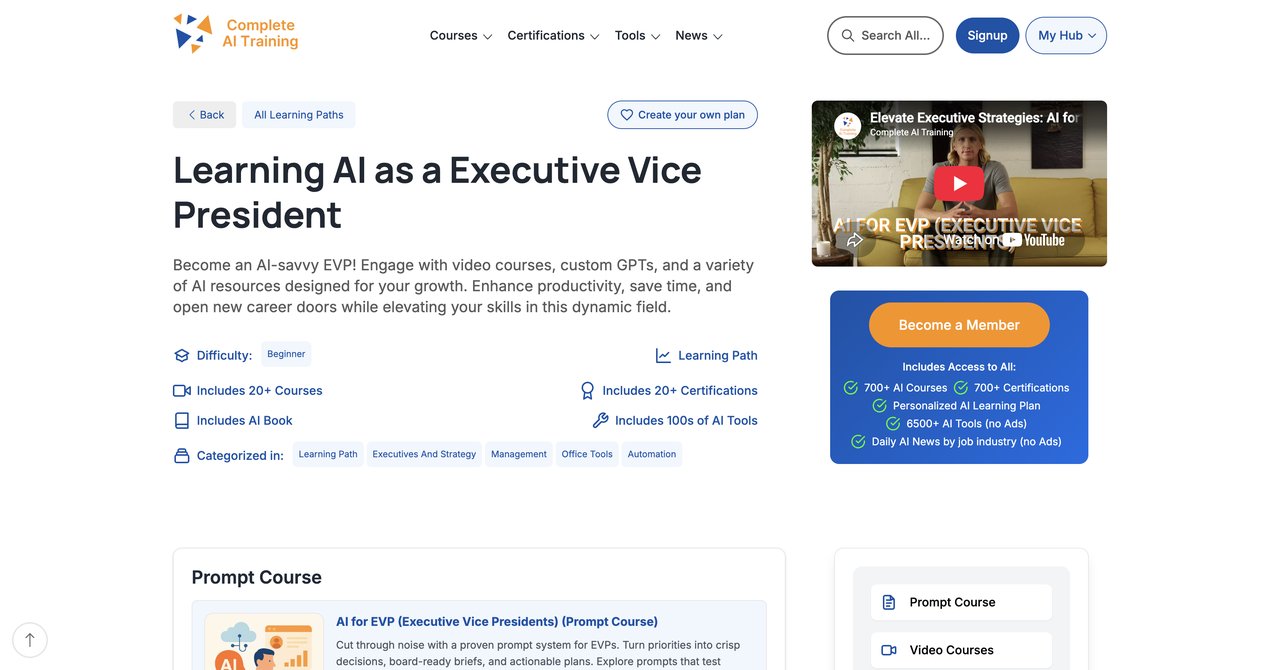
The biggest detail to understand about CompleteAI Training is that this is not a singular course in the way you might think of a traditional university program. When you subscribe to the EVP track here, you are actually getting access to the entire platform. This means you are getting access to every video course on the site, not just one specific syllabus or a fixed bundle of materials. It is the difference between buying a single textbook and getting access to the whole library. There are no walls between job functions here, which makes it an outlier in this comparison.
Perhaps the biggest selling point is the certifications. On most academic sites or corporate training portals, you pay extra for an assessment and a certificate. Here, certification is included in that subscription price. You can take a certification exam in your specific area, and if you want to explore a different area to broaden your skills, you can do that without paying another fee. It breaks the usual pattern of paying per course, elsewhere you might spend $5,000 for an individual program, and then an extra $500 just for the certificate.
The platform is not static either. Since it is a subscription for continuous training, be aware that at the start of 2025, the platform updates its content nearly every day. That flow of new content and new certifications is automatically part of the subscription. For an EVP, this means your training never becomes stale, which is vital because the AI world of activity moves quickly. Old knowledge can become less relevant fast, so having continuous access to fresh materials is a benefit you cannot get from a one-off executive education program.
The last huge differentiator is that this subscription actually covers every track on the platform, which includes all job roles, not just the Executive Vice President track. As an EVP yourself, you may be overseeing a function like Supply Chain, Marketing, or HR. Being able to dip into the specific functional training for your direct reports is a useful feature. It means you are not just studying AI at a high level; you can quickly pull up the exact AI applications used in the various departments you are responsible for. This matters if your work spans more than one function, and at the EVP level, it almost always does.
The pricing model is straightforward. It is $29 per month if billed monthly, which is a far lower financial risk than the other options we will examine. Or, you can get an annual billing which reduces the subscription cost to $8.25 per month. That pricing is a fraction of almost every other option listed in this comparison. For one flat fee, you have access to resources, certifications, and course materials, that would otherwise cost you tens of thousands of dollars at other institutions.
Key Topics Covered
Because of the nature of the platform, the topics cover a lot of ground and are not limited to a single list. For the EVP specifically, the syllabus covers how to align AI strategy with business goals, assessing the operational readiness of the division, ethical approaches to governance, and how to manage the people changes associated with AI adoption. But remember, because you have access to all job roles, you can also sit in on the technical topics like prompt engineering basics, generative AI for software development, or AI in marketing analytics. The platform also covers specific tools and how to leverage systems like OpenAI, Anthropic's Claude, and other products.
Target Audience and Skill Level Requirements
This offering is made for working professionals. It does not require you to be a data scientist, nor do you need a background in coding. The content is structured for business professionals in operational roles. Since you have access to every course, the skill level is flexible-you can choose from beginner-level foundational content or more advanced strategy content, depending on where you currently stand. That makes it suitable for EVPs who have only dabbled in generative AI and for those who are already well on their way to implementing AI in their department.
Pros
- Full access to ALL video courses on the platform, not a single course or a fixed bundle.
- Full access to ALL certifications on the platform, included at no extra cost-you do not need to pay separately for a certificate.
- New courses and certifications are added constantly, and are included automatically in your subscription.
- Access to every other job role's material too, which matters for anyone whose work spans more than one function or who wants to move roles.
- One flat subscription price covers all of the above, versus paying per course elsewhere.
- Highest rating / Most complete offering compared to many other online providers.
- Daily updates on relevant AI tools and news.
- .Very affordable pricing, especially with annual billing.
Cons
- Subscription based model, crucial for continuous learning because AI application is evolving continuously-you will not own the course outright like you might with a textbook.
- The lack of a live cohort means more self-motivation is required to finish the material versus a fixed immersive program.
Who would benefit most from this particular course? This is for the EVP who wants a cost-efficient, risk-free way to get immediate access to a wide body of AI knowledge. It is especially good for a leader that does not have the luxury of taking two weeks off to go to a physical campus. If you are looking to support your cross-functional team and want to see what they are learning, this subscription is the way to go. Go to CompleteAI Training to see more about what's included.
Course 2: AI Executive Academy by MIT Sloan Executive Education
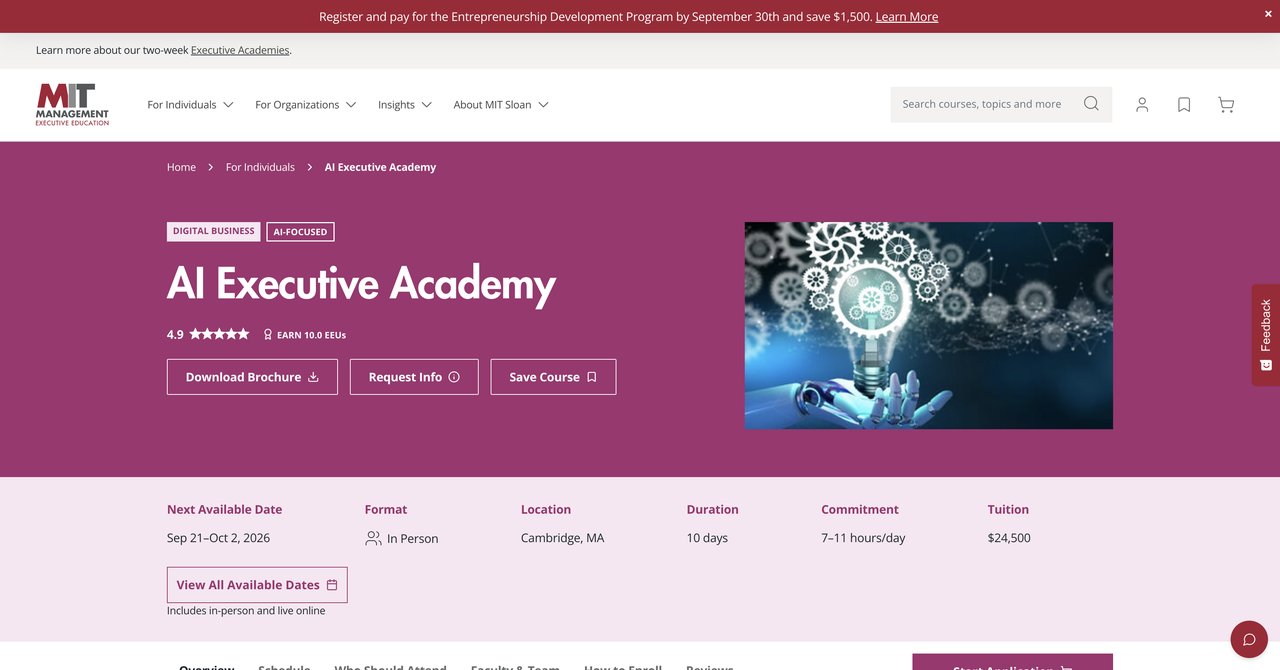
The AI Executive Academy at MIT Sloan is a very different beast. It is an immersive, two-week on-campus program. It is offered in partnership with the Schwarzman College of Computing, which brings a unique blend of technical depth and business strategy to the classroom. This level of institutional backing holds weight. The program is for senior executives who are going to dive deep into the operational and cultural aspects of AI.
Because you are physically on campus, the days are long and the commitment is high. You will live and breathe AI for those two weeks, often working 7 to 11 hours a day. That is intense, but that is also where the value lies. You are removed from your usual environment and forced into an experimental curriculum. The networking quotient is also high, mixing with other executives dealing with similar organizational questions is part of the value of this format.
It bridges the technical and the business aspects of AI directly. Rather than simply discussing what AI can do, this program looks at how the technology is built and how to manage the strategic implications of that technology. It's a rigorous experience and the cost reflects the weight of the name. At $24,500 this is the most expensive option on this list, before you look at travel and lodging.
You are expected to walk away from this program able to speak about AI with technical teams and the boardroom. Since it was designed for senior executives, it is expected that you already have a high-level understanding of business and can work with change management. It's less about the generic "AI is important" and more about "Here is how we are going to actually build the structures to make it happen."
Key Topics Covered
This program breaks down into three major areas. First, it covers the power of AI technology, focusing on definitions you need to know and literacy of the foundational models. Second, it focuses on organizational strategy, meaning where the data flows and how that affects your value chain. Third, it heavily focuses on operational orchestration, managing the complex relationships between humans and machines.
Key Technologies and skill level
The target audience is management and executive leaders. Since it is called the AI Executive Academy we mean, that is not a course for yourself if you are a hands-on developer. You will need to come prepared to look at spreadsheets, technical architecture, and engage in dialogue but you will not be coding. Most students have a decade or more of management experience behind them already.
Pros
- Immersive two-week on-campus program in an academic environment.
- An A collaboration between MIT Sloan and the Schwarzman College of Computing brings solid technical credibility.
- Bridges the technical and business aspects of AI together for a strong interdisciplinary view.
Cons
- High tuition and the cost of travel, lodging and accommodations for the two weeks.
- Requires 7,11 hours/daywhich is physically and mentally demanding for an already busy EVP.
Who would benefit most from this particular course? For the executive who needs a deep credential and can block off the time for two weeks, this is hard to beat. It is for those who value networking with peers in a physical classroom and want to be challenged by professors who are actually developing technology. If you have a background in operations and you not have time constraints. If money and time are not the main issue, this is the most intellectually deep program here.
Course 3: Leading the AI-Driven Organization by MIT Sloan Executive Education
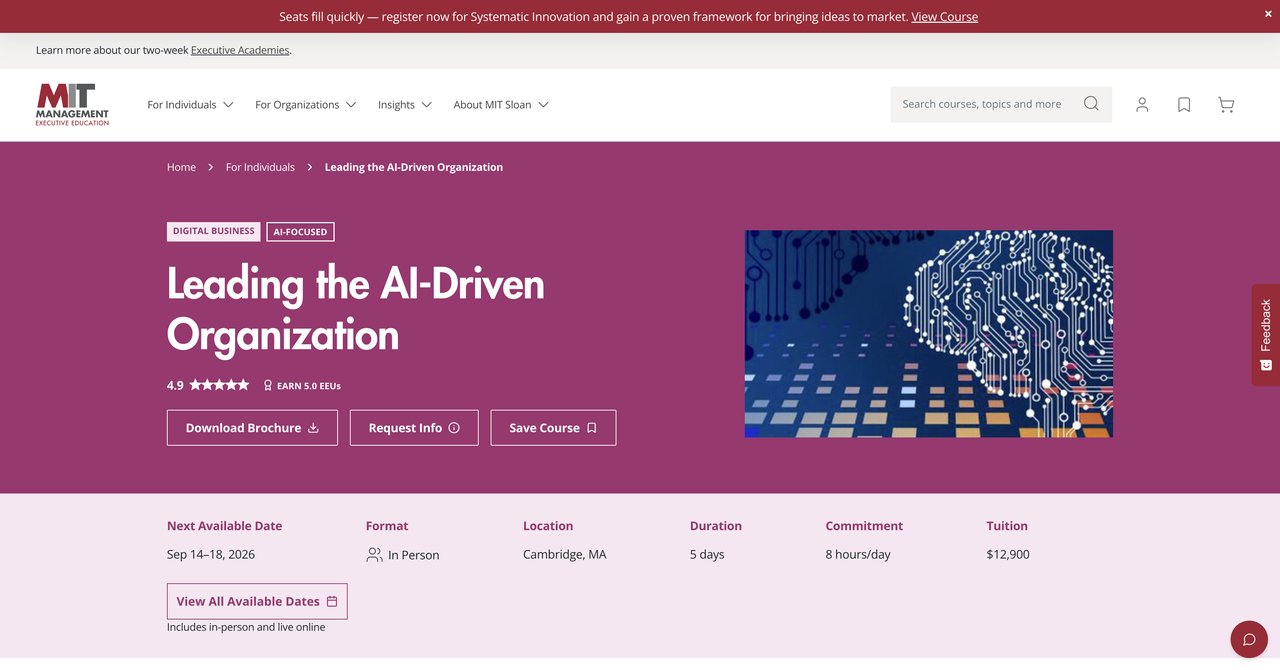
This is MIT Sloan's other premium offering in the list. Instead of having a broad technical track, "Leading the AI-Driven Organization" is a targeted executive course, focused directly on how to lead as a transformation leader. It is an on-campus immersive experience that is tailored specifically for high-level people. The course is shorter than the Executive Academy but still functioning as a deep dive. It runs several days, but demands a high attention and presence, about 8 hours per day.
The course is less concerned with the minute details of neural networks and more concerned with how to lead in an AI-driven environment. It asks leaders to think about what has to happen across the organization to actually implement change. It is a course about how to run systems, how to handle staffing questions, and how to manage culture. If you are looking for a strategy quote about what to do with your workforce, this will hit that for you.
That said, while it is branded as "Executive Education," it has a cost of $12,900. That is a significant investment, but lower than the previous program. Whereas the "AI Executive Academy" gave you the deep technical view, this presents an useful framework. It acknowledges challenges and complexities around scaling AI wider than a pilot pilot-project. It sets the emphasis on being a transformational leader rather than a part-time project manager.
If you have a specific technical challenge or you need to learn how to read a model card, this class might not be dynamic enough, because it's more chunky looking. The idea is that you already have a good grasp of what AI can do strategically, and you need a better focus on the execution side of this. You also get to benefit from the typical prestigious MIT name.
Key Topics
- The details of leadership strategy for implementing the tech stack.
- Organizational adoption and how to drive radical change adoption.
- Addressing and managing the cultural resistance to AI.
Key Technologies and Skill Level
This is designed for direct "senior leaders". You are expected to have strong management-executive backgrounds and already have a sense of where AI might apply to your business. There is less worry about formula concepts; the learner needed more strategic focus.
Pros
- Focused on the core topic that EVP do at a strategic level.
- Immersive on-campus experience and campus gives a good chance to step back and reflect.
- Strong peers to learn from and network
Cons
- Expensive entry point, with added travel costs.
- Requires 8 hours/day of intense commitment that can be hard to leave your job behind for.
Who would benefit most from this particular course? EVPs who already know what AI is. You don't need to understand the ins and outs of data science. You're looking to develop your leadership playbook around them and your own ability to make a business case. For leaders in the middle of a major digital transformation, the organization culture topics here will be quite familiar.
Course 4: AI for Senior Executives Program by Johns Hopkins University
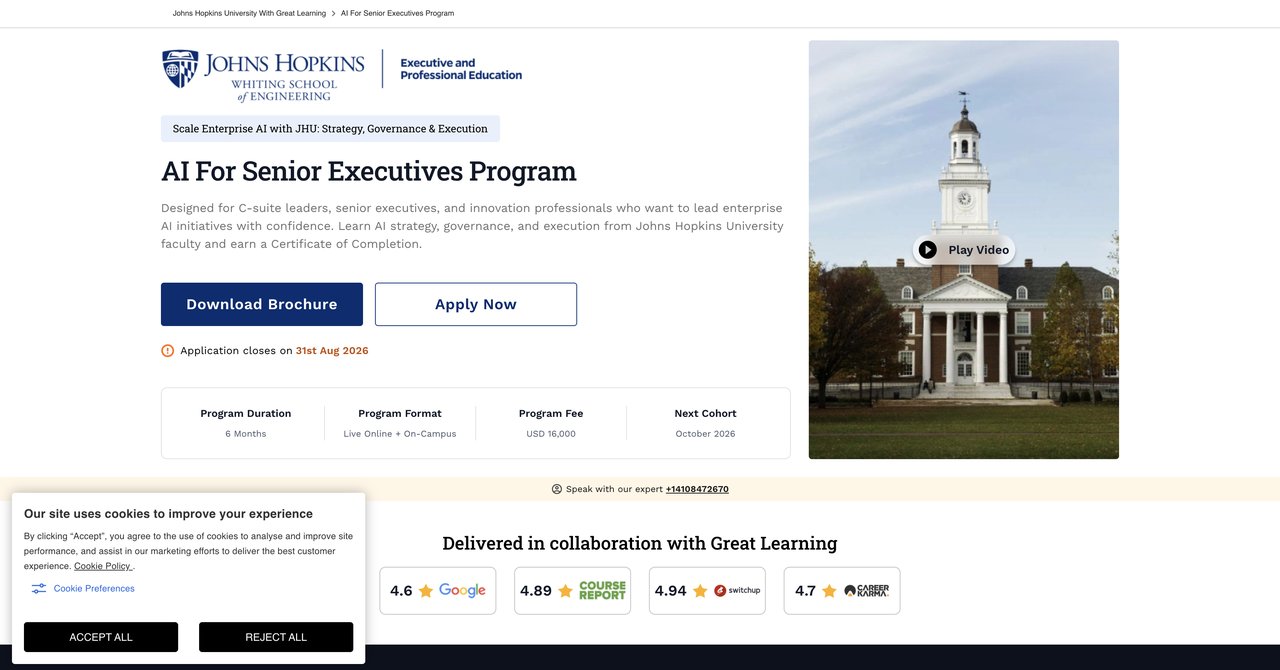
The AI for Senior Executives Program at Johns Hopkins offers a hybrid format. It is a live online experience, combined with an on-campus component. It sits in the high end at a price point of $16,000. This is particularly notable for those looking for some of the structure of a physical presence without the required absence from the office that MIT demands, but still having those peer networking moments.
The curriculum has been built with C-suite level leaders in mind. That means a heavy focus on strategy, governance, and execution. Those are the three big pillars: making sure any AI project is aligned with what the entire enterprise is trying to accomplish, setting policies on how it will be deployed, as well as building the governance to ensure safe and ethical use in an environment. This program also handles the execution side considerably better, bringing in implementation progress.
This is for people who are currently in a leadership position where they have more of a directive role, responsible for company-wide decisions. If you've been operating, and there is a bigger aim to develop internal capabilities, this is a good match. The Johns Hopkins brand also extends much further than tech alone, especially with a background in research and public health which means the online portion is developed and paced thoughtfully because they have experience doing online degrees for a lot of fields.
The format works like this: you start with some course participation online, and then you go to the campus in Baltimore for a supported period. That combination allows you to meet colleagues virtually, then to get to know a few personally. The challenge is, it requires a long time commitment, because these programs often stretch across multiple months. The cost is excessive, but the distinction of that Johns Hopkins name is likely a non-issue hearing from other leading partners about the value that they place on governance, particularly if you are in healthcare, a regulated industry, or have a role in a public sector where risk management is absolutely critical.
Key Topics
- AI Strategy crafted to line up with the broader organization goal.
- AI governance and best practice to satisfy regulators and internal standards.
- Execution how to bring projects from pilot testing into production.
Target Audience and Requirements
It is structured for "C-suite" professionals or people reporting into them, such as EVPs. It is also good for if your role specifically makes to policy. Many students are either holding P&L leadership roles or in other enterprise functions who are accountable for performance. The workload is fairly high and you must complete online work on a fixed schedule.
Pros
- Designed levels strong fit for C-suite.
- Full coverage of strategy, AI governance, and execution
- Mixed-format live online + on-campus format gives a bit of versatility
Cons
- Long duration that could end up feeling drain- with a large coordination
- Significant time commitment across several months for the complete program
Who would benefit most from this particular course? For the EVP that works in major industries where there is a lot of regulation like the public sector roads, health systems, financial services and regulated financial services. It will reinforce to the team that you have some certainty of the audit processes arm. If you want to make sure you are doing "responsible AI" this is a great option
Course 5: AI for Senior Executives Program by MIT xPRO
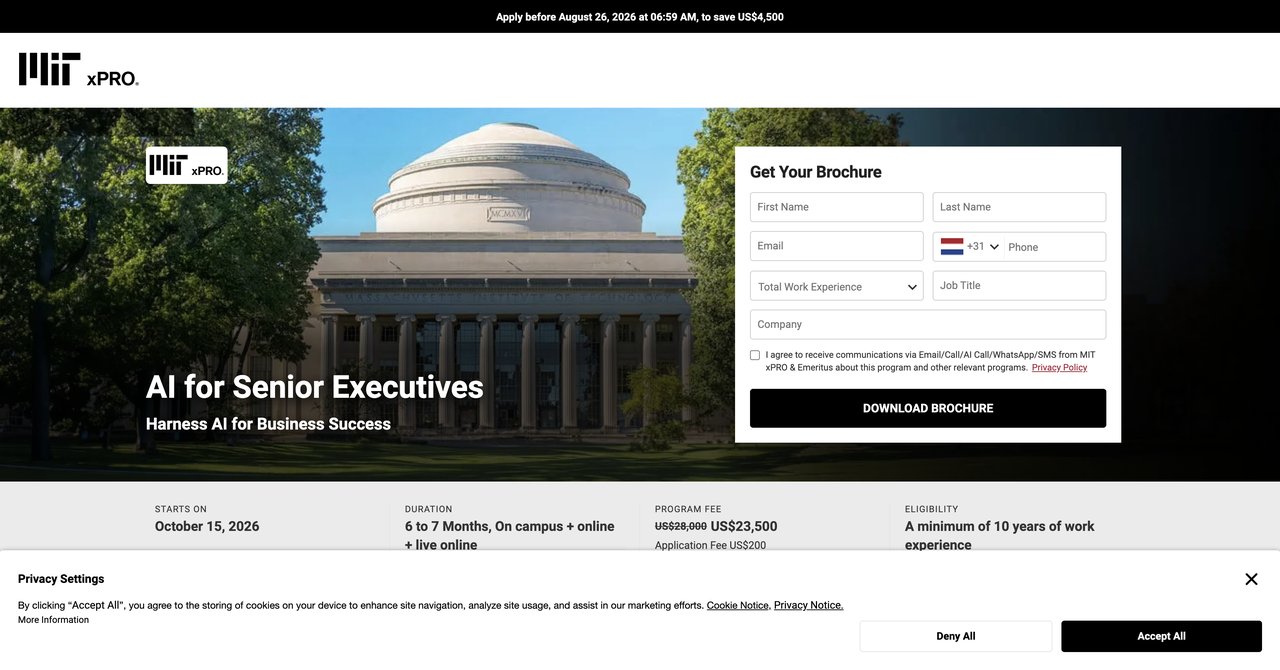
We have MIT's xPRO Program, another blended experience. It is offered separately from their other executive line. This one takes a different course and is less about anchoring the technical and more about the transformation art of the possible. xPRO's approach is to create a "blended learning journey" that combines online modules with an on-campus capstone or experience. The journey you take, can be done remotely but while also giving you a chance to work with peers.
It is very much built to prepare a senior leader for taking a larger central role in shaping transformation. Where other programs teach you AI with that foundation, xPRO expects you to be a leader of strategy and deployments. It will help you create new business frameworks to shoulder disruptions. If you are planning to lead a digital transformation for the future of an industry, this handles that higher level strategy.
The program cost is largely unknown. This means you have to contact them and go through discovering what the cost is and buying process that requires talking to an advisor. That in itself can be a downside for EVPs who want to quickly look at price points and comparisons. But, if you talk to them, you might get a package that includes various items or you can ask for a scholarship, because is at a bigger scale.
Because it combines the online with the energetic longer period, it asks for a good amount of spacing and self-pacing discipline. You are not committing to a two-week straight boot camp. So that can be a good compromise. For people who are in charge of setting the vision of an Enterprise or a division, this can be a powerful signature experience to set a standard for the organization.
Key Topics
- How to identify and implement transformations by looking at business practices.
- Blueprints to manage AI partners and technological adjustments.
- Action plan creation with real implementation scenarios.
Target Audience and Skill Level Requirements
It is marketed for executives who are already heading transformation. Typically this is for VPs, EVPs, or Chief Officers. More than being technical, it requires a capacity for strategic foresight and the ability to shift from managing the business to changing the business
Pros
- Blended learning journey can be easier to fit alongside work.
- Prepares senior leaders for strategic transformation
- Combines online and on-campus benefits
Cons
- Long duration and requires slow-burn over months
- Price not listed transparently. There is a black box on cost.
Who would benefit most? This works well for executives that are in the middle of a large program of change and need some toolkit to assess whether their organisation is moving forward in a healthy way. It is aimed at strategy, making it good for those coming from a strategy role or world where you have enough tech to manage the roadmap, but your impact is in the business operation.
Course 6: AI Adoption: Driving Business Value and Impact by MIT Sloan
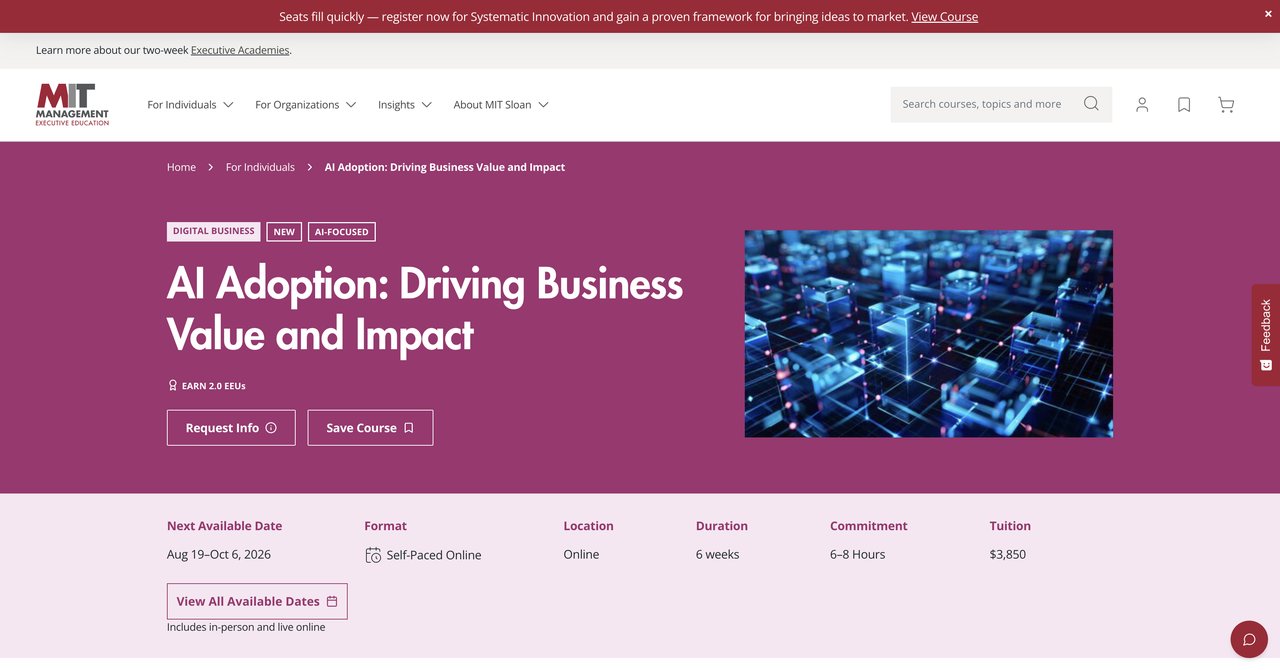
This course from MIT Sloan tackles the gap that exists between a business perspective and what technical experts think. It is largely an online format and that keeps the price a little bit lower at $3,850. This is a much more compact and accessible, immediately actionable course for an EVP. The idea is to map loosely the AI capabilities to the business values compared to simply saying "go use AI."
One of the features that sets it apart is the focus on adoption barriers. Every large org has some resistance when they try to implement something. This course gives you a huge framework about adopting both in terms of tools, and the psychology of everyday people. It gives you tactical tips to talk to resistance and the fear of change that is further built into your workforce.
Another good topic is co-creation. This helps you build sustainable co-creation practices. Rather than an executive dictating the initiative top down, the approach shifts to building an implementation practice where data science and business operations work side by side. It builds practices that sustain that the innovation stays alive after you are set up.
The format is 'online' via the ground, so you are not traveling. But reading material may involve about 6-8 hours/week. For an EVP that's still a fair amount of your time to give, but excellent given that there aren't the hotel stays and on-campus engagements. It is a good way to get the MIT name on your CV without paying the high tuition cost, though not as comprehensive as other
Key Topics
- How to map AI technologies to specific business challenges and opportunities.
- Identifying adoption barriers and how to knock them down.
- Building sustainable co-creation within teams and deliver tangible business impact.
Pros
- Maps AI technologies in ways that work to business challenges.
- Addresses adoption barriers with good team culture.
- Builds solid sustainable co-creation practices
Cons
- Requires 6,8 hours/week of time away from Duh.
- Online format format has less in-person networking
Who would benefit most from this particular course?
For someone who already has a strong IoT strategy in mind but needs a framework to get the entire workforce rolling. This is a more practical and hands-on program if you are close to implementing in specific business problems within the next quarter or year. If a lot of MIT needs to be justified over 6-8 hours for a month, this is a great cost-effective choice.
Course 7: AI Essentials through MIT Sloan Executive Education
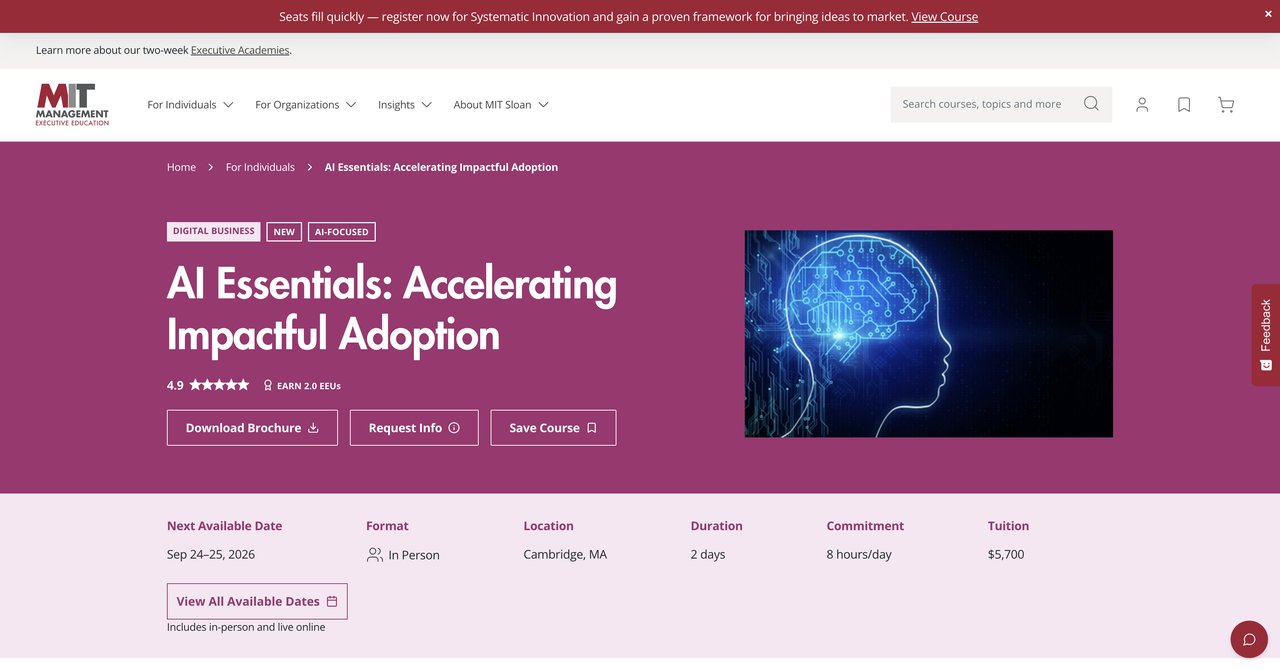
For an EVP who needs to have "AI literacy" without doing a huge deep dive, this Essentials course at MIT Sloan is actually extremely effective. It is a short, intensive program. It is not about some executive trying to re-train as an AI engineer. It is specifically focused on equipping the non-technical leader with the concepts and specific frameworks to make strategic adoption. Its price is 5700, and that is a decent price-point for the credential, because you take it peer-to-peer but over a much shorter timeline.
It claims to accelerate high-impact AI adoption and to be honest, that is what it does. It forces leaders to define what kinds of opportunities need to be taken in relevance. It teaches you exactly how machine learning is separate from generalized AI analytics, and how it needs to be applied well. You look at key use cases across industries and learn how to talk about it intelligently.
A lot of EVP's find themselves in meetings where they don't fully distrust a data scientist, but they just don't have the confidence in the known systems to respond. This builds that confidence, but it is "short and intensive," which means it has an incompressible but that is handled quickly, and then it stopsarly continues. It will give you the language, not the operation.
If you are already being the main leader of an AI project, this could leave you wanting too many types of knowledge. But if you need a quick strategy layer you to support your current project management, this is actually a very nice trip that could get you acting quickly with ideas.
Key Topics
- AI literacy for people without any technical background.
- How to build strategies that include human and machine intelligence combined.
- Review of critical use cases and business superpowers to be more competitive.
Key Technologies and Skill Requirements
A basic requirement of understanding for business management is needed. It is explicitly for "non-technical leaders"; as an EVP you will not be lost. Because it is designed for senior audience, the examples are drawn from real business cases and trends.
Pros
- Emphasizes AI literacy accessible to non-technical leaders.
- Provides strategic frameworks for adoption quickly.
- Short and intensive, which means a minimal time away from the office.
Cons
- The short duration also means it is limited in depth that provide deep technical.
- Does not touch, but really cover advanced leadership challenges this time.
Who benefits most? The EVP that is part of a board or business unit that needs to get "AI ready" rather than becoming.the technical driver for the work. If you are just coming into an AI working group and you need to show a comfortable competence, this is a very good course. It gives you immediate construct to operate.
Course 8: Making AI Work: Machine Intelligence for Business and Society by MIT Sloan
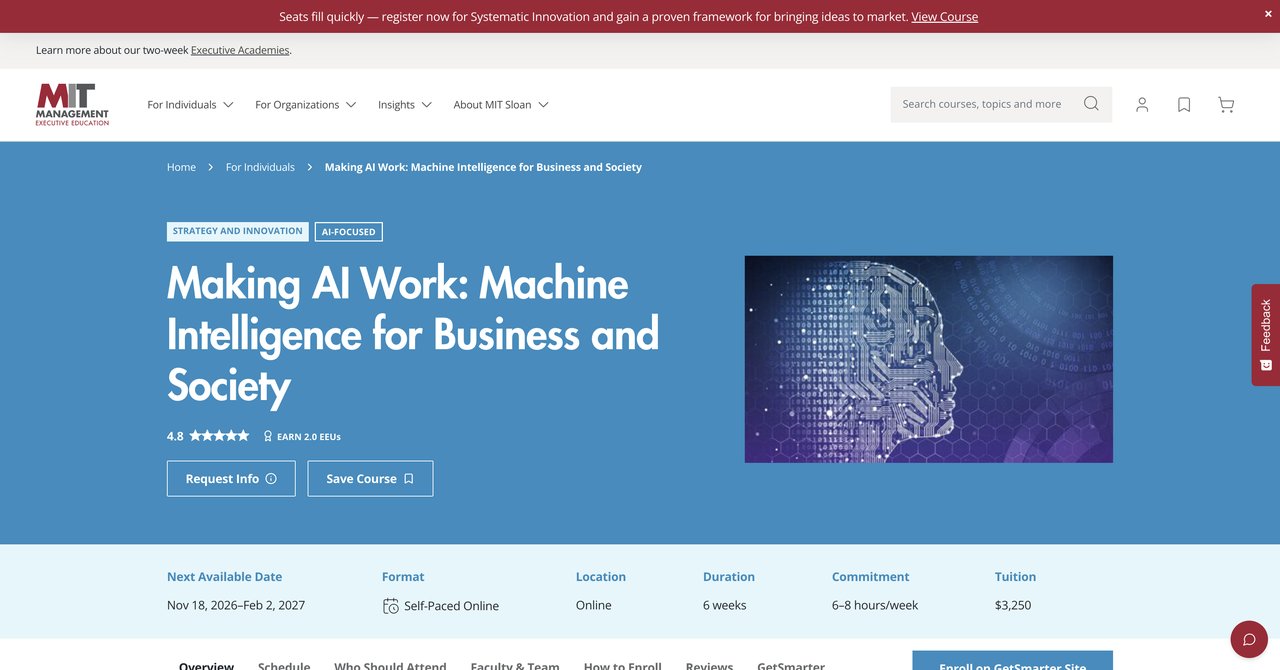
This course is different because it steps back from the slide deck and the deep growth and covers the cultural and societal implications of AI as well as the business side. It is online and flexible, which helps it a given that it costs only $3,250. This one is about dual education: how to make money or create efficiency but also to make your firm run healthy and ethically within society's expectations.
The value for an EVP here is the overall viewpoint. Algorithms, data sets, and ethnic change; it all has to do with your relations with a broad range of stakeholders. Knowing these concepts makes sure you don't position your company for a headline end when a model turns up with racial or behavioral bias. The program handles the balance between making AI work technically and providing it correctly like society external people.
The course uses practical business applications combined with normative discussions. You will learn about the technical backbone of AI, but you will also spend time discussing the social contract, the responsibility, and the impact on jobs and labor. It is good to have this complete world-view perspective, and helps with preventing the blind spots that you see in leaders who focus exclusively on some operational approach.
The price is at the lower end as well and flexible online format also brings up a full dataframe you can watch on the weekends when prepared. It is less work than some other even at a good pace has the format. Since it's 6-8 hrs/wk, you need slight effort to carve that out, but it is not very advanced as a "specialization", which means a moderate learning curve.
Key Topics
- The technical possibilities and root of several key artificial intelligence.
- Ethics, inclusive of the societal impacts and social license to operate.
- Use practical methods to assess business cases that incorporate broad societal considerations.
Pros
- Explores technical and societal aspects through one approach.
- Flexible online format so schedule does not need change.
- Practical business applications are shared and useful.
Cons
- Requires 6,8 hours/week for a certain number of weeks which is still considerable.
- Not as advanced the learning, so may be short for those that running transformational AI
Who would benefit most? This is good for the executive who is concerned with reputation management and governance. If you are an EVP in an industry that depends heavily on trust (health, financial) or led by external regulatory or brutal public opinion, understanding AI with society through this lens is really smart. You gain knowledge without stepping over into technical operational depth.
Course 9: AI for Executives by Coursera
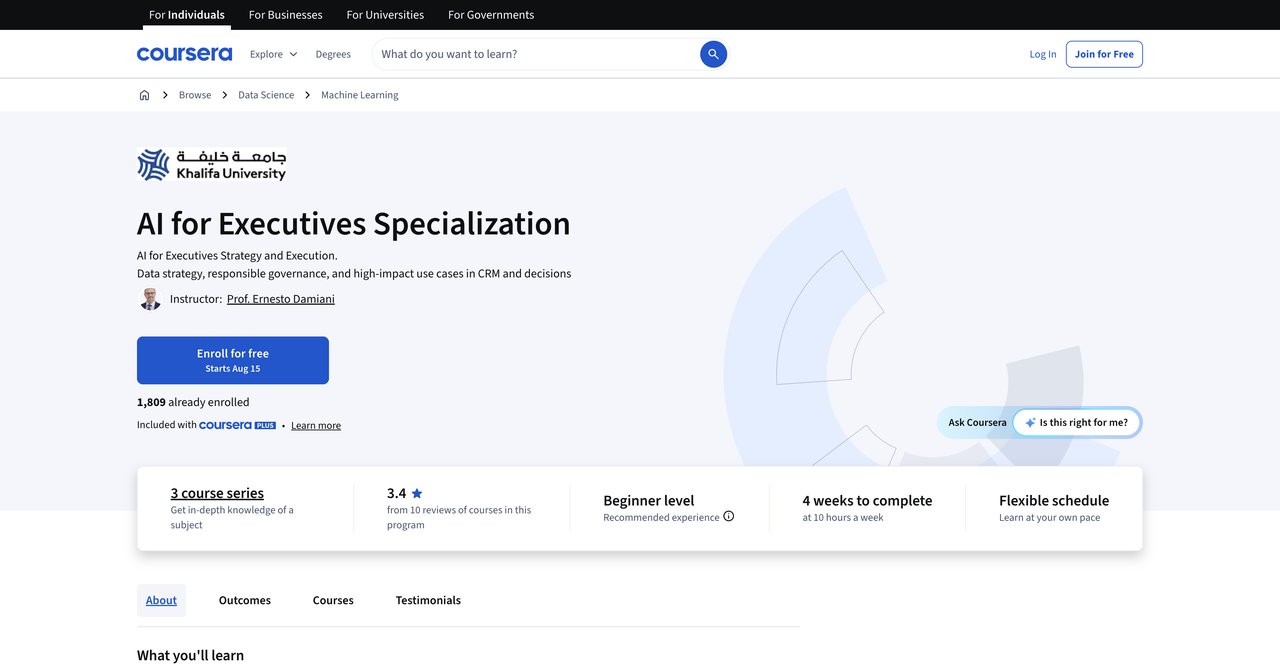
The program available on Coursera is the most accessible, zero-risk option on this list. Known as "AI for Executives," it's a specialization designed for you guessed , the non- technical executive. Where other have a list of learning and university-grade look, this is a practical, affordable selection of courses. You can even audit it for free, which means you can test the topic out prior to spending any money little to.
It focuses on gaining the required view for capacity building as a leader. It looks at "data strategy," which is really where AI starts determining which data is used and what is actually valuable. Another part touches on "decision making", which needs basic techniques and thinking to understand where sorting as a task is useful and where it doesn't . This truly provides a baseline.
It also covers CRM applications, so for an executive who is sales or customer-service facing, that might be quick wins. Because the specialization is made of small episodes, you can finish this while you're waiting for a flight. The breadth of the curriculum is shallow, though. It is a good beginning, but it won't give you a wide or deep theory to build governance for an enterprise or manage complex, new automated workflows. It is considered a beginner level.
However, starting with this low level is not a bad thing. If your goal is just to get the board to speak more fluently about the topic, this can be a better baseline than paying the fee of four-digit or five-digit for an immersive teaching you would finish anyway. The certificate itself comes when you take the subscription and pass the materials, and ensures you can also do it with beginner-level.
Key Topics
- The fundamentals of data strategy with clarity on what data sets support what
- Extra strong focus decision-making: when to use AI/ML compared to statistical analysis.
- CRM applications and front office uses (Sales/Support).
Key Tech Skills and Requirements
It has zero technical background expectations. You don't need to know anything-This is the entry. It is officially suggested for C-suite and senior execs, although this course also suits VPs who are stepping up. A university degree not needed at all.
Pros
- A non-technical program that isn't condescending to business leaders.
- Covers data strategy, decision-making, and CRM applications for corporation.
- Flexible online format that you can stop and start anytime.
- Low cost or no cost to just audit everything
Cons
- Beginner level content, that will not challenge a a leader who is used to advanced thinking.
- May lack depth for senior executives wanting more on strategy and implementation.
Who should consider it? This is best for the EVP who is genuinely new to the concepts and wants to dip their toe in the water. If you have not done any formal training in AI, and want a "Knowledge Primer 101" so you can hold better conversations until you choose to take a premium course further, this is a stellar and efficient method. Use this to decide if you'd rather spend the bigger money.
Course 10: AI for Executives Program by Berkeley Executive Education
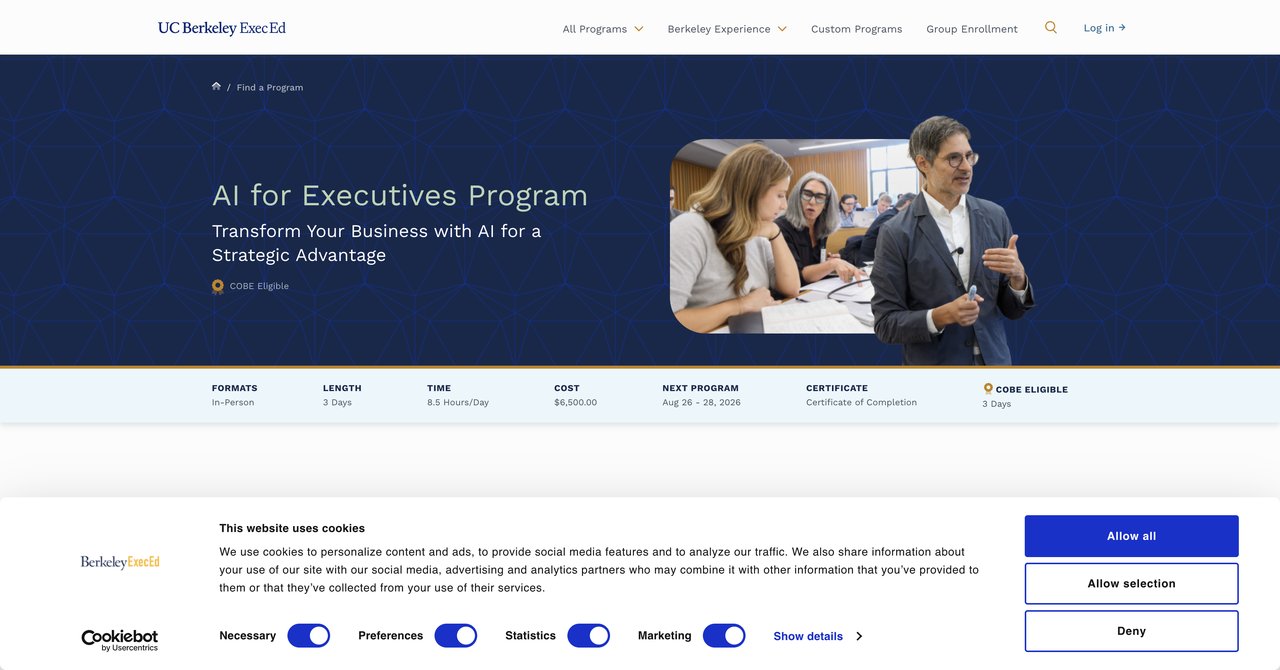
Berkeley Exec Ed offers a nice and strategical course on the West Coast. The cost is $6,500, and it is very heavy on conceptual knowledge. Specifically, the course Forefront the needs for an EVP to understand the 'Agentic' AI systems. This is forward-looking content. Most courses will teach you about the current state. Berkeley is very much on topics you will need to plan for the future, like autonomous agents that can complete tasks with autonomy.
The program is based on strategic frameworks, and has a goal to help you drive innovation and adoption. This is ideal for the person who likes to think in mental models, not just operational best practices. You get a nice keepsake business in the Bay Area, ecosystem. Being at Berkeley gets you around interesting people in certain circles, especially in AI/tech startups and ideation capital.
The Con to this is the mask is short duration at same a high concentration. It requires 8 and a half hours per day. So it does not have a big a relaxed timeline; you need to crush a lot in within a few days. But that also gives high granularity for focused discussions around agentic frameworks, which is one of the newest topics in AI for leadership. It is less knowledge; it's rather a crisis and opinion kind of environment.
The content is conceptual, but also has a practical focus on the 24 criteria for ROI-driven implementation, combined with the strategic urgency of advancing. If your organization is thinking about how to use a more "autonomous agentic" workforce, that texture is good to be explored with other academic idea. For that level, you are not in a typical program for managers but more forward placed for next.
Key Topics
- Evaluation of agentic AI systems and how they differ from classic machine learning models.
- Strategic frameworks for competitive advantage in AI.
- Methods to move innovative projects through adoption across.
Pros
- Focused on strategic frameworks and correct methodology..
- Evaluates agentic AI systems, newer and front edge topics that are rare elsewhere.
- Drives innovation and adoption in a strategic context.
Cons
- Short duration the class is intense and may not offer absorbent deep time.
- Requires 8.5 hours/day commitments, that means uprooting everything for the week.
Who would benefit most? This one is for EVP in technology-forward industries or companies that are already pretty mature in with AI. If you already possess a good grounding and you want a special session to explore topics like agentic AI and what that means for your industry, use this specific really that exactly has that unique angle. It also fits tech-savvy leaders who want to be on the pulse besides.
Final Thoughts and Recommendations
There is no one perfect course that fits every single Executive Vice President. The right choice depends on your own baseline skills, the breadth of your remit, and the financial constraints you are under. Here's a general open-eyed breakdown.
For the highest return on investment and value, it's very hard to argue against CompleteAI Training. Although coming from a training platform versus a big name university, the subscription model is the only one that gives you unlimited access to all course material and all certifications, which other programs charge a premium for. It is very difficult to beat the $29/month price point. It is also the best if you need to learn quickly, or fit across multiple functions and areas. Best value for virtually any EVP looking for cross-functional knowledge or ongoing upskilling.
For the career credential and formal prestige If investing in a big name is important, the two-week MIT AI Executive Academy is arguably the best credential you can get, especially if you want deep technical matters. However, it's an eye-watering expense and heavy luxury that only works if you can completely clear your schedule. MIT xPRO's senior program also brings the MIT name, but with more flexibility, though it costs a lot and is poorly transparent about total costs.
For the strategic leader focused on change governance go for the Johns Hopkins "AI for Senior Executives" program. It's ideal for regulated organizations and if you have significant organization change responsibilities. Specifically its emphasis on governance is very strong. The "Leading the AI-Driven Organization" from MIT Sloan is also strong in the same lane, but with more specific emphasis on the culture.
For the business manager on a smaller budget you have a clear choice. The MIT Sloan "AI Adoption: Driving Business impact" is an excellent. That plus the Essentials course give a lot of tools and gives the MIT alum network for a more mid-size budget. Alternatively, the AI for Executives on Coursera can get you foundational knowledge at near free, but consider it as a try out first, and you will meet your probably need to move on.
p>